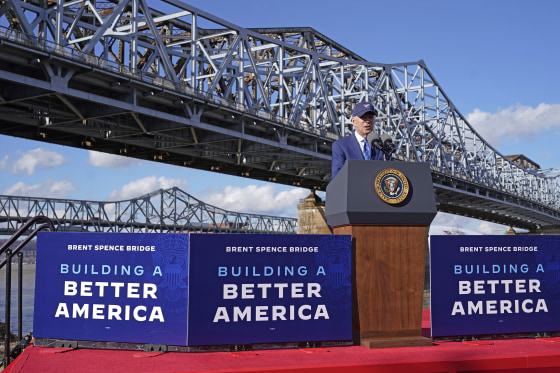
WASHINGTON — Signs are popping up around the country delivering the message that President Joe Biden deserves a big piece of credit for the new bridges and roads being built with billions in federal money.
“Project funded by the Bipartisan Infrastructure Law,” one reads at a project to ease traffic on the Brent Spence Bridge across the Ohio River, between Covington, Kentucky, and Cincinnati. “President Joe Biden,” the message continues. “Building a better America.”
Federal tax dollars are upgrading the bridge and paying for the signs, but Biden hopes there will be a windfall at the ballot box in 2024.
If he runs again, he'll make a case that lives are improving in discernible ways because of legislation most people may not even be aware that he helped pass. Maybe their commute to work takes less time or expanded broadband has done away with cyber dead zones in their neighborhood. Biden aims to remind them that he pushed through a $1 trillion infrastructure spending bill and “implemented” it in efficient fashion, making all that possible, his advisers said.
That may prove a tough sell. Through bitter experience, elected officials of both parties have learned that rebuilding tunnels, railways and highways takes time — so much time that any hope of a swift political dividend vanishes. Looking to jump-start an economy reeling from the financial collapse, then-President Barack Obama rolled out nearly $50 billion in new transportation projects after taking office in 2009, only to ruefully remark a year later that projects advertised as “shovel-ready” were nothing of the sort.
What’s different this time around, Biden allies contend, is that projects are moving from conception to completion more quickly, potentially making a difference in the 2024 presidential election.
About 20,000 projects have received funding under the bill that Biden signed into law in 2021. Mitch Landrieu, the former New Orleans mayor who is coordinating the infrastructure program for the Biden administration, said the benefits will be visible to people by the time the next election rolls around.
“There are projects coming out of the ground as we speak,” he said. “Almost every physical project that you see coming out of the ground right now has a federal dollar in it. It’s going to be critically important. Some of these things will take a little bit more time, but most people will know.”
The stimulus projects that Obama launched were in some ways a trial run for the more sweeping program that Biden envisions. “We’re rebuilding the entire country,” Landrieu said.
As much as anyone, Biden is familiar with the pitfalls and successes of what the Obama administration undertook: Obama tapped then-Vice President Biden to oversee the program, dubbing him “Sheriff Joe.”
One lesson gleaned from the Obama years is how to identify and position projects so that they are truly “shovel-ready” when the financial spigot opens, officials said.
In Colorado, officials are expanding a stretch of I-70 in hopes of easing a notorious bottleneck as motorists travel to iconic ski lodges, including Vail and Breckenridge. A $100 million federal grant is helping underwrite the project.
“We call it the first place to get stuck in traffic going to the mountains,” said Shoshana Lew, executive director of Colorado’s transportation department and a former Obama administration official.
“We received the largest federal grant our department has ever received because of” the infrastructure spending law, she said. “It’s already under construction and moving very quickly.”
Rep. Joe Neguse, D-Colo., who leads the House Democrats’ messaging and policy operation, argued that these infrastructure projects “move the needle” for voters when they head to the polls.
Several months ago, Neguse was at the groundbreaking for the I-70 project. “It will transform the mountain and rural communities that sit adjacent to the highway, a huge deal for my constituents, a huge deal for the people of Colorado,” he said. “And you can go down the list in terms of broadband projects, water infrastructure projects, and the like that are having a real impact every day.”
Others suggest Biden's timeline may be too ambitious, given the complexities involving federal spending.
Jim Gilmore, the Republican governor of Virginia from 1998 to 2002, helped launch the construction of a new Woodrow Wilson bridge connecting his state with Maryland. By the time the ribbon-cutting took place in 2006, a Democratic governor was in office and Gilmore didn’t get invited to the ceremony.


