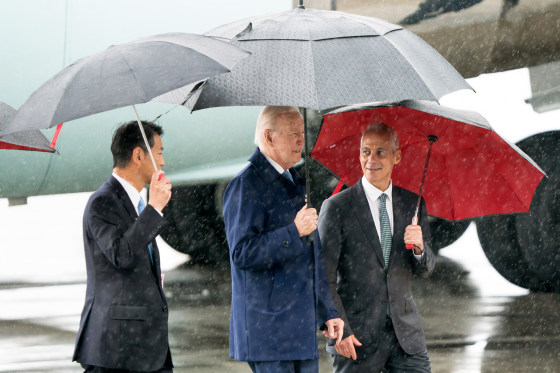
WASHINGTON — President Joe Biden’s aides have asked that Rahm Emanuel, the U.S. ambassador to Japan, stop posting messages on social media taunting Chinese President Xi Jinping, according to three administration officials.
Officials at the National Security Council told Emanuel's staff in recent days that his comments risk undermining the administration’s efforts to mend deeply strained relations with China, including with a possible meeting this fall between Biden and Xi, according to the officials.
Over the past two weeks Emanuel, who served as White House chief of staff to former President Barack Obama, has criticized Xi directly and sarcastically speculated about the Chinese leader’s treatment of his top aides, using the hashtag “#MysteryInBeijingBuilding.”
Emanuel’s tweets are “not in keeping with the message coming out of this building,” a White House official said, speaking on condition of anonymity to discuss the issue.
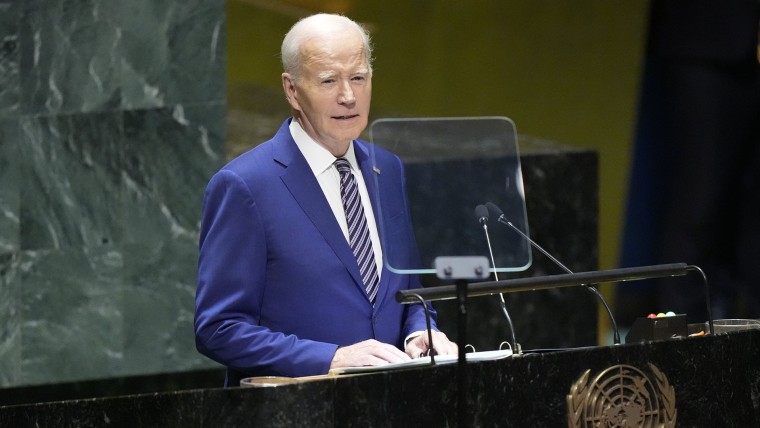
In his address to the United Nations General Assembly on Tuesday, Biden struck a conciliatory tone when it comes to America’s rivalry with China. The U.S., he said, is “ready to work together with China on issues where progress hinges on our common efforts.”
"We seek to responsibly manage the competition between our countries so it does not tip into conflict," Biden added.
It was a markedly different message than the one Emanuel has recently conveyed publicly. “President Xi’s cabinet lineup is now resembling Agatha Christie’s novel And Then There Were None,” the ambassador wrote on Sept. 7 on X, the social media platform formerly known as Twitter, referring to the disappearance of China’s foreign minister earlier this year and more recently its defense minister. “Who’s going to win this unemployment race? China’s youth or Xi’s cabinet?”
The administration officials, who spoke on the condition of anonymity to discuss internal deliberations, said China has been furious about Emanuel’s posts.
Liu Pengyu, a spokesperson for the Chinese Embassy in Washington, D.C., said in response to Emanuel's criticisms that "at a time of partisan bickering and unattended domestic social issues, seeking limelight for oneself is good for nothing. Shifting attention brings no useful solution. It is better to act in a way that fits one’s official capacity."
A spokesperson for Emanuel disputed NBC News’ report, calling it “absolutely not true.”
“Ambassador Emanuel is serving with distinction as an uncommonly effective representative of the United States in Japan. Every day his inventiveness, passion and relentlessness are on full display,” Kurt Campbell, deputy assistant to the president and coordinator for the Indo-Pacific, said in an interview.
He continued, “This guy is a superstar and when you put Rahm on the field you get the full Rahm.”
Campbell did not comment when asked whether Emanuel will continue posting about China’s leadership.
Chinese Defense Minister Li Shangfu has not been seen in public since Aug. 29, and last week reports surfaced that he’s under investigation in China. The mystery of Li’s whereabouts follows a similar disappearance in June of China’s foreign minister, Qin Gang, who was subsequently replaced.
Some administration officials have been upset with Emanuel’s comments, according to the officials and a former official familiar with the matter. But one administration official described the sentiment more as annoyance and said Emanuel is still a valued part of the team.
A longtime, outspoken Democratic operative, Emanuel served in Congress and left the chief of staff job in 2010 to mount a successful campaign for mayor of Chicago. Emanuel knows Biden and his top aides well, and some of them worked for Emanuel at a different point in their careers.
He was confirmed as ambassador to Japan in December 2021, a role he’s heartily embraced. Emanuel is prolific on social media and gets regular media attention in Japan. He also played a leading role during Biden’s recent visits to Japan.
A second administration official said for Emanuel to make these comments makes no sense and does not advance U.S. strategic goals with China or with the Asia-Pacific region.


