WASHINGTON — This week, federal health officials warned Americans to prepare for the coronavirus to become a pandemic, stocks tumbled on fears of just how widespread the virus could get, and the White House sought $2.5 billion from Congress to fight the deadly infection.
But in the telling of President Donald Trump, everything is fine.
The media, he tweeted Wednesday, is "doing everything possible to make the Caronavirus [sic] look as bad as possible, including panicking markets, if possible. Likewise their incompetent Do Nothing Democrat comrades are all talk, no action. USA in great shape!" he said, announcing a 6 p.m. ET press conference addressing the issue.
With his re-election clearly in focus — Trump spent last week on the West Coast hosting high-priced fundraisers and holding three political rallies — there is little incentive politically for him to echo the growing concerns of the global health community.
But with public health officials warning the virus is far from being contained, Trump could be heading into the peak of his re-election bid with the virus affecting economic growth and depressing the stock market — two key selling points for his pitch.
Stocks fell sharply Tuesday for a second day in a row and bond yields tumbled on rising concern that the global economy will face a significant blow because of the spreading virus — despite attempts by the president's top economic adviser to argue otherwise.
"We have contained this. I won't say airtight, but pretty close to airtight," Larry Kudlow said on CNBC on Tuesday.
Health experts disagreed. “This is like trying to control the wind, we will see serious problems here in the United States and no amount of political rhetoric will over-trump the science of what we have here,” said Michael Osterholm, director of the Center for Infectious Disease Research and Policy at the University of Minnesota.
Past presidents have used moments of national emergency to bring the country together and project the image of a strong commander in chief, like George Bush following the Sept. 11, 2001, terror attacks or Barack Obama when Hurricane Sandy hit days before his re-election. But Trump has shown an unwillingness to do so when past opportunities have presented themselves, like with Hurricane Maria.
The response to the coronavirus is already off to a polarizing start with Democrats and Trump criticizing each other Tuesday, and the president appearing to be operating off a different set of talking points than his top scientists.
Trump told reporters while traveling in India on Tuesday that he thought the virus in China was “a problem that's going to go away,” and downplayed the mortality rate for a pathogen that has been confirmed to have killed 2,700 people.
He also said a vaccine, which hasn’t yet begun the monthslong process of human testing, is “very close” — even as other officials warned it could be more than a year away.
And while Trump was traveling in India, he told reporters he hadn’t been paying very close attention to the situation over the previous two days because he had been preoccupied with the trip.
“You may ask about the coronavirus, which is very well under control in our country,” he told reporters at a press conference before heading back to Washington, D.C. “We have very few people with it, and the people that have it are, in all cases, I have not heard anything other. Maybe there’s something new, because for two days I haven’t been seeing too much of that news because it’s been very all encompassing.”
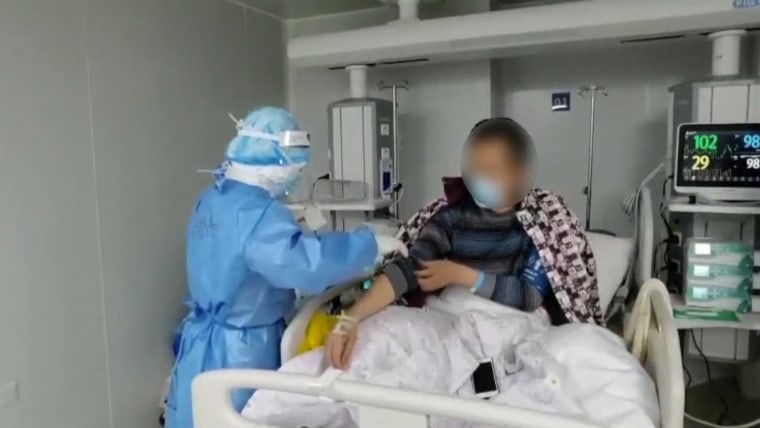
In less than a month since the virus was officially declared a public health emergency, the number of confirmed cases globally has risen to more than 81,000, with the virus quickly spreading throughout Europe, with Italy hardest hit so far with 300 confirmed cases in recent days.
On Tuesday, Trump rejected the comparisons between the 2014-2016 Ebola outbreak, which killed 11,310 people in West Africa, and the much more easily spread coronavirus, pointing to the lower mortality rate with the coronavirus. “There’s a very good chance you're not going to die. It's just the — it's very much the opposite. You're talking about 1 or 2 percent, whereas in the other case, it was a virtual 100 percent. Now they have it, they have studied it, know very much. In fact, we're very close to a vaccine.”
It was a perspective in stark contrast to that of the country’s top health officials. Shortly after Trump’s remarks, Dr. Nancy Messonnier, director of the National Center for Immunization and Respiratory Diseases, warned “it’s not so much of a question of if this will happen in this country anymore, but a question of when this will happen” and told the public to “prepare for the expectation that this might be bad.”
Dr. Anthony Fauci, head of the the National Institute of Allergy and Infectious Disease, told NBC News it could be at least a year before a vaccine is widely available, and said the mortality rate in China was closer to 2 to 2.5 percent.