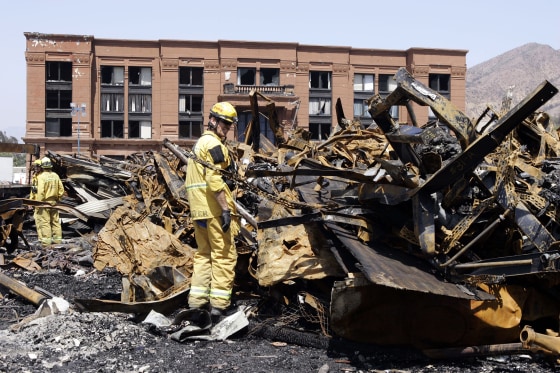
LOS ANGELES — When a fire blazed through part of the backlot of Universal Studios Hollywood a little more than 11 years ago, it took with it the music equivalent of a presidential library.
The fire on June 1, 2008, destroyed anywhere from 120,000 to 175,000 master recordings, The New York Times reported last month in an investigation that shook the music industry.
A "master" is the original sound recording of a song or other work. It's the closest thing there is to a physical copy of what happened in the studio as it happened — the audio equivalent of the original negative for a photograph.
"When a listener is listening to a master mix, that's as good as it gets," said Susan Rogers, who was the sound engineer for Prince during much of the 1980s, working on the recording of albums such as "Purple Rain," "Around the World in a Day" and "Sign o' the Times."
"Everything else from there is a copy. By the time the consumer gets it, it is several steps removed," said Rogers, who's now a professor in the music production and engineering department at the Berklee College of Music in Boston.
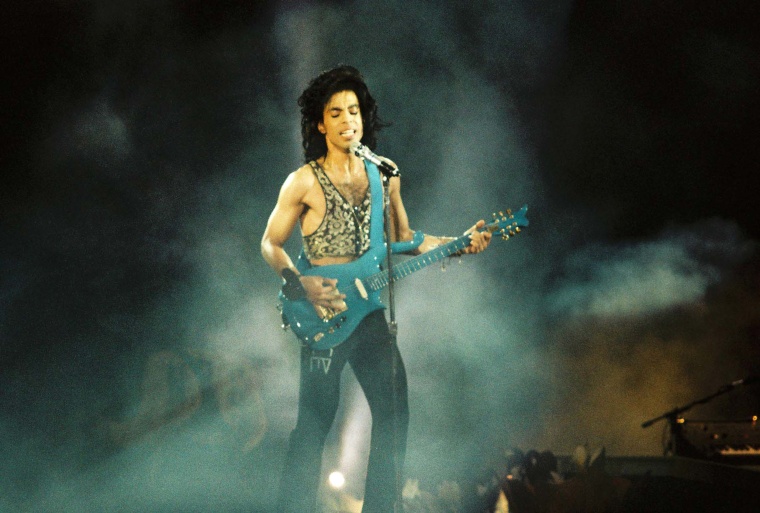
Prince was a hands-on producer of his own music, so when Rogers joined him in October 1983, she was forever being tasked with tracking down tapes, often from recording studios on the West Coast. Eventually, she said, she decided that it would be easier to retrieve as much of Prince's work as she could to have on hand at his home in Minnesota.
Those materials would become the treasure chest that today is known as the Prince's Vault, kept safe in the basement of his home, Paisley Park. By some estimates, as much as 70 percent of the material in the vault — an actual fireproof, waterproof, soundproof bank vault — has yet to be heard by the public.
Rogers likened the archive to a presidential library that preserves materials for continued study by future generations of scholars.
"That was part of his creative process," she said. After Prince died in 2016, "that thinking could be part of a historical record, or it could be part of a cognitive profile."
'That little exhale'
Universal Music Group was once part of NBC. In 2004, NBC, then owned by General Electric Co., merged with the French media company Vivendi Universal, creating NBCUniversal, the parent company of NBC News. Universal Music Group wasn't part of the deal, and it wasn't part of NBCUniversal by the time of the fire.
NBCUniversal, however, was still leasing storage space to Universal Music in 2008, including the warehouse site that burned. In 2009, Universal Music filed a negligence lawsuit against NBCUniversal. The suit was settled under undisclosed terms in 2013, and much of the case file remains sealed in Los Angeles County Superior Court.
Universal Music Group didn't respond to a request for comment for this article. In a statement last month, it said the Times' article "contains numerous inaccuracies, misleading statements, contradictions and fundamental misunderstandings of the scope of the incident and affected assets." It didn't specify what those were.
In 2008, Universal Music told Billboard magazine that "we had no loss, thankfully."
Related

"We moved most of what was formerly stored there earlier this year to our other facilities," a company spokesperson told the magazine at the time. "Of the small amount that was still there and awaiting to be moved, it had already been digitized so the music will still be around for many years. Moreover, in addition to being digitized, we also had physical backup copies of what was still left at that location, so we were covered."
Rogers contended, however, that a digital copy of a master tape can't replace a master tape, because "something will be lost every time you make a copy."
With each copy, "softer signals are lost — that little exhale of the singer's breath," she said. "We lose the tail of reverbs and the final last bit of information. Those little gestures convey a lot about what the performers were feeling."
And as with photos, digitized audio copies of originals can be manipulated later, as frequently happens when the music industry moves to new formats — such as compact discs, beginning in 1982, or mp3 files, beginning around 1999. While they might sound better to the average listener, especially if they're older monaural recordings that have been remixed for stereo, with hisses and pops edited out, they're not what the artist produced or likely intended.
Matters can be even worse than that with digital copies, which are simply sequences of ones and zeros. On tape, "the sound decays into chaos, softness — the sound sinks into the tape," Rogers said. But the ones and zeros can disappear entirely as digital media like compact discs degrade over time. When that happens, "it becomes completely unusable; we lose it completely," Rogers said.