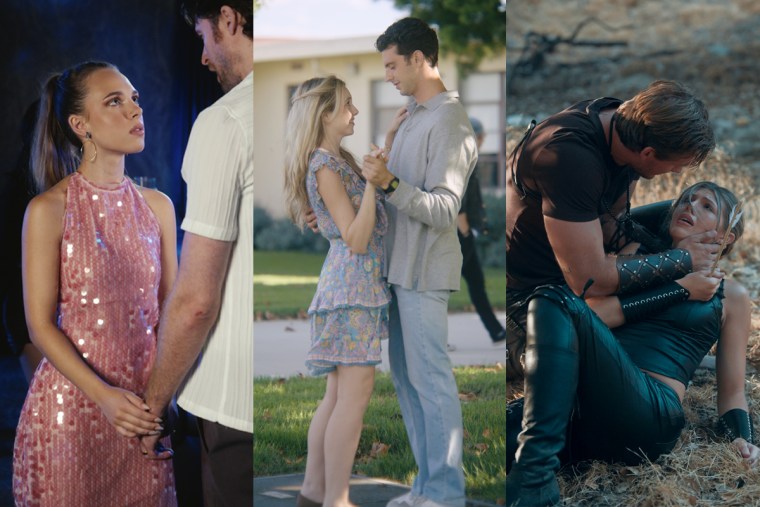
The premise of “Bound by Honor” makes it sound like a typical soap opera.
On her 18th birthday, Aria’s Chicago mobster father tells her that she’s expected to marry Luca, the vicious heir to a rival New York City gang. She agrees only so she can spare her younger sister from the same fate. Crime, chaos and romance ensue.
But unlike made-for-television series, “Bound by Honor” isn’t on air or on streaming services. The actors aren’t household names, nor do they have traditional Hollywood résumés. Each episode is one to three minutes long. And over 334 million people and counting have tuned in to the show — from their phones.
The series is among the hundreds within a growing genre known as microdramas. The format, which originated in China and has spawned a multibillion-dollar industry overseas, is now booming in the U.S., as everyone from tech brands like TikTok to footwear companies like Crocs rushes to cash in on their popularity.

Microdramas are “sort of the ‘Triple Crown’ of the modern entertainment industry,” said Tomm Polos, director of creator arts at the University of Southern California. “Because they’re social-friendly, they’re cost-effective and they’re data-driven. That is what everyone wants.”
The rush to get in on the microdrama boom comes when some traditional film and TV productions are scaling back, or leaving Los Angeles altogether, because of rising costs. Consumers also continue to shift their viewing habits, opting for phone-first experiences and bite-size content on social media platforms.
Some companies have tried — and failed — to find the same massive audiences with similar formulas. Notably, Jeffrey Katzenberg’s short-form video streaming service, Quibi, launched and quickly shuttered in 2020 after it was unable to draw in a large subscriber base. Twitter shut down Vine, the hugely popular social video app, in 2017.
Now, platforms like ReelShort and DramaBox are testing out a similar strategy but leaning into low-budget, soapy series, instead. Some, like the U.K. microdrama app Tattle TV, have even repurposed Hollywood classics, like Alfred Hitchcock’s 1927 feature "The Lodger: A Story of the London Fog," in microdrama format.
Thus far, their efforts appear to be working: Short dramas made $1.4 billion in revenue in the U.S. last year, according to data from Owl & Co., a consulting firm that focuses on media and technology.
Last month, the Los Angeles City Council voted to explore creating a $5 million subsidy for microdramas to help support their continued growth.
“The microdrama space is an incredible opportunity for ... not just those who are new and trying to get their foot in the door, but established people who know how to work with format and structure,” Polos said. “There are a lot of empty sound stages in Hollywood. There are a lot of empty studio spaces in Hollywood. It should not surprise anyone if, in the coming quarters or years, those studio spaces get converted to be laboratories for microdramas, and that’s going to really help the economy of Los Angeles.”
For actors, the appeal of microdramas is the visibility they offer.