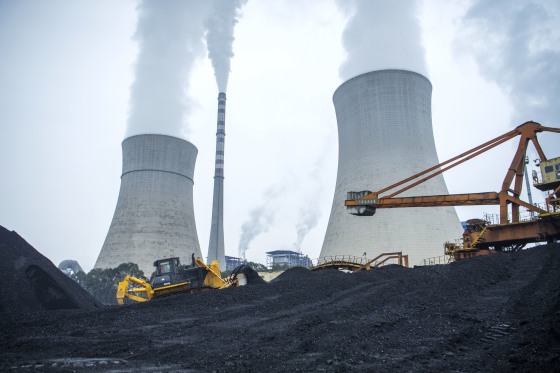
BEIJING — China is promoting coal-fired power as the ruling Communist Party tries to revive a sluggish economy, prompting warnings Beijing is setting back efforts to cut climate-changing carbon emissions from the biggest global source.
Official plans call for boosting coal production capacity by 300 million tons this year, according to news reports. That is equal to 7 percent of last year’s output of 4.1 billion tons, which was an increase of 5.7 percent over 2020.
China is one of the biggest investors in wind and solar, but jittery leaders called for more coal-fired power after economic growth plunged last year and shortages caused blackouts and factory shutdowns. Russia’s attack on Ukraine added to anxiety that foreign oil and coal supplies might be disrupted.
“This mentality of ensuring energy security has become dominant, trumping carbon neutrality,” said Li Shuo, a senior global policy adviser for Greenpeace. “We are moving into a relatively unfavorable time period for climate action in China.”
Officials face political pressure to ensure stability as President Xi Jinping prepares to try to break with tradition and award himself a third five-year term as ruling party leader in the autumn.
Coal is important for “energy security,” Cabinet officials said at an April 20 meeting that approved plans to expand production capacity, according to Caixin, a business news magazine.
The ruling party also is building power plants to inject money into the economy and revive growth that sank to 4 percent over a year earlier in the final quarter of 2021, down from the full year’s 8.1 percent expansion.
Governments have pledged to try to limit warming of the atmosphere to 2 degrees Celsius (3.6 degrees Fahrenheit) above the level of pre-industrial times. Leaders say what they really want is a limit of 1.5 degrees Celsius (2.7 degrees Fahrenheit).
Scientists say even if the world hits the 2-degree goal in the 2015 Paris climate pact and the 2021 Glasgow follow-up agreement, that still will lead to higher seas, stronger storms, extinctions of plants and animals and more people dying from heat, smog and infectious diseases.
China is the top producer and consumer of coal. Global trends hinge on what Beijing does.
The Communist Party has rejected binding emissions commitments, citing its economic development needs. Beijing has avoided joining governments that promised to phase out use of coal-fired power.
In a 2020 speech to the United Nations, Xi said carbon emissions will peak by 2030, but he announced no target for the amount. Xi said China aims for carbon neutrality, or removing as much from the atmosphere by planting trees and other tactics as is emitted by industry and households, by 2060.
China accounts for 26.1 percent of global emissions, more than double the U.S. share of 12.8 percent, according to the World Resources Institute. Rhodium Group, a research firm, says China emits more than all developed economies combined.
Per person, China’s 1.4 billion people on average emit the equivalent of 8.4 tons of carbon dioxide annually, according to WRI. That is less than half the U.S. average of 17.7 tons but more than the European Union’s 7.5 tons.
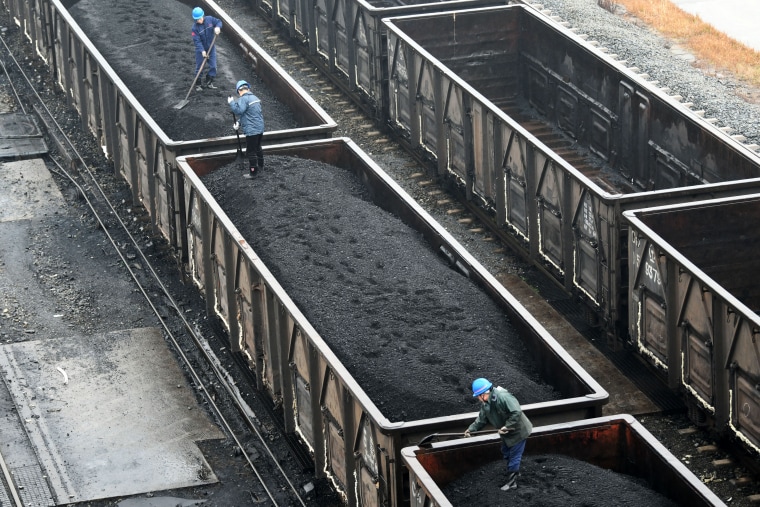
China has abundant supplies of coal and produced more than 90 percent of the 4.4 billion tons it burned last year. More than half of its oil and gas is imported and leaders see that as a strategic risk.
China’s goal of carbon neutrality by 2060 appears to be on track, but using more coal “could jeopardize this, or at least slow it down and make it more costly,” Clare Perry of the Environmental Investigations Agency said in an email.
Promoting coal will make emissions “much higher than they need to be” by the 2030 peak year, said Perry.
“This move runs entirely counter to the science,” she said.

