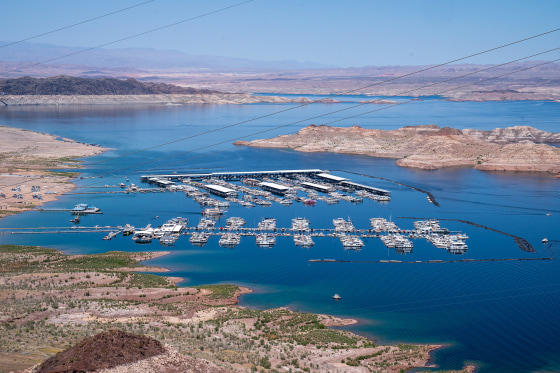
The seven states that rely on the Colorado River for power and drinking water have reached a deal on cuts to keep the drought-stricken river flowing.
Three states — Arizona, California and Nevada — have agreed on a plan to conserve at least 3 million acre-feet of water by 2026 — roughly the equivalent to the amount of water it would take to fill 6 million Olympic-sized swimming pools.
The Biden administration, which helped broker the agreement, announced the consensus deal Monday in a news release.
The seven states that rely upon the Colorado River were on the precipice of crisis after decades of overuse. Before a banner winter of snowfall, officials grew concerned as dams at Lake Mead and Lake Powell neared “dead pool” status — when flow would be cut off to lower regions of the river as water levels dropped too low to pass through the dams.
About 40 million people rely on the Colorado River for drinking water. Utilities depend on it to generate electricity at dams on Lake Mead and Lake Powell and keep power flowing in several states.
The deal could avert the near-term crisis and put the states on a more sustainable trajectory for water use, but it calls for less conservation than some scientists say is required to stabilize the river after a more than two-decade drought. The deal prevents a political predicament for the Biden administration, which would have been compelled to enforce cuts unilaterally if the states could not negotiate an agreement among themselves.
Interior Secretary Deb Haaland said in the release that the announcement was “a testament to the Biden-Harris administration’s commitment to working with states, Tribes and communities throughout the West to find consensus solutions in the face of climate change and sustained drought.”
Once analyzed and officially approved by the Bureau of Reclamation, which operates the dams on Lake Mead and Lake Powell, the new agreement would be in place through 2026.
“This is a big deal,” said Robert Glennon, a professor emeritus at the University of Arizona who specializes in water law and policy, adding that the problems states faced were “truly historic and potentially catastrophic if either Lake Powell or Lake Mead hit dead pool.”
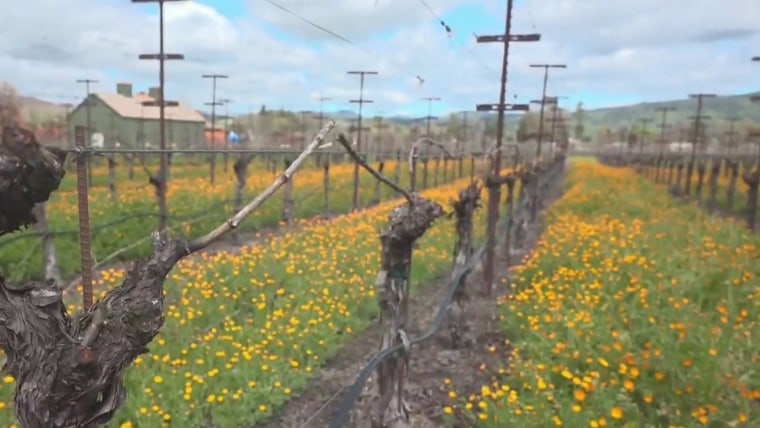
As part of the agreement, the administration would use funding from the Inflation Reduction Act to compensate some farmers and other water users who temporarily agree to cuts.
As it analyzes the new agreement, the Biden administration has agreed to temporarily withdraw the plans it drew up for dramatic cuts in case the state negotiations failed.
Glennon said the proposals from the federal government — which laid out competing proposals with stark consequences if states couldn’t find common ground — “focused the minds” of negotiators and forced them to find tolerable cuts. The federal dollars from the Inflation Reduction Act will provide compensation for more than three quarters of the water conserved in the deal.
“Without that money, this deal doesn’t happen,” Glennon said.
The federal money will fund water conservation programs to compensate farmers, tribal communities, cities and other water users that take steps to voluntarily and temporarily cut back on water use, said Dave White, a professor at Arizona State University and the leader of the Arizona Water Innovation Initiative. Such programs could push farmers to grow less water-intensive crops, use more efficient irrigation methods or fallow fields temporarily.
The governors of California, Arizona and Nevada — the lower basin states that agreed to the cuts — cheered the agreement.
“California has stepped up to make significant cuts to water usage and now, this historic partnership between California and other Lower Basin states will help maintain critical water supply for millions of Americans as we work together to ensure the long-term sustainability of the Colorado River System for decades to come,” California Gov. Gavin Newsom said in a news release.
Negotiators for the four upper basin states — Colorado, New Mexico, Utah and Wyoming — have said they support the decision to submit the new plan for the federal government’s consideration and to avoid emergency measures imposed by the federal government.
In a letter to the Bureau of Reclamation, the governors of California, Arizona and Nevada said they hoped the new agreement would allow negotiations to “pivot to discussions on post-2026 operations that will address the impacts of climate change on system water supply availability and the existing overallocation of water.”

