Cristina Velazquez says she never played outside as a kid because it was too hot and the parks were too dangerous.
Velazquez, 24, grew up in Westlake, a densely populated area in Central Los Angeles that like many inner-city areas had little trees or green space. The community is mostly Latino and more than 20 percent of its residents live in poverty. When she took bus rides to the other side of the city, she remembers seeing children playing together under the shade of trees.
“When you watch TV and you see a program that has little kids playing on the streets, that is not something that I had ever experienced,” said Velazquez, who was part of Los Angeles’ Tree Ambassador Program, which recruits people directly from communities that need more trees to do environmental outreach within their own neighborhoods. “It is a massive difference. Like you can really tell just how different even like a few trees can make in terms of your childhood.”
Many major American cities, including Los Angeles, Denver, Phoenix, Chicago and Boston are working to bridge the equity gap in major tree canopy coverage through volunteer tree-planting events, community partnerships and green job programs.
But those efforts face challenges, including several physical, social and financial barriers that stand in the way of making tree canopy coverage equitable.
Physical barriers tend to be the trickiest and priciest obstacle. City planners and urban foresters have to navigate the built infrastructure to make room for trees. Sometimes this involves cutting into pavement, which is more expensive than planting trees where there is readily available green space.
Generally, it can cost around $300 to pull up enough concrete for a single tree, according to Ian Leahy, vice president of urban forestry at American Forests, a nonprofit group dedicated to conserving forests in the United States.
“It’s great to plant trees in a big open field, but a lot of times where the trees are needed most, it’s like a building, a sidewalk, a road, like there’s just not a lot of space,” he said.
Extreme heat in cities is a major issue around the world, and underserved urban communities like Westlake can be at particular risk because of urban heat island effect, which is when an area traps more heat due to the lack of green space and a higher density of pavement and buildings. It’s a growing problem in a warming world — extreme heat is already the deadliest weather-related hazard in the U.S.
This has brought renewed scrutiny to the lack of green space in many poor urban areas. Research shows that historically redlined communities, which are Black and brown communities that recieved little investment due to discriminatory practices, face more extreme heat threats largely due to the lack of tree canopy.
One solution may seem simple: plant more trees.
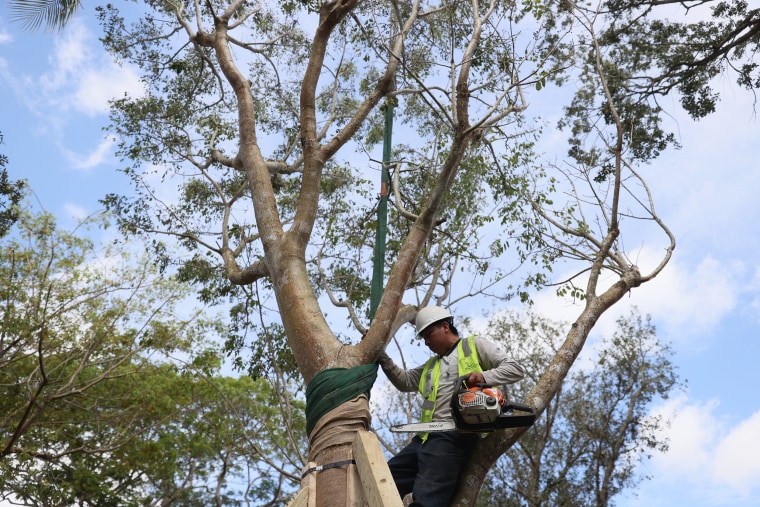
Tree canopy coverage can significantly decrease temperatures, sometimes by almost 10 degrees Fahrenheit, which can help in Westlake where the average temperature is close to 90 degrees Fahrenheit in the summertime. A recent study from the International Journal of Biometeorology found that 1 in 4 lives in Los Angeles could be saved during extreme heat events when there is more tree canopy, as well as other cooling methods in place.
But planting trees in cities is not as easy as it seems.
Urban foresters have to get creative with the space available, but urban forestry is an underresourced industry, many times with one or two people working on intricate plans in city governments, and major labor shortages occurring at the tree maintenance level. In some smaller cities, like Jackson, Mississippi, nonprofit groups have to fill in the gaps. Overall, it’s difficult for cities to maintain already existing trees, let alone add more.
“One of our biggest hurdles, people just don’t know our field exists,” Leahy said.
There are efforts in place across the nation to recruit more diverse workers into the field. Denver will pilot a pre-apprenticeship program this summer to train formerly incarcerated people in urban forestry jobs. This spring, Los Angeles graduated the first class of its Tree Ambassador Program that recruits people directly from the communities that need more trees.
Velazquez is one of the new graduates. During the program, she went door to door in her neighborhood asking residents if they would water a newly planted tree in the area, many of whom answered no. This is not an uncommon response, especially in historically disadvantaged communities.
She said that in her neighborhood, some residents believe it would be too much of an expense, others simply don’t have the time between work and taking care of their households. But many have a distrust of the city’s ability to take care of the trees properly as they grow. She said many of the older trees that are in the neighborhood are not maintained.

