Christopher Nolan's sci-fi blockbuster, "Interstellar," is winning kudos for its true-to-Einstein depiction of a black hole as well as its off-the-planet exploration agenda.
The movie tells the story of a failing Earth — and a last-gasp space mission that sends astronauts through an extradimensional portal known as a wormhole in hopes of finding a habitable haven for humanity amid alien stars.
The film boasts Nolan, the mastermind behind "The Dark Knight Rises" and "Inception," as director and co-writer. It also boasts Caltech theoretical physicist Kip Thorne, who came up with an earlier wormhole concept for Carl Sagan's "Contact," as executive producer and science adviser.
Thorne has written a movie-themed book, "The Science of 'Interstellar,'" which is due for release just as the film is coming out. He's even planning a series of technical papers based on the calculations that went into creating the movie's special effects on a cosmic scale.
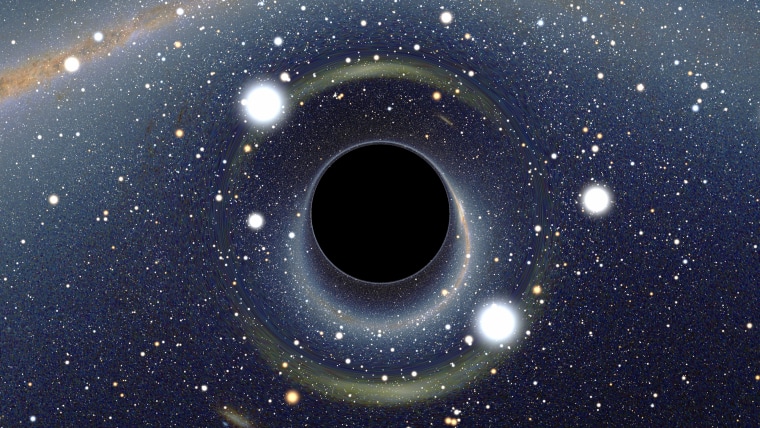
"Neither wormholes nor black holes have been depicted in any Hollywood movie in the way that they actually would appear," Thorne says in a behind-the-scenes featurette. "This is the first time the depiction began with Einstein's general relativity equations."
But Sten Odenwald, an astronomer at the Virginia-based National Institute of Aerospace, says Thorne's conception of a wormhole still may not match up with reality. "His latest idea, that it looks something like a mirror disco ball ... I don't buy it," Odenwald said.
Whether or not an actual wormhole looks like a mirror ball, the premiere of "Interstellar" provides an opportunity to reflect on humanity's long-term options for space travel — and the reasons why we should reflect on those options in the first place.
That's a particularly pointed question in the wake of last week's crash of Virgin Galactic's SpaceShipTwo rocket plane — a commercial spaceflight disaster that killed one test pilot and injured another. Is it worth the cost in lives and fortunes to send deep-pocketed tourists on suborbital space jaunts? You can find plenty of pros and cons in the debate.
Seth Shostak, senior astronomer at the California-based SETI Institute, is one of the pros. Here's how he answered the question in an email.
"History tells us that the long-term consequences of exploration are perhaps the most mind-bending and society-changing activities we can pursue," he said. "If it weren’t for guys like Columbus, most of us would still be serfs today."
Start with the solar system
If things get really gnarly on Earth, as they do in "Interstellar," do we really need a wormhole? Shostak says no. "The real answer for dealing with an Earth that's running out of steam for us is to colonize our own solar system," he said. "Sure, Mars and maybe the asteroids. But mainly with orbiting space habitats."
Odenwald said pretty much the same thing, but more colorfully: "What we should be doing with the very, very meager money we have is basically colonizing the hell out of our solar system," he told NBC News. "I want to turn the solar system into New York City, for crying out loud."
Last month, in a Huffington Post column, Odenwald pointed out the flaws in the roadmaps proposed for sending humans to other stars. "Even if we were on the brink of extinction, do you really think that 7 or 10 billion humans would want to foot the bill and the decades-long effort to send a few lucky humans on a one-way trip to a distant planet — that may not even be habitable?"
This is the part where we should stress that "Interstellar" is only a movie, and should not be taken seriously as a recruiting video for a wormhole-hunting campaign. The filmmakers' main goal is to create a thrill ride of a sci-fi flick with box-office appeal. If it inspires theatergoers to think more seriously about spaceflight, as "Gravity" did last year, so much the better.
Theoretically, "Interstellar" should be even more thought-provoking than "Gravity," because it focuses on the ultimate bottom line for space travel: the long-term survival and expansion of humanity. It's also cool to see audiences exposed to the weird implications of relativity, including time dilation, black holes — and yes, wormholes as well.
Reality check on wormholes
So what about that wormhole? The concept provides a handy plot device for screenwriters who want to get their characters from one corner of the universe to another without having to worry about faster-than-light travel. You simply bend the fabric of spacetime, and then connect point A and point B with an extradimensional passageway, also known as a wormhole.
The plot also turns upon the effects of a supermassive, rapidly rotating black hole on the other side of the wormhole. That's where Thorne's calculations helped guide the filmmakers. He figured out how light would be distorted by the black hole's gravitational field. The special-effects team turned Thorne's vision into "Gargantua," a black hole that's spinning at nearly the speed of light.
All the effort behind visualizing black holes and wormholes, detailed in Wired magazine, makes for impressive visual effects — but Odenwald said there's no way that a wormhole could ever pop up in our celestial neck of the woods.