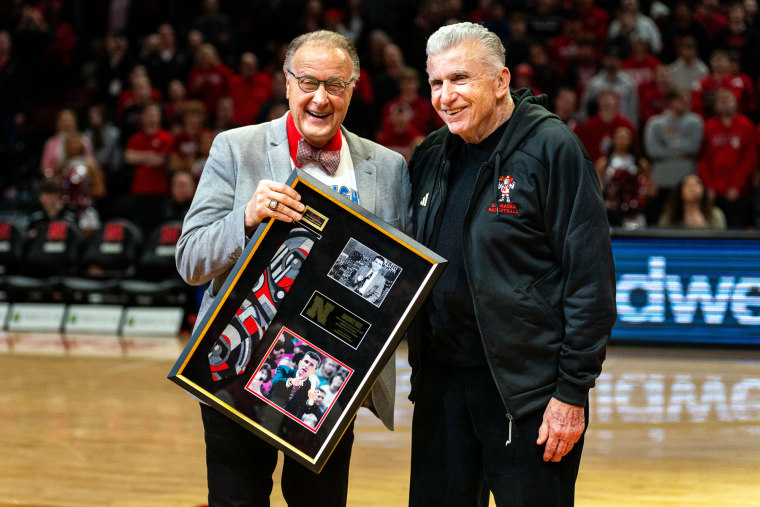
Kent Pavelka has seen a lot since he started calling Nebraska men’s basketball games on the radio in 1974.
But after 51 years, he’s still waiting to witness the Cornhuskers do something every other team from an NCAA power conference has already accomplished: win a game in the NCAA Tournament.
Nebraska’s men are 0-8 all-time in the annual postseason tournament that crowns a national champion. They have lost as a higher seed — third in 1991, sixth in 1994 and eighth in 2024 — and as an underdog. They’ve lost by as few as five points (1991) and been blown out by as many as 21 (1992).
After a while, as more programs won their first all-time tournament games, leaving Nebraska in an ever-more exclusive and ignominious club, fans grew resigned to disappointment, Pavelka said.
“I’m pretty long in the tooth here,” Pavelka told NBC News. “I’ve been thinking, how many more rodeos do I have?”
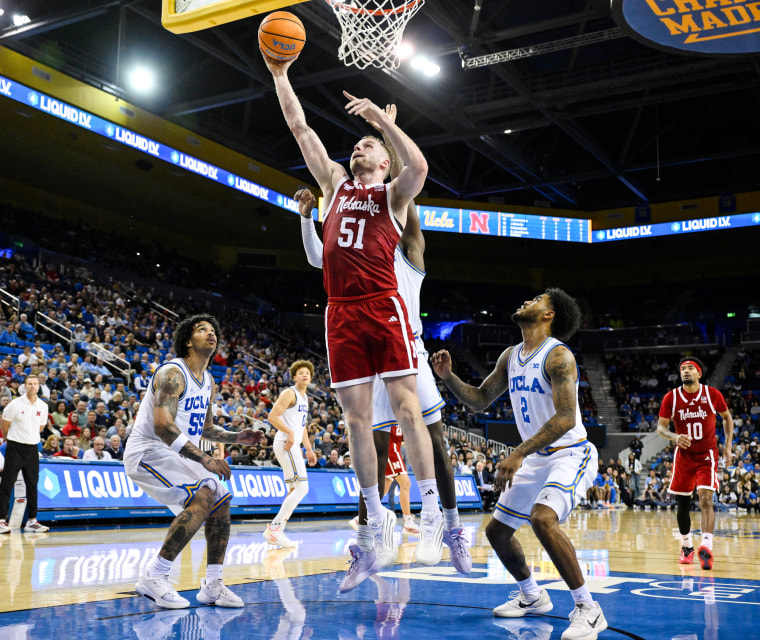
This winter, however, as the Huskers started 15-0 on their way to earning a program record No. 4 seed in the tournament — they will face 13th-seeded Troy on Thursday — something different has taken hold in Lincoln and beyond: optimism that this finally could be the year that March won’t drive the Huskers mad.
“Here we are, deep into the movie ‘Hoosiers,’ but it’s Huskers,” Pavelka said. “And we don’t know how it’s going to end, but we have a feeling and that this is it. This is the year.”
Every spring, the volatility of the NCAA Tournament, in which the lowest-seeded schools have toppled the highest twice and tradition-less programs regularly catch fire, turns the competition into a phenomenon. Yet starting with its first appearance in 1986, when a top player suffered a season-ending knee injury weeks before the tournament, the Huskers have continually been snakebit in the postseason.
More Sports from NBC News
Eight Division I men’s programs have played in seven or more NCAA tournaments but have never won, said Joe Spagnolo, the executive director of Hoop Historians. But unlike the likes of Boise State (0-10), Eastern Kentucky (0-8) and Colgate, Long Island University, Louisiana Monroe and South Dakota State (all 0-7), Nebraska has long played in some of the country’s most powerful conferences, which theoretically allows for more resources to recruit and play better schedules.
It hasn’t exactly eased Nebraska’s frustration over the drought that Creighton, a smaller, private school 59 miles away in Omaha, has become a March Madness staple, with a 21-27 all-time tournament record.
Rienk Mast, a 6-foot-10 Huskers senior from the Netherlands, said he was aware of the drought when he transferred to Nebraska two years ago. The potential to go down in history as the team that would break the streak factored into his transfer, he said.
“I sometimes read comment sections, and however good we’re doing, there’s always comments about, ‘They’ve never won an NCAA Tournament game,’ and it always gets brought up,” Mast said.
“If we’re good, if we’re bad, it’s a thing that’s still kind of a dark spot of our program, and to be the team that finally, finally gets that first one, yeah — I just want people to stop talking about it, honestly. So we need to get it done this year. This is about as good of a chance as the program has had in decades. So we need to get it done.”
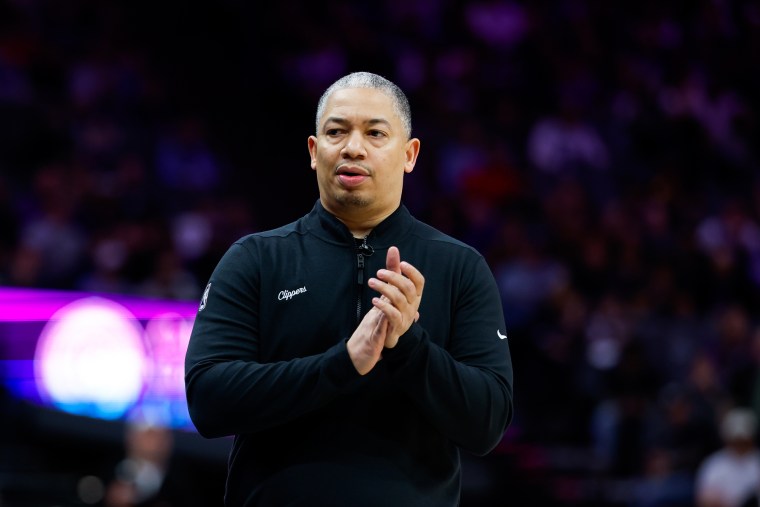
Twenty-eight years ago, Tyronn Lue thought his team could be the one to end the streak.
Lue, a small but lightning-quick point guard from Missouri, was being recruited by Nebraska while the Huskers were making the tournament four consecutive seasons from 1991 to 1994. They returned to the Big Dance in 1998, Lue’s junior season, when he blew past Arkansas’ signature full-court press and got teammates open dunks to build a lead that grew to 10 in the second half.
Then the Razorbacks dropped their press, instead defending Lue using a triangle-and-two, a rarely used zone. Nebraska’s shots stopped falling.
By now, you know the rest.
“The football school still can’t win an NCAA basketball tournament game,” the next day’s Associated Press recap began.