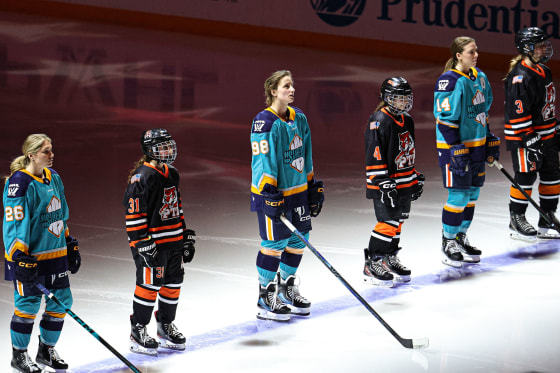
Growing up, Kate Hoos was told girls don’t play hockey.
“If you can find a girls team, we’ll let you play,” she recalled being told. But there was no girls team at the time — and it wouldn’t be until a decade later, at age 20, that she learned to skate.
Now 44 and fresh off a championship with her recreational team in New York City, she’ll be watching Saturday as the Professional Women’s Hockey League has its first nationally broadcast game in the U.S.
The New York Sirens will face the Montréal Victoire (1 p.m. ET, ION) at Detroit’s Little Caesars Arena as part of the league’s Takeover Tour featuring regular-season games played in cities without franchises to increase exposure.
For PWHL fans, the broadcast is a watershed moment that reflects their long-held truth: Women’s hockey deserves national attention.
“This is the world that I knew would exist,” said Hoos, whose fandom stretches back to the U.S. women’s winning gold at the 1998 Winter Olympics.
“Everybody back then told me I was crazy. It’ll never happen. It’ll never make money. No one will ever care. There won’t be enough players. Every excuse under the sun,” she added. “And it took a while. It was a long and it was a thorny road, but now I feel that we’re finally emerging into the world that I knew would exist.”
Interest in women’s hockey skyrocketed at the 2026 Winter Olympics. The gold medal final between Team USA and Canada became the most-watched women’s hockey game on record, amassing 5.3 million viewers across USA Network and Peacock.
The first three PWHL games after the Olympic break were sold out, including one in Seattle that had a record turnout of 17,355. And upcoming games at Madison Square Garden in New York on April 4 and Boston’s TD Garden on April 11 are also sold out.
The broadcast “represents all the growth that we’re seeing in women’s hockey right now,” said Jackie Johnston, a content creator known as “Coach Jackie” to her more than 1 million social media followers. “It’s always great for that to be recognized by broadcasters who think and know that if they want to make money and they want to be successful in their business that women’s sports is the place to be right now.”
The PWHL, which began in 2024, has broadcast partners in Canada but has yet to secure a full-time national TV deal in the U.S. Games are available on its YouTube channel for free and on some local channels. Now, ION will bring this weekend’s match to more than 126 million households nationwide.
Rachel Donner, co-host of “At Even Strength,” a women’s hockey podcast, described her reaction to the broadcast as a combination of excitement and “finally.”
“The people that love it seek it out on YouTube or through social media,” she said. “But if it’s just on the grid and people are searching and they can see it there, that will bring new fans to the game.”
The timing of the Olympics midseason provides money and visibility that allow the league to capitalize on the surge in interest. Fans can follow players from the international tournament to the professional league, a “natural onboarding” that helps the PWHL grow, Donner said. Sixty-one PWHL players from eight countries competed at the Milan Cortina Games, returning with 41 medals.
Ava Wood, a content creator and newsletter writer whose brand 365HockeyGirl has more than 50,000 followers across social media, called the national broadcast announcement a “relief.” After a history of instability in women’s professional hockey, it brings salience to an eight-team league just three seasons old, she said, assuaging her nagging worries that the PWHL could fold.
“That signals to me the PWHL will be here to stay and it’ll really be sustainable,” she said.
Wood said her TikTok following nearly doubled after the Olympics, and she’s also hopeful that Saturday’s broadcast will help usher in a new wave of support for the league.
“There are so many people that are going to become PWHL fans once they just see it,” she said.
