Radically revamped NBA All-Star Game brings return of defense and competition

A team of youthful NBA standouts outlasted older American stars and a team comprised of the best non-U.S. players.
Image: 75th NBA All-Star Game
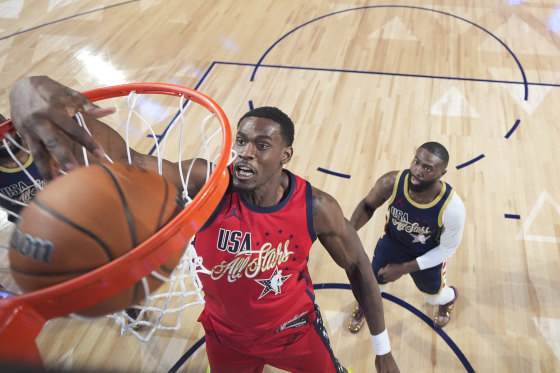
Jalen Duren of the Detroit Pistons dunks the ball during the 75th NBA All-Star Game in Inglewood, Calif., on Sunday.Ronald Martinez / Getty Images
Listen to this article with a free account

INGLEWOOD, Calif. — The world's best basketball players participated in what could've been the most unusual game of their careers Sunday, in a generally well-received mini-tournament that included welcome doses of energy, a tad of confusion and, perhaps, one foreseeable flaw.

A team of younger American standouts, dubbed "USA Stars," beat the veteran "USA Stripes" squad 41-21 in the radically revamped 75th NBA All-Star Game.

The midseason exhibition featured three squads, the two American sides and "Team World," a roster filled with the NBA's best foreign players.

The association's midseason celebration had, in recent years, morphed into a high-scoring, defenseless dunk fest that had grown tiresome, even for the most dedicated basketball fans.

But Sunday’s contest felt different according to the players.

“All three teams came out there and played good ball,” said Houston Rockets forward Kevin Durant of Stripes, the team informally dubbed the “Old Heads.” “It was definitely a step up in a competitive department compared to last season.”

The 2024 All-Star Game nearly topped 400 total pints in a 211-186 East victory over the West. The 2025 game also featured a mini-tournament format.

The three-way play of Sunday unfolded with 315 points of offense, down from recent games, thanks to renewed sparks of energy and defense.

"I like this format," said All-Star Game MVP Anthony Edwards of the Minnesota Timberwolves. "I think it makes us compete, because it's only 12 minutes and the three different teams, you separate the guys, I think it was really good."
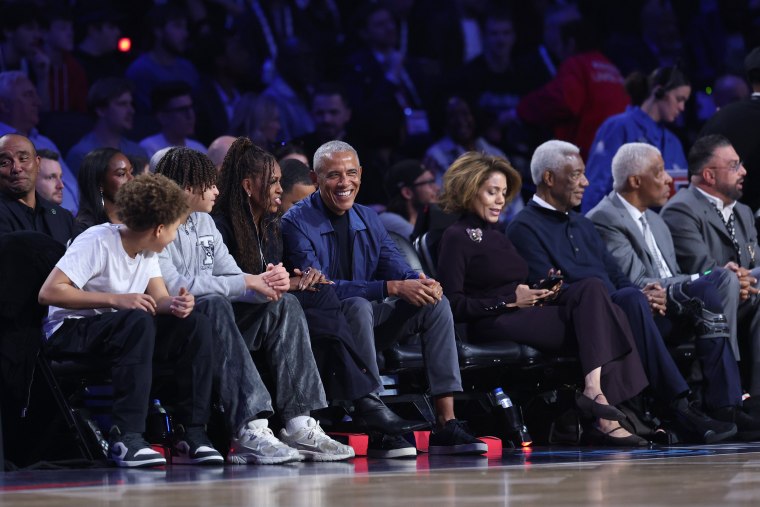
Image: 75th NBA All-Star Game
The Obamas watched from courtside seats. Ronald Martinez / Getty Images

This year's contest was clearly different from past midseason celebrations, winning Stars coach J.B. Bickerstaff said.

"You saw guys getting upset when shots didn't go or when plays weren't made," said Bickerstaff, coach of the resurgent Detroit Pistons. "I thought the competition level was high, but you could tell the guys were bought into it."

Spark of defense makes ASG return

Defense made its triumphant return to the All-Star hardwood in the game that recorded 25 steals and 16 blocked shots.

In that infamous 2024 run-and-dunk game, there were 14 steals and just a trio of blocked shots.

The intensity of Sunday was put into motion early by World center Victor Wembanyama, who scored seven points in the first 90 seconds of play and blocked three shots in the first 12-plus minutes.

"He set the tone, man," Edwards said. "And it woke me up for sure."

Tie-breaking confusion almost came to pass

This All-Star Game format called for the three teams to play each other once, in 12-minute games, with the two best teams advancing to the final.

So the total of four games resulted in a bit more than 48 minutes of play, virtually equaling a regular NBA game — only this one featuring three teams rather than a normal two.

The format also opened a door to the possibility of the three-way tie at 1-1 with point differential as a potential tiebreaker.

After the Stars' 37-35 win over World in Game 1 and the Stripes' 42-40 triumph over the youngsters in Game 2, that set up potential chaos for Game 3 between World and the veterans.

A World win over Stripes would've created a 1-1 logjam.

Image: 75th NBA All-Star Game
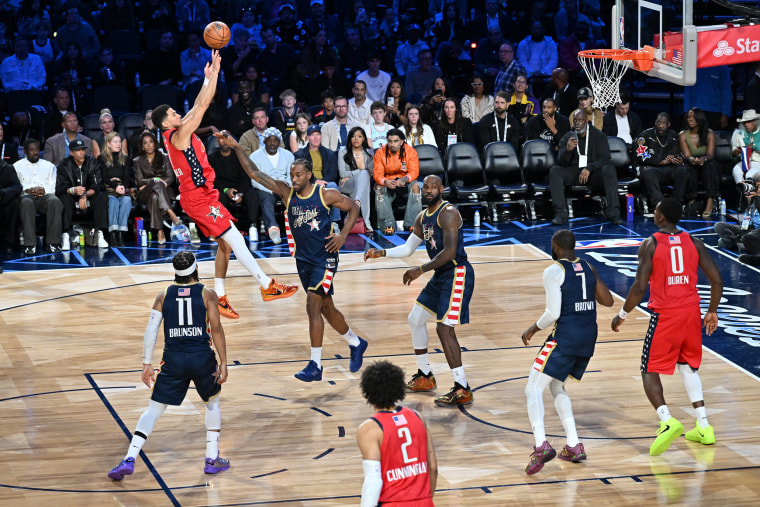
Devin Booker of the Phoenix Suns shoots during the NBA All-Star Game at Intuit Dome in Inglewood, Calif., on Sunday.Allen Berezovsky / Getty Images

If all three teams had a 1-1 record after Game 3, the tiebreaker would be point differential in each team’s two round-robin games.

The Intuit Dome PA announcer told fans that World needed to win by three points to advance to the final, while Stripes would make the title game with a win or a 1-point loss.

There was no mention of what would happen had World won by two points, making all three sides 1-1 and each team with a net zero point differential.

The chaos was avoided in a dramatic 48-45 Stripes win over World.

Unexpected return of the Elam Ending

The day's first game between World and the young Stars was tied 32-32 after 12 minutes, necessitating a brief overtime where the clock was turned off and the winner was the first to five points.

Stars center Jalen Duren got the ball down low in good position with his team trailing 35-34. He could have easily scored, but instead kicked it to Scottie Barnes who hit the walk-off 3-pointer.

Duren said math was on his mind the whole play.

"We knew it was first to five, so we needed a three," Duren said. "I got it on the short roll, little man stepped over and (I was just) being unselfish and trying to find a shooter."

The Elam Ending, a basketball format that shuts off the game clock and sets a target score for victory, had been used in recent NBA All-Star games and at various other levels of ball.

Veterans worn out by last game

In this three-team, four-quarter format, someone from Game 3 was always going to have to play in back-to-back games in the title matchup.

The older Stripes team, after winning Game 3, came out flat against the rested Stars, who jumped out to a 12-1 lead and never looked back.

While fatigue was clearly a factor, the veteran U.S. players refused to cite that disadvantage for their loss.

"We play back-to-back throughout the year. The only difficult thing was, you're just standing around and waiting around for the next game," Stripes guard Jalen Brunson said. "This is our job, this is what we do."

Durant mocked any notion that fatigue was to be blamed, sarcastically telling reporters after the game: "Yeah, we can make that excuse."