The most important team at the Olympics isn't a country. It's the timekeepers.

In competitions decided by fractions of a second, it's up to Omega to get the timing right. Every time.
Alpine Skiing - Milano Cortina 2026 Winter Olympics Day 2
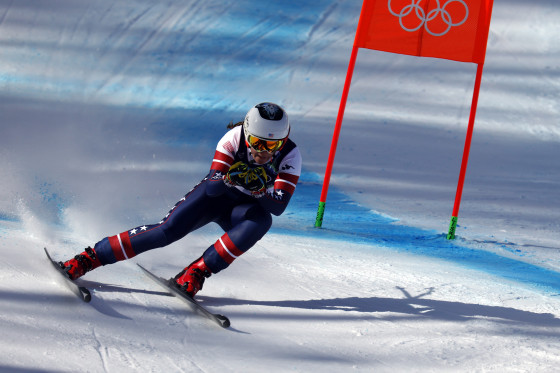
Breezy Johnson of Team USA competes in the women's downhill in Cortina d'Ampezzo, Italy, on Sunday.Christophe Pallot / Agence Zoom / Getty Images
Listen to this article with a free account

MILAN — Watching from the finish line, American skier Breezy Johnson was in first place of the women's downhill Sunday when Germany's Emma Aicher flew down the course in Cortina D'Ampezzo, gaining time on the leader.

Follow along for live updates

But almost as soon as the front of Aicher's body crossed the finish line, triggering the timekeeping system to stop, Johnson knew she was in the clear. Instantly, scoreboards showed Aicher had finished in 1 minutes, 36.14 seconds — four-hundredths of a second behind. Johnson sighed and rubbed a hand over her head in relief.

Johnson ultimately won and Aicher took the silver, their careers forever altered by that tiny difference determined by the most important team at the Olympics you don't know about — the Omega timekeepers.

"We take a lot of pride doing it but it also humbles us a lot," said Alain Zobrist, the chief executive of Omega Timing. "We know that we can’t do any mistakes."

Since the Swiss timing giant sent employees with 30 stopwatches to Los Angeles for the 1932 Olympics, Omega's business of keeping results at the Olympics has grown so large and sophisticated that a delegation from the company is already in Los Angeles preparing for the Olympics’ return in 2028.
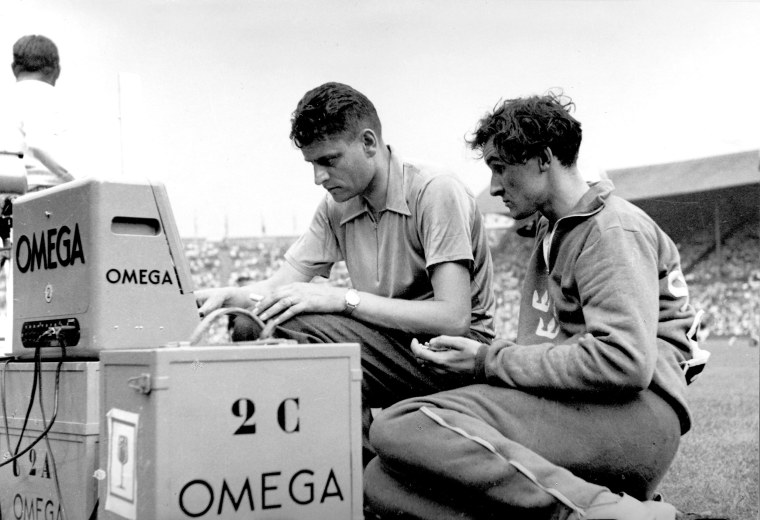
Omega introduced the "Magic Eye" slit photo finish camera at the 1948 Olympic Games in London.
Omega introduced the "Magic Eye" slit photo finish camera at the 1948 Olympic Games in London. Omega

Their work on these Milan Cortina Olympics began three years ago, Zobrist said. That level of planning stems from the baseline expectation of Omega's job performance — every result must be perfect.

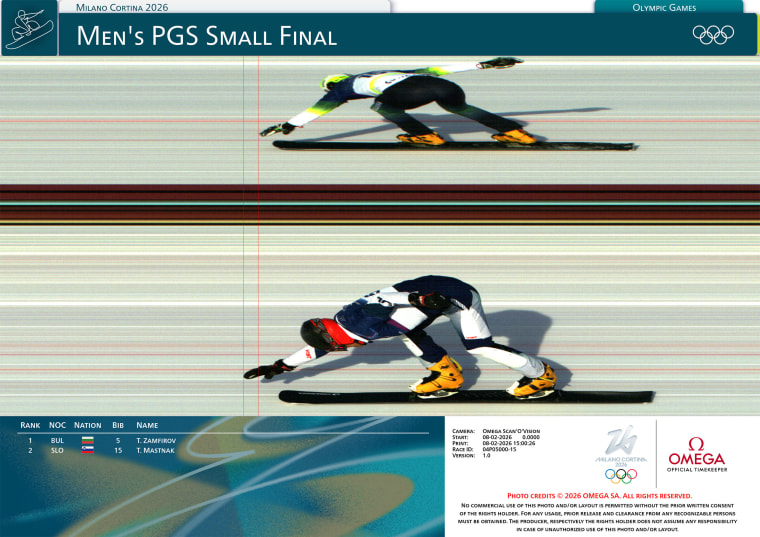
In the most high-stakes moments, a photo finish, an operator looks at a monitor with footage from finish-line cameras shooting 40,000 photos per second. The operator then manually places a cursor where the athlete officially crosses the finish — it varies from sport to sport, from the front of the torso, to the front of the skate — to determine a time.

By itself, the camera doesn't take much time to learn how to operate, Zobrist said.

"What you cannot learn is the pressure that comes with it when you operate it," he said. "Think about the 100-meter final at the Summer Olympics, where billions of people are watching for and waiting for the results to appear as soon as the athletes cross the finish line. And you know as an operator that you’re not allowed to do any mistakes, because as soon as you push that enter button, the result is released and public."

At the 2014 Olympics, the men's 1,500-meter speed skating final was decided by three-thousandths of a second — about a hundred times faster than the blink of an eye.

"There is no contextualization from real life," Zobrist said of a margin that small. "Because these tiny little margins you can’t see with your naked eye. It’s just too fast, so we need sophisticated camera technology to be able to capture those differences. Our cameras are taking about 40,000 pictures per second off that finish line to allow judges to have a very accurate understanding of who crossed the line first. Without this, no chance to see."

Omega's systems can measure down to the millionth of a second, Zobrist said, but such detail isn't needed, for now. Some sports require timing out to the hundredth of a second, others the thousandth.

A split-second rendering of Team USA figure skater Ilia Malinin.
A split-second rendering of Team USA figure skater Ilia Malinin.Omega

That precision will again be under the spotlight this week as speed skating, which consistently produces some of the smallest winning margins at every Winter Olympics, gets under way. But timing is only part of Omega's responsibilities. Fans in arenas rely on Omega operators who transmit statistics about competitions onto scoreboards. Fans on television watching the games will see graphics that Omega provides to the Olympic Broadcast Services that are created by its mixture of specially developed cameras, computer-vision technology and artificial intelligence.

The first graphic shown on television at an Olympics was thanks to Omega, in 1964.

Johnson reached a top speed of 80 mph during her winning downhill run Sunday — which was broadcast in real time thanks to two different sensors Omega placed on her boots that collected 2,000 data points per second. They tracked her live speed, trajectory and a number of other metrics.

When American star Jordan Stolz attempts to win four individual gold medals in speed skating, data on his runs will be sent back via an Omega transponder worn on his ankle. Transponders have been worn since 2004.

A split-second frame from the finish line in the men's parallel giant slalom snowboard finals between Tervel Zamfirov of Bulgaria and Tim Mastnak of Slovenia in Milan.
A split-second frame from the finish line in the men's parallel giant slalom snowboard finals between Tervel Zamfirov of Bulgaria and Tim Mastnak of Slovenia in Milan. Omega

And when American figure skater Ilia Malinin leaped for a quad flip Sunday during a run that helped earn the U.S. a gold medal in the team event, 14 cameras stationed around the arena used computer-vision technology to track his biomechanical movements. It found he had begun his leap at a speed of 15.08 kilometers per hour, with the angle of the blade of his skate at 96 degrees, and reached a maximum height of 0.54 meters.

"This is the baseline for us to also provide support systems to judges in the future," Zobrist said.

An electronic starting gun was first used in 2010. Its chief advantages were that it could transmit the sound of its firing to loudspeakers behind individual starting blocks, to ensure it will be heard at the same time, no matter how far away an athlete was from the starter.

The only device Omega uses at the Olympics that hasn’t changed since 1932?

A metal bell is still rung by hand to mark a race’s last lap.

"We’re doing this for almost 100 years, so we know what to do," Zobrist said. "We have sophisticated technology that were used at thousands of events prior to this, and we have backup systems in place to make sure that we can switch from one system to another in case of need.

"So, there is not much that keeps me up at night."