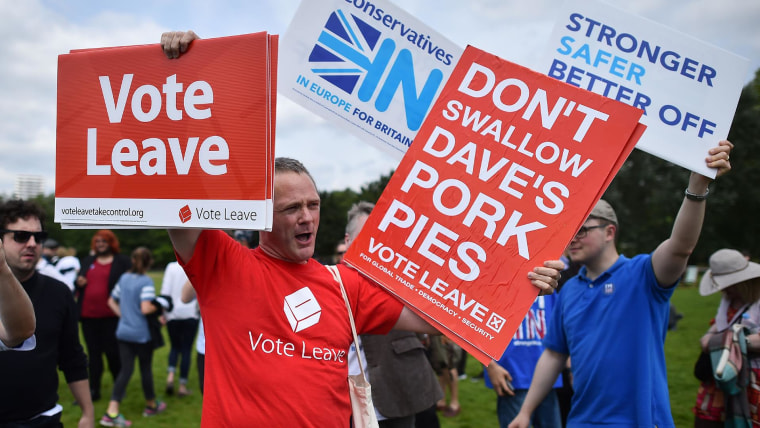
LONDON — Britons voted to quit the European Union after a divisive and bitter national referendum, according to predictions early Friday.
The Brexit debate, in which Britons weighed the strategic and trade benefits of bloc membership against costly European bureaucracy and the erosion of national sovereignty, was overshadowed by last week’s murder of pro-EU lawmaker Jo Cox.
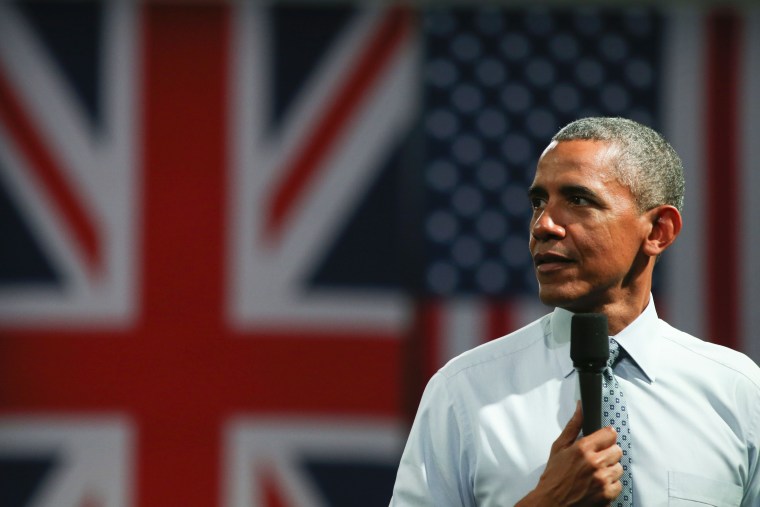
President Barack Obama had warned that the outcome of Thursday’s referendum was “of deep interest to the United States” as well as a possible turning point for Europe.
The predicted result spooked financial markets, where stocks fell sharply.
Here's what you need to know about Brexit.
What is at stake?
In short, the future of Europe and the global order. Britain is the EU’s second-largest economy, has a powerful military and exerts outsize influence in global affairs; it would be difficult to interpret Brexit as anything other than abandonment of the EU by one of its most important members.
Obama urged British voters to remain in the EU because its economic growth and counter-terrorism efforts will be “far more effective” with the U.K. as a member. But that intervention earned him a rebuke from some senior figures, including the mayor of London who said the president’s position was “perverse.”
Some predict a domino effect as other EU members consider their own departures, fearing an EU without Britain would be economically dominated by Germany. Countries such as Spain could also be forced to make hundreds of millions of extra dollars in annual contributions as budgets are realigned. A structural crisis is the last thing Europe needs amid the biggest refugee crisis since World War II, intractable economic woes and a nebulous security threat from international terrorism.
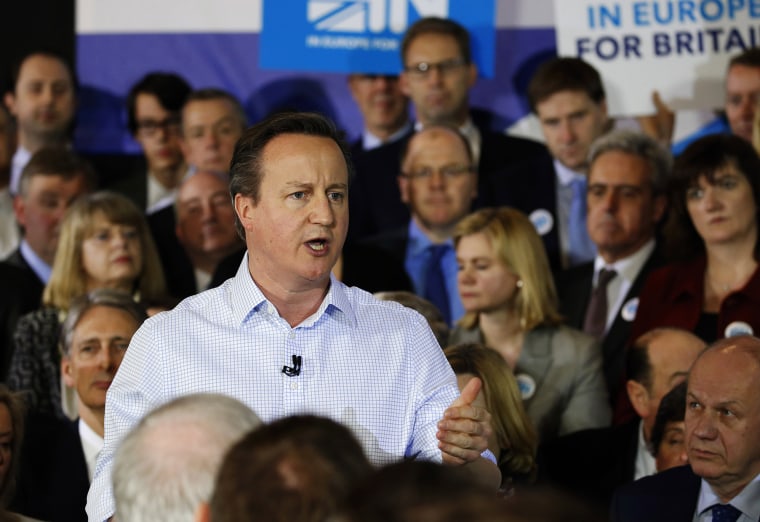
Only two days before the vote, British Prime Minister David Cameron said his country faced “an irreversible decision" on Europe. “There is no going back” from Brexit, he warned.
Cameron announced Friday that he would step down by the fall.
Why does it matter for the United States?
The United States advocates a strong, stable Europe. Even a smooth Brexit would see Washington building a new relationship with both Britain and a Britain-free remainder of the EU. However, some observers fear the rump of the EU could begin to unravel, weakening America’s allies and bringing instability.
Despite a weakened "special relationship" between Washington and London, Britain remains America’s primary transatlantic military ally and its role in Europe is strategically important to the U.S.
Why is this happening now?
Cameron was fulfilling an election promise to negotiate a better deal for his country in the European Union and to put the new terms to a national vote. It was an act of political expediency aimed at uniting two factions within of his Conservative party, which for decades has been bitterly divided over the issue of Europe.
An uptick in immigration and a long period of austerity have eroded British enthusiasm for the EU.
The trading bloc is arguably the modern world’s first attempt at creating a “superstate” — a collection of nations that have agreed to give up meaningful aspects of their sovereignty in exchange for greater collective security and economic development.
A series of treaties have given courts and politicians in Brussels the power to change national laws and bring them in line with European standards. Up to 55 percent of Britain's laws and regulations are now set by Europe.
This forfeiture of national authority lies at the root of concern among many British voters.
How could it affect the U.S. election?
A perceived dissolution of the European Union would reinforce the isolationist views of many conservative Americans on the right. Politicians like Donald Trump would likely pounce on a Brexit as a reinforcement of the worldview he has championed on the campaign trail — that Europe is weak and its institutions are unable to cope with the realities of the modern age, and that border controls, protectionist trade policies and a reassertion of national sovereignty are essential to deal with the chaos of the outside world.