The more we learn about the cosmos, the more it seems possible that we are not alone. The entire galaxy is teeming with worlds, and we’re getting better at listening — so the question, “Is there anybody out there?” is one we may be able to answer soon.
But do we really want to know? If aliens are indeed out there, would they be friendly explorers, or destroyers of worlds? This is a serious question no longer confined to science fiction, because a growing group of astronomers has taken it upon themselves to do more than just listen. Some are advocating for a beacon swept across the galaxy, letting E.T. know we’re home, to see if anyone comes calling. Others argue we would be wise to keep Earth to ourselves.
Related: NASA's Bold Plan to Save Earth From Killer Asteroids
“There’s a possibility that if we actively message, with the intention of getting the attention of an intelligent civilization, that the civilization we contact would not necessarily have our best interests in mind," says Lucianne Walkowicz, an astrophysicist at the Adler Planetarium in Chicago. "On the other hand, there might be great benefits. It could be something that ends life on Earth, and it might be something that accelerates the ability to live quality lives on Earth. We have no way of knowing.”
Like many other astronomers, Walkowicz isn’t convinced one way or the other — but she said the global scientific community needs to talk about it.

That conversation is likely to heat up soon thanks to the Breakthrough Initiatives, a philanthropic organization dedicated to interstellar outreach that's funded by billionaire Russian tech mogul Yuri Milner. Its Breakthrough Message program would solicit ideas from around the world to compose a message to aliens and figure out how to send it. Outreach for the program may launch as soon as next year, according to Pete Worden, the Breakthrough Initiatives’ director.
“We’re well aware of the argument, ‘Do you send things or not?’ There’s pretty vigorous opinion on both sides of our advisory panel,” Worden says. “But it’s a very useful exercise to start thinking about what to respond. What’s the context? What best represents the people on Earth? This is an exercise for humanity, not necessarily just about what we would send.” Members of the advisory panel have argued that a picture (and the thousand words it may be worth) would be the best message.
Next comes “more of a technical expertise question,” Wordon says. “Given that you have an image or images, how do you best encrypt it so it can be received?”
Breakthrough Message will work on those details, including how to transmit the pictures, whether through radio or laser transmitters; how to send it with high fidelity, so it’s not rendered unreadable because of interference from the interstellar medium; which wavelengths of light to use, or whether to spread a message across a wide spectrum; how many times to send it, and how often; and myriad other technical concerns.
Related: Space Mining: The Intergalactic Gold Rush Is On
The scientific community continues to debate these questions. For instance, Philip Lubin of the University of California, Santa Barbara, has published research describing a laser array that could conceivably broadcast a signal through the observable universe.
Breakthrough is also working on where to send such a message, Worden adds. The $100 million Breakthrough Listen project is searching for any evidence of life in nearby star systems, which includes exoplanets out to a few hundred light years away.
“If six months from now, we start to see some interesting signals, we’ll probably accelerate the Message program,” he says.
The fact that there have been no signals yet does pose a conundrum. In a galaxy chock full of worlds, why isn't Earth crawling with alien visitors? The silence amid the presence of such plentiful planets is called the Fermi Paradox, named for the physicist Enrico Fermi, who first asked "Where is everybody?" in 1950.
In the decades since, astronomers have come up with possible explanations ranging from sociology to biological complexity. Aliens might be afraid of us, or consider us unworthy of attention, for instance. Or it may be that aliens communicate in ways that we can’t comprehend, so we’re just not hearing them. Or maybe aliens lack communication capability of any kind. Of course there’s also the possibility that there are no aliens.
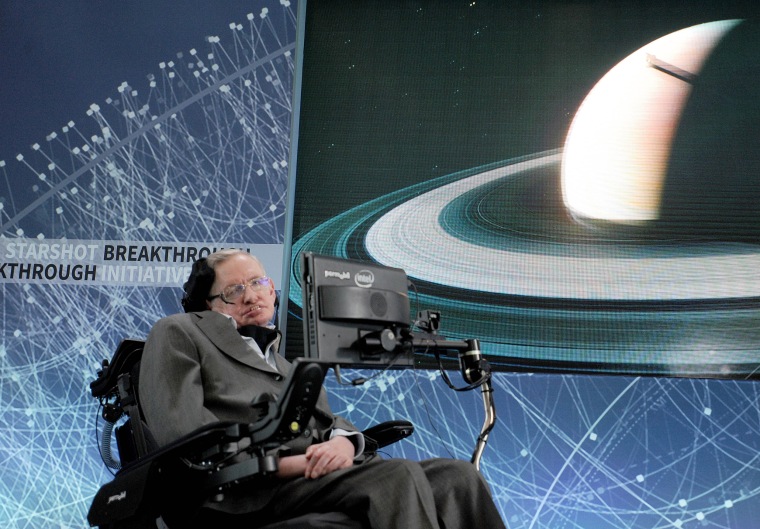
But those questions don’t address the larger one: Whether it’s a good idea to find out. Some scientists, most notably Stephen Hawking, are convinced the answer is a firm “No.”
“We only have to look at ourselves to see how intelligent life might develop into something we wouldn’t want to meet,” Hawking said in 2010. He has compared meeting aliens to Christopher Columbus meeting Native Americans: “That didn’t turn out so well,” he said.
Others have warned of catastrophic consequences ripped from the pages of science fiction: Marauding aliens that could follow our message like a homing beacon, and come here to exploit Earth’s resources, exploit humans, or even to destroy all life as we know it.