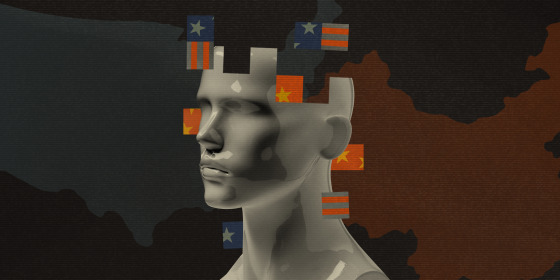
Last month, as the tech industry was buzzing about ChatGPT, the research arm of the Defense Department put out an artificial intelligence announcement of its own: An AI bot had successfully flown an F-16 fighter jet in the skies above Southern California.
The news got relatively little attention, but it revealed an overlooked truth: The race to develop the next generation of AI isn’t just between tech companies like Microsoft and Google — it’s also between nations, which are working furiously to foster and develop their own technology.
An international competition over AI technology is playing out at a time of high tensions between the U.S. and China, and some experts said they fear how high the stakes have gotten.
“If the democratic side is not in the lead on the technology, and authoritarians get ahead, we put the whole of democracy and human rights at risk,” said Eileen Donahoe, a former U.S. ambassador to the U.N. Human Rights Council and now executive director of Stanford University’s Global Digital Policy Incubator.
AI has become increasingly intertwined with U.S. geopolitical strategy even as chatbots, digital artwork and other consumer uses are stealing the headlines. What’s at stake is a host of tools that countries hope to wield in a fight for global supremacy, according to current and former U.S. government officials and outside analysts.
And it’s not just about military weapons like autonomous fighter jets. Some of the same advances that are powering ChatGPT may be useful for such varied geopolitical tools as large-scale propaganda machines, new kinds of cyberattacks and “synthetic biology” that could be important for economic growth.
“Within the technical community and some parts of the policy community, this race has been going on for quite some time,” said Jason Matheny, CEO of the Rand Corp., a nonprofit that provides research assistance to the U.S. government.
“But what’s different now,” he added, “is that this is a topic of conversation among the general public. There’s millions of people now who’ve interacted with a large language model” — specifically, ChatGPT and its cousin on Microsoft’s Bing search engine.
On the surface, chatbots may not have much in common with autonomous weapons, but they’re built on similar ideas. AI technology is made up of a series of separate advances going on in parallel including new specialized microchips and a new computing architecture called a “transformer” that Google engineers developed. The “T” in ChatGPT stands for transformer.
One casualty so far is the exchange of technology across borders, similar to the way the internet itself has splintered into competing factions. China’s regulators have told Chinese companies not to offer access to ChatGPT services, Nikkei Asia reported last month, and the Biden administration has tightened controls on the export of AI-related technologies to China.
From the Chinese perspective, the competition has resulted in a “decoupling” that hurts both countries but China even more so, according to a report earlier this year from academics at the elite Peking University. The report was later taken offline, the Hong Kong-based South China Morning Post reported.
But in response to U.S. export controls, Chinese President Xi Jinping has emphasized a goal of technological self-reliance.
AI dominance isn’t necessarily winner-take-all. China does more with facial recognition tech than other countries do, using it as a form of control, but censorship may hold it back in the area of large language models.
Matheny said that for the U.S. to maintain an edge, it has to look at several essential components: computing power with microchips, large amounts of data, advanced algorithms and talented engineers.
“Each of these is sort of a strategic resource,” he said. “There’s not an endless supply of people who have the expertise needed to build these large AI models.”
To make the race even more complicated, the biggest source of advanced chips is Taiwan, the island that China claims as its own.
“It’s an inconvenient feature of geography that one of the most important parts of the AI supply chain is also one of the most complicated places geopolitically, 100 miles from mainland China,” Matheny said.
Both the U.S. and China have committed vast resources to AI development. The Defense Department is spending $1.5 billion over five years on AI, and last year Congress added another $200 million. The Defense Advanced Research Projects Agency, or DARPA, which tested the F-16 jet, has separately said it was spending billions of dollars. China’s spending is less clear, but estimates are in the billions of dollars.
