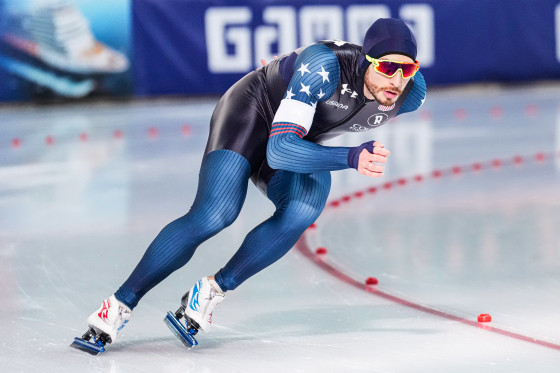
In speedskating, tenths of a second can determine whether an athlete wins gold or even misses out on medals entirely.
To hunt for these slivers of a second, the United States Olympic speedskating team has put traditional analytics on ice and turned to a new tool powered by artificial intelligence to simulate skaters’ complex aerodynamics.
The new app, called Slippery Fish and custom-designed for the team, is one of an emerging suite of AI-powered tools used by U.S. Olympic teams to improve athletes’ performances ahead of the 2026 Milan Cortina Winter Games opening Friday.
Emery Lehman, a 29-year-old member of the speedskating team competing at this year’s Games, said the AI-enabled app has revolutionized how he and the wider team approach training.
“We used to have athletes fly out across the country to a wind tunnel, spending all of this time and money, where they would then stay in a static position so the team could gather aerodynamic data,” Lehman told NBC News last week, while exercising on a stationary bike during the team’s practices in southern Germany.
“With this app, it’s all just done through AI,” said Lehman, an engineer who has already won a bronze medal at the 2022 Beijing Olympics. “In the team pursuit, for example, we want to maybe make a change and find a position amongst the three guys or girls who are skating, so the whole group can be more aerodynamic.”

The Slippery Fish app is based on a similar AI-powered aerodynamic analytics tool for cyclists called AiRO and allows coaches to upload images of athletes on the ice. From those images, the app creates a digital avatar of the athlete and simulates how different postures affect airflow and drag, variables critical to speedskating success.
“We can now plug changes in posture into this app and see if those tweaks are actually efficient or not,” Lehman said. “Then we can go on the ice, see if it’s practical and kind of evaluate from there. Something that maybe took a week or two to validate or say, ‘That was a good or bad idea,’ that can now be done in a day.”
Shane Dormer, chief of sport performance for the speedskating team, agreed that the AI-powered technology had improved how the team trains, calling it “a wind tunnel in your pocket.” “We want to test new positions in short periods of time so we can iterate on the fly, actually have conversations and really get our coaches and athletes involved in the process,” Dormer said. “We’re looking at tiny adjustments, like whether skaters’ elbows are drifting out from their body, and examining what kind of time cost is involved.”
AI systems have become increasingly capable over the past year, with new iterations capable of analyzing troves of data to create insights and provide detailed recommendations based on new research techniques. To harness these growing abilities, the USA bobsled and skeleton team announced a new partnership in November with Snowflake, one of the world’s leading AI-focused data analytics companies.
For Curt Tomasevicz, director of sport performance for the bobsled team, this new collaboration has allowed a better understanding of individual athletes’ strengths and weaknesses, enabling coaches to provide better advice and improve overall team performance ahead of the Milan Cortina Games.
“It sounds very simple to load two or four athletes into a sled,” said Tomasevicz, who won the gold medal in the four-man bobsled at the 2010 Vancouver Olympics and holds a doctorate in bioengineering. “But when you have four athletes running, and you’re asking different athletes to get in at different times before they truly feel like they’re maximizing their push, it goes against their natural tendency sometimes.”
“Now, if we can train this AI tool to say on this track, on this day, with these specific athletes, how many steps should they take to get into the sled, to have an optimal speed? Wow.”
Tomasevicz said that when he was training, he only had access to a fraction of the data that now feeds Snowflake’s AI tools.
“In 2006 at my first Olympics, we would get splits down the track every couple hundred meters,” Tomasevicz said, referring to timing checkpoints. Now, bobsleds contain accelerometers and gyroscopes that provide 100 data points every second.
“We’re talking about thousands and thousands of times of higher accuracy. And then in terms of turnaround time, if we can get the data, upload it to AI, ask a question, download the results and give the feedback back to a pilot and a coach in between runs, now they can make adjustments before the next run starts.”
Mike McCarver, a principal at Snowflake, said the new wave of AI-powered data analytics is going beyond simple AI prompts and was making a real difference in teams’ training routines.
“This has really opened up the opportunity for sports teams, athletes, or even brands in general, to kind of make more use of data that they might not have been able to really kind of digest otherwise,” McCarver told NBC News.
