Engineers working on self-driving technology have given a lot of thought to difficult questions over the years, including how to keep pedestrians safe and how to avoid collisions with other vehicles.
But last weekend’s protests in Los Angeles threw a spotlight on one of the thorny problems that remain for autonomous vehicles: what to do about arson, vandalism or other physical attacks.
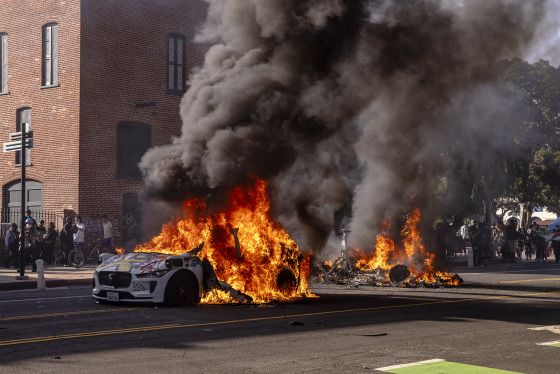
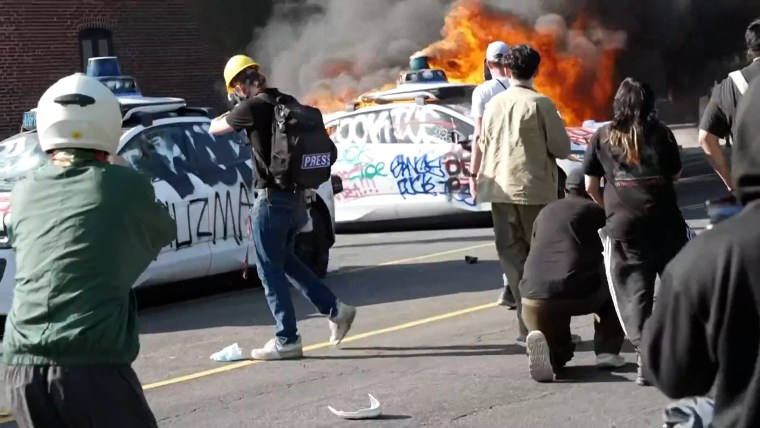
Five vehicles owned by Google’s self-driving spinoff Waymo were set ablaze last Sunday during protests against the Trump administration’s immigration policies. Images and video of the flaming cars quickly went viral, illustrating for a global audience how vulnerable robotaxis can be in volatile situations.
For all their advanced technology, including expensive cameras and sensors, the cars seemed to be defenseless. Waymo says the five cars were in downtown Los Angeles to serve passengers when they were attacked. There were no drivers to plead for mercy, and with crowds surrounding the vehicles, there was no escape path that didn’t include threatening pedestrians — something Waymo vehicles are programmed not to do.
“They’re very much sitting ducks,” said Jeff Fong, who has worked at tech companies including Lyft and Postmates and now writes a newsletter about cities and technology.
And it wasn’t the first time Waymo was a victim of arson. Last year, a Waymo in San Francisco’s Chinatown was set on fire during Lunar New Year celebrations. Police later charged a juvenile with starting the blaze, saying they had thrown a lit firework into the vehicle.
Waymos have been vandalized in other ways, too, including having their tires slashed, their windshields smashed, their doors torn off and their exteriors defaced with spray paint. Local prosecutors have charged individuals in at least some cases.
Part of what makes robotaxis vulnerable is their caution. While it’s impossible to know if a human driver behind the steering wheel could have deterred or escaped vandalism in any specific case involving a robotaxi, driverless vehicles are generally designed to stay put if there’s any risk that they’d hit a person while moving.
“There’s been so much effort into making sure they can’t hurt human beings,” Fong said. “That’s the problem Waymo has been solving for, rightfully so, but when you have the problem where a human wants to do harm, these cars have no countermeasures.”
Autonomous technology companies, including Waymo, appear to be largely at a loss for ideas on how to deter vandalism over the long term. Their cameras may be a partial deterrent — Waymo says each of its cars has 29 cameras — and the company has cooperated with police to help find vandalism suspects after the fact. But Waymo’s collection of street data through its cameras and sensors is also one of the sources of anger against the company and other startups like it.
Some Uber and Lyft drivers have said that vandalism incidents bolster the importance of human drivers as a deterrent.
A spokesperson for Waymo said that in response to the protests in Los Angeles and elsewhere, it was temporarily adjusting its service area. Waymo declined to make anyone available for an interview about the problems of arson and vandalism and how the company plans to deal with such incidents in the long term.
The vandalism problem is mostly limited for now to Waymo, which is the biggest self-driving car company. It has about 1,500 vehicles operating in four regions, with additional cities scheduled to come online this year. But the market is set to become more competitive soon, with Tesla saying it plans to launch a robotaxi service this month in Austin, Texas, and Amazon-backed Zoox planning a service in Las Vegas and San Francisco.
Representatives for Tesla and Zoox did not respond to requests for comment about how they plan to avoid incidents like last Sunday’s attack on Waymo vehicles.
The problem has been gnawing at robotaxi fans on message boards on Reddit. In one thread in January, users tossed around ideas like having dedicated security on motorcycles nearby or equipping Waymo vehicles with pepper spray.
Adam Millard-Ball, director of the UCLA Institute of Transportation Studies, said that robotaxis are a symbolic target for some street demonstrators.
“They’re attacked not because they’re autonomous cars but because they’re a symbol of inequality in cities and a symbol of the power of large technology companies,” he said. He noted that electric scooters are also sometimes targets.
He also said it’s hard to imagine what the companies, police or city officials could do to eliminate the threat entirely.