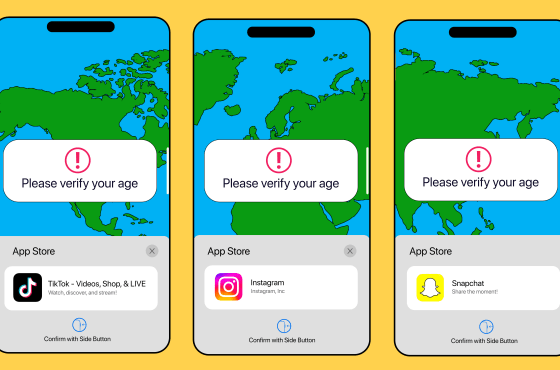
Age verification is coming for app stores.
Laws requiring Google and Apple to check people’s ages before they can download apps are gaining momentum in the United States and around the globe in what could be a radical shift for how people access content on their phones.
While age checks have become increasingly common across the internet, the focus of attention has usually been on individual websites and app makers, not app stores. That’s shifting as some politicians and tech companies argue it would be more efficient and uniform for app stores to check people’s ages in the name of child safety.
Eric Goldman, a law professor at Santa Clara University, said there’s a battle raging within the tech industry over who’s going to be accountable for children’s lives during the hours they spend on phones and tablets.
“We’ve got this food fight,” he said. “Everyone’s pointing the finger at each other.”
Three states — Texas, Louisiana and Utah — have passed laws this year compelling app marketplaces to check the ages of everyone when they create accounts. They were joined by Singapore, an Asian tech hub that passed a similar law. All four laws are scheduled to take effect next year, and similar proposals are under consideration in other states and in Congress.
But some argue the laws have potential costs in reducing privacy and burdening free speech. Some people in the United Kingdom, which has a new mandate for age checks, are verifying their ages through selfies that are run through facial age verification software.
And it’s not clear how much the new laws would limit access to adult content, especially if they don’t affect web browsers. Online age checks are often followed by surges in workarounds, such as virtual private networks, or VPNs, which mask users’ locations to sidestep local regulations.
Lobbying for the new laws is coming partly from within the tech industry. Mark Zuckerberg’s Meta and some other app makers are eager to shift the burden of online kid safety to the app stores rather than take on more of the responsibility themselves.
But the trend is getting pushback from Apple and Google, which run the biggest app marketplaces, as well as from civil liberties advocates who see age verification mandates as a death knell for the internet’s privacy and anonymity.
Goldman, who opposes age verification mandates on privacy and free speech grounds, said the laws are popular now for several reasons: the broader backlash against tech companies; the number of hours kids spend online, especially since Covid-19; and the lack of unity in the tech industry.
“Censorship is in style today,” he said. “Regulators are full-throated in embracing censorship as a good thing, and they’re more than willing to exert their will on other sources of power in our society.”
State lawmakers who are pushing the measures say the status quo isn’t working.
“Parents are constantly fighting to protect their children, especially from dangerous content on their phones, tablets, and other devices,” Texas state Sen. Angela Paxton, a Republican who sponsored the new law there, said in a statement. The law says an app store “shall use a commercially reasonable method of verification to verify the individual’s age.”
Google and Apple object to the laws on various grounds, including that they are too sweeping and that they require collecting too much data about users.
“This level of data sharing isn’t necessary — a weather app doesn’t need to know if a user is a kid,” Kareem Ghanem, a director of public policy at Google, said in a blog post about the state laws.
He argued that app makers are best positioned to think about age. “By contrast, a social media app does need to make significant decisions about age-appropriate content and features,” he said.
More broadly, age verification has built up considerable momentum. Twelve states have passed laws restricting children’s access to social media or requiring parental consent, though the courts have blocked three of those laws, according to the Age Verification Providers Association, a trade group for tech companies that handle age checks. And 24 states have passed laws requiring age verification to view pornography online, the association says.
