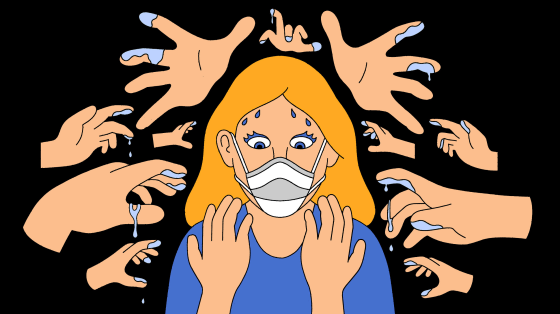
President Donald Trump confessed Wednesday that for the last few weeks he's been missing something: touching his face.
"I haven't touched my face in weeks,” Trump said during a meeting about coronavirus with airline executives. "I miss it."
He's not alone.
The emergence of a new coronavirus around the world has triggered widespread warnings about personal hygiene and habits in an effort to limit its spread: wash your hands, limit unnecessary travel and don't touch your face.
It's that last piece of advice that's a challenge for many people.
"Realizing basically all I do is touch my face,” tweeted actor Seth Rogen.
"Did not realize how often I touch my face until the CDC explicitly told me not to touch my face,” tweeted author Allison Raskin.
On social media, scores of people have lamented their fears that their inability to stop touching their faces will cause them to catch the new coronavirus. The anxiety surrounding face touching is just one way stress over the coronavirus has manifested in the general population.
And the warnings themselves may be causing more face touching — and associated anxiety — than intended.
The tweets about face touching point to a problem that health professionals are warning can be as pervasive as the coronavirus itself. Although many of the tweets about face touching are tongue-in-cheek, the palpable anxiety over contagion is not.
"Fear and hysteria are the biggest things we fight other than the virus itself,” said Joseph Fair, a virologist and outbreak response specialist. "Fear, hysteria, hoaxes, conspiracy theories, everything else — 50 percent if not more of containing the outbreak is that, be it this outbreak or others.”
Fears over face touching have become the hallmark of anxiety surrounding the coronavirus' spread, and anxiety manifesting as behavioral changes is common, experts told NBC News. Whether it's people buying surgical masks, staying home from work or panicking about touching their faces, most people's fears are overblown, said Fair, an NBC News contributor.
"I think the biggest fear people should have is that this could do a lot of harm to our elderly community. … The biggest irrational fear is ‘Oh, my God, I'm going to get coronavirus, I'm going to die,'” Fair said. "Overwhelmingly, the numbers show that's not going to be the case.”
While there are communities whose fears of coronavirus are founded, the behavior of less at-risk communities could fan the flames of hysteria among people who are able to fight off the illness.
Dr. Timothy Scarella, an instructor in psychiatry at Harvard Medical School, said that what might be accepted as rational behavior in Hubei province in China, where the outbreak originated, would likely be considered irrational behavior in Boston.
"If someone bought a pack of surgical masks and feels better having them in their living room and that's it, it's not the end of the world, versus somebody who hasn't left their house in three weeks and says, ‘I'm not going to leave until this is settled,'” Scarella said.
Both professionals agreed that practical steps of practicing good hygiene are the best ways for the general population to avoid coronavirus, but they said face touching — the biggest source of fear expressed on social media — is going to be a hard habit to break.

