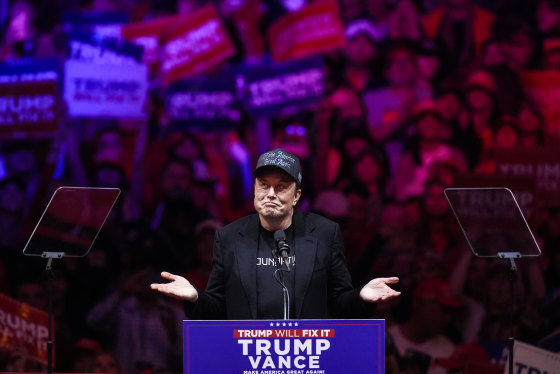
A lawyer for Elon Musk said in a Philadelphia courtroom Monday that the winners of Musk’s $1 million daily prize giveaway in election swing states are not chosen at random, contradicting what Musk said when he announced the contest last month.
Legal experts told NBC News that the disclosure could have legal fallout for Musk across multiple jurisdictions under laws designed to protect consumers from deceptive practices.
“This is absolutely, unambiguously illegal,” Christopher Peterson, a University of Utah law professor who specializes in consumer protection, said in an email.
“You cannot lawfully lie to the public about conducting a random sweepstakes, lottery, or contest and then rig the results to hand-select the winners,” he said. “It really is not complicated. This is just fraud; a simple, ugly fraud on the public.”
He said Musk and his super PAC’s behavior could be “both a civil wrong and a crime.”
Musk’s America PAC declined to comment on that analysis or the views of other legal experts. Musk did not immediately respond to a request for comment.
Chris Gober, a lawyer for America PAC, made the disclosure at a hearing about the giveaways. He said that the winners are not chosen by random, as in a lottery drawing, but that the super PAC instead selects the winners based on who it believes would be effective political spokespeople.
The disclosure flew in the face of what Musk said onstage at a Pennsylvania rally on Oct. 19, when he revealed the contest to draw attention to a petition supporting free speech and gun rights.
“We’re going to be awarding $1 million randomly to people who have signed the petition every day from now until the election,” Musk said, followed by wild applause from the audience.
The disclosure that Musk’s statement was not true was met with backlash on Musk’s social media app, X, where some users said Monday that he had deceived petition-signers or even defrauded them. To sign the petition, people are required to give their names, email addresses, cellphone numbers and mailing addresses, and they must be registered to vote in one of seven swing states: Arizona, Georgia, Michigan, Nevada, North Carolina, Pennsylvania or Wisconsin.
America PAC’s daily $1 million giveaway has been a key feature of Musk’s efforts on behalf of former President Donald Trump. Musk has spent more than $118 million to try to re-elect Trump, and he has appeared in Pennsylvania numerous times to campaign in person. Philadelphia District Attorney Larry Krasner sued Musk and America PAC over the offer, calling it an unlawful lottery under Pennsylvania law and leading to Monday’s court hearing.
John Summers, a lawyer for Krasner, called Gober’s disclosure “a flat-out admission of liability” at the hearing.
While Gober said he believed the non-random nature of the offer means it is not a lottery, legal experts said the statement could open up Musk and the super PAC to additional claims of liability under federal consumer protection law or in the seven battleground states where people have been winning prizes.
Rebecca Tushnet, a professor at Harvard Law School who specializes in the First Amendment and false advertising, said she considered Gober’s disclosure to be an admission of liability.
“They falsely advertised that people who never had a chance to win should participate, and participation meant providing the PAC with valuable information about voters to target,” she said in an email.
“Deceptive trade practices laws may be triggered by claiming ‘random’ selection and then not delivering, but states may differ about exactly what conduct is covered — many limit prohibitions to conduct that relates to selling goods or services,” she said.
Whether such laws apply in the circumstances around America PAC would be determined in court only if someone decides to sue. Tushnet said that she expects plaintiffs’ lawyers could explore class action lawsuits over consumer protection and that state attorneys general may be interested in pursuing enforcement actions, too.
George Conway, a prominent lawyer and former Republican who is a vocal critic of Trump, agreed that state attorneys general could see the disclosure as a consumer protection issue.
