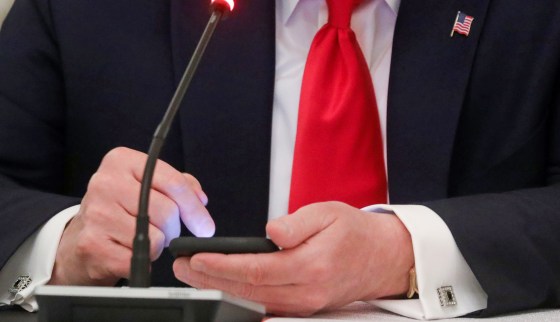
When President Donald Trump's Facebook account Monday posted an evidence-free assertion that mail-in ballots "cannot be accurately counted," the social media giant responded, placing a label on the post that said simply: “Visit the Voting Information Center for election resources and official updates.”
That did not sit well with some of Facebook's critics.
“That label is worse than nothing,” Kate Starbird, a University of Washington associate professor of human-centered design and engineering, said in a tweet.
Facebook later changed the label to make it more aggressive, describing a “long history of trustworthiness” for both voting in person and by mail. A parallel scene played out with Twitter, where an identical claim from the president resulted in a short label: “Learn how voting by mail is safe and secure.”
But Facebook and Twitter still left the posts up.
Facebook and Twitter announced months ago that this is how they would deal with many posts from Trump about mail-in ballots: leave the posts up, but if they contained misleading information, add a fact-check label. And while the platforms in 2020 have new and aggressive policies about taking down misleading information, they have rarely removed Trump’s content.
The president has since taken full advantage, making the labels seem quaint in comparison.
“They’re not a magic fix to the president’s misinformation about elections,” Brendan Nyhan, a government professor at Dartmouth College, said.
Experts who study misinformation said the fact-check labels by Facebook and Twitter likely still have some value, especially if they’re made more prominent than they are now. Democrats are also ramping up the pressure.
But the labels also show how half-measures used by tech companies to try to fight harmful misinformation are bound to fall short of solving the problem.
The pattern has repeated for months and now seems destined to continue into November, leaving all sides somewhat dissatisfied with the outcome.
To Trump and his supporters, the labels are at turns an afterthought, a speed bump or a badge of honor from social media companies that want to deny him re-election by enforcing their rules. To Trump’s opponents and people who research false information online, the labels are a tool that’s inadequate for the weighty job of ensuring the integrity of the election.
Sometimes the labels are added only after a post has gotten many views, and it’s unclear if the labels affect the number of people who see the false information.
A Twitter spokesperson declined to answer questions about whether the company thinks the labels are working well, saying only that the labels offer context in line with its “civic integrity policy.”
Facebook also declined to say whether it thinks the labels are working well, but it said more than 39 million people had visited a Facebook website to get information on voting. It also said it was applying its rules impartially.
“We’ve faced criticism from Republicans for being biased against conservatives and Democrats for not taking more steps to restrict the exact same content,” Facebook spokesperson Andy Stone said in an email.
Mail-in ballots are popular in Republican and Democratic areas, and fraud involving mail-in ballots is exceedingly rare in part because of safeguards imposed by state and local officials to cross-check signatures and home addresses. Most states now provide ballot tracking.
But mail-in ballots may take longer to tally. In Pennsylvania, it took 28 days to count all the votes in the state’s June 2 primary.
