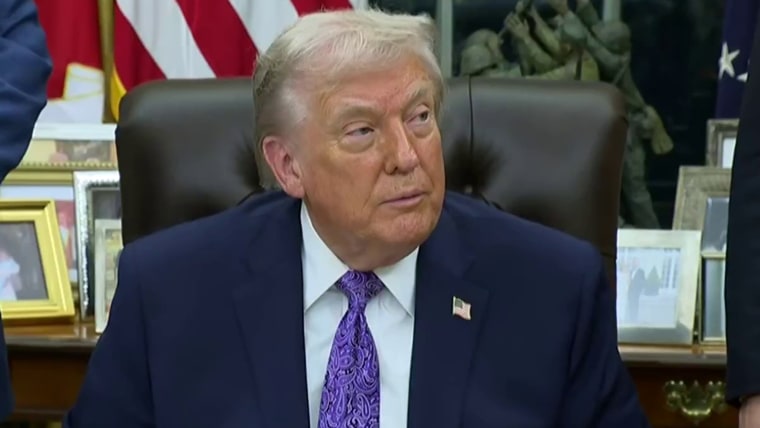
President Donald Trump signed an executive order Thursday evening that seeks to limit the ability of states to regulate artificial intelligence while attempting to thwart some existing state laws.
The order aims "to sustain and enhance the United States’ global AI dominance through a minimally burdensome national policy framework for AI," according to text published on the White House website.
At at signing ceremony in the Oval Office, Trump said AI companies "want to be in the United States, and they want to do it here, and we have big investment coming. But if they had to get 50 different approvals from 50 different states, you could forget it."
The order directs Attorney General Pam Bondi to create an “AI Litigation Task Force” within 30 days whose "sole responsibility shall be to challenge State AI laws" that clash with the Trump administration's vision for light-touch regulation.
In addition, the order instructs Commerce Secretary Howard Lutnick to identify existing state laws that "require AI models to alter their truthful outputs," echoing earlier Trump administration efforts to prevent what it calls "woke AI." States found to have these and other "onerous" laws may have to enter into agreements not to enforce those statutes in order to receive discretionary federal funding.
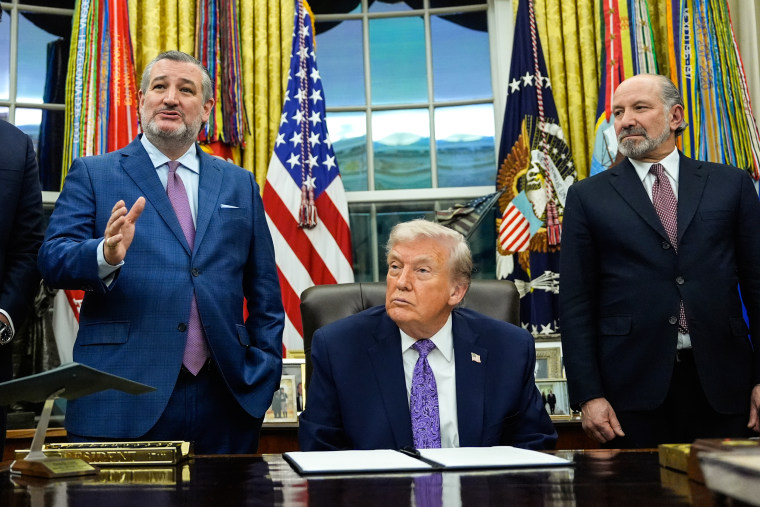
The order also directs White House AI czar David Sacks and director of the Office of Science and Technology Policy Michael Kratsios to create recommendations for a federal law that will preempt, or supersede, state laws regulating AI.
According to the order, the recommendations will not affect state AI laws related to child safety protections, data center infrastructure, state procurement of AI and other topics that have not yet been established.
The order comes on the heels of a failed push to enact similar policy in Congress in late November, which followed a similar unsuccessful attempt in July. House Republicans recently tried to include a provision in the must-pass National Defense Authorization Act asserting that only the federal government could legislate AI; the effort faced backlash and the language was eventually removed.
Given the halting and slow-moving efforts to regulate AI at the federal level, critics of the executive order view it as an attempt to block all meaningful regulation on AI and put little faith in Congress to replace existing state laws with a nationwide standard.
Brad Carson, director of the bipartisan AI advocacy group Americans for Responsible Innovation and a former member of Congress, called the order another attempt to push through unpopular and unwise policy.
“Big Tech has failed twice to jam an AI amnesty into legislation,” Carson told NBC News on Wednesday, predicting the executive order will soon be blocked in court.
Trump indicated in a Truth Social post Monday that he would sign an AI order this week.
“There must be only One Rulebook if we are going to continue to lead in AI,” Trump wrote. “That won’t last long if we are going to have 50 States, many of them bad actors, involved in RULES and the APPROVAL PROCESS.”
Shortly after Trump's post, Sacks elaborated on the rationale for the executive order in a post on X.
Sacks argued that this domain of “interstate commerce” was “the type of economic activity that the Framers of the Constitution intended to reserve for the federal government to regulate.”
At the Oval Office signing ceremony, Sacks said, "We have 50 states running in 50 different directions. It just doesn't make sense."
"We’re creating a confusing patchwork of regulation, and what we need is a single federal standard, and that’s what the EO says," he added.
Mackenzie Arnold, director of U.S. policy at the Institute for Law and AI, said Wednesday that it is crucial to put the administration's reasoning into context. "By that same logic, states wouldn't be allowed to pass product safety laws — almost all of which affect companies out of state that sell their goods nationally. But those laws are the classic example of acceptable state legislation," he said.
