Tech companies want you to buy wearable devices, promising an artificial intelligence boost to your work and your life.
I put that promise to the test myself, by giving four products a spin for a few days to see if they could make my complicated life any easier.
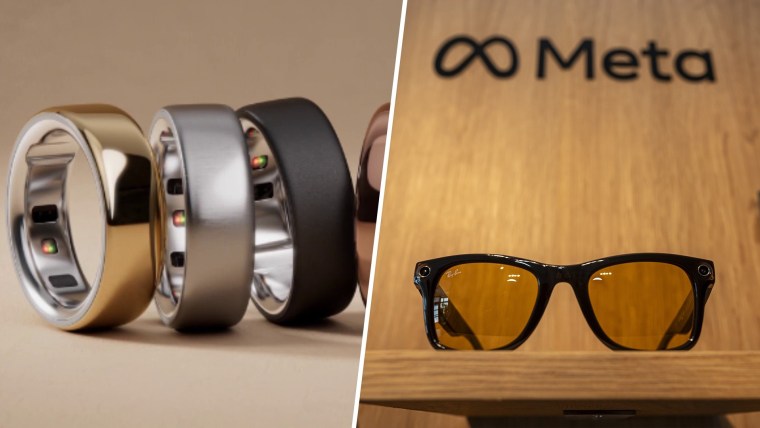
So I strapped Amazon’s Bee bracelet onto my wrist ($49.99), popped a pair of Ray-Ban Meta Gen 2 glasses on my face ($329 — $459), slid an Oura Ring onto my finger ($349 — $499) and hung an Omi around my neck ($89). The ring was borrowed from a co-worker, while the other three devices were provided by the companies for testing.
The overall takeaway? AI can make work and play slightly more efficient, but the overlap in functionality makes it clear that more is not necessarily better, and you don’t have to wear four AI products at once to get by. And beyond the jarring aesthetic of wearing all these devices, there’s also the weirdness of walking around with the ability to record people around you — sometimes passively.
The first of the four devices I interacted with upon waking up was the fitness and sleep tracker Oura Ring, the only one that really requires 24-hour usage. Through a chatbot on the app called an “Oura Advisor,” I could ask questions such as how to structure a workout that would meet my activity needs for the day.
Consulting my Oura “advisor” ahead of a workout in the NBC gym, where I can commonly be seen pushing massive amounts of weight.NBC News
The ring has no buttons, and it interacted with me through an app that neatly summarized my life and sleep through reports, the most helpful of which I found to be the sleep score. Based on sensors that logged my heart rate and oxygen levels, among other stats, the report would tell me how I slept — and also offered advice on how to improve my sleep.
The Oura Ring was the most discreet of the four devices I tested, sitting on my finger without requiring me to do much else. The other devices, which I slapped on before leaving for the day, were slightly unusual for me as someone who usually doesn’t wear more than a watch.
As I arrived at the office, my co-workers gave me a hard time for looking like I had tripped through an electronics store backroom somewhere along my commute. But to be fair, if worn independently, any of these products could be easily confused for any standard accessory thanks to smaller chips and sensors.
The true technological feat came from the glasses, where Meta has somehow managed to pack five microphones, a 12 megapixel camera, and two speakers into Ray-Ban branded frames. They are thicker than your average pair of specs, but only so much so that my friends thought I simply had a preference for bolder frames.
The Ray-Ban Gen 2s have enough battery life to last about eight hours on mixed use, according to Meta, but can quickly get a charge while sitting in a neatly designed glasses case — similar to how Apple AirPods are charged.
I used my Meta glasses to identify a plant in my office. The glasses were wrong.NBC News
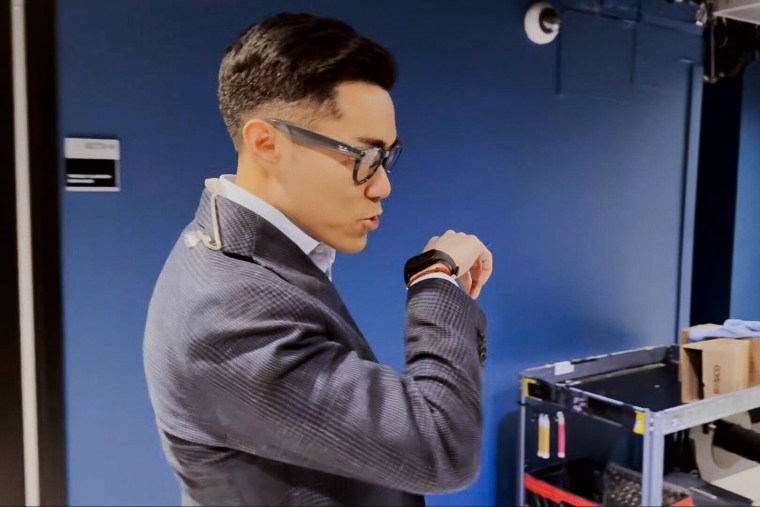
Amazon’s Bee bracelet is a small black module on a rubber strap that looks like any fitness tracker. With just a single button on the front, it’s easy to activate the bracelet’s key power: a listening mode that transcribes and summarizes meetings and conversations throughout the day.
As for the Omi, it was more noticeable because the quarter-sized pendant sat against my chest without any aesthetic of jewelry (beyond being silver), making it obvious to others that I’m wearing this for some utilitarian reason. But it’s still small enough to likely go unnoticed by passersby.
Like the Bee bracelet, the Omi listens to conversations and offers transcriptions and summaries in-app. The Omi is different in that it’s always listening, unless the user powers it off.
You can already see the redundancy; the necklace and the bracelet are just microphones worn on different parts of the body. The makers of Omi seem to acknowledge this, and note that owners of the Bee bracelet, for example, can plug the device into their Omi app to deliver the same functionality.
The summaries were helpful to me, cataloging the many meetings and conversations I had over the course of the day. But I found that asking questions into my necklace or bracelet didn’t save me more time than pulling up ChatGPT or Claude on my phone, beyond the novelty of looking like James Bond while doing so.
A similar theme emerged with the Meta Ray-Bans, which have the novelty of a camera to interact with its Meta AI. Smart glasses and headsets are clearly where Meta (as well as Snap, Google and Apple) see the tech going.
In practice, it can be cool. For example, while out buying lunch for myself, I was able to wake up my glasses with a “Hey Meta,” before asking the AI to give me a caloric estimate on the glorious hot dog I had purchased from a midtown Manhattan food cart. The glasses took a hands-free snapshot of my lunch, before informing me, through the small speakers at the back of the frames, that I was about to consume about 150 to 200 calories.
Feeling like James Bond talking into my Bee bracelet. I don’t think anyone in the office was that impressed.NBC News
It’s not perfect. Sometimes connectivity with my phone led to lags with the device, requiring me to repeat “Hey Meta” multiple times, which you could imagine would look a bit unhinged while standing in public.
Other times the model was just wrong. While looking at one of my plants, Meta’s AI repeatedly identified it as a begonia, when in fact it’s a nerve plant.
The bigger issue is having microphones on you recording all the people you come across during the day. Both devices have a light (green on the Bee, blue on the Omi) to indicate that they are recording. But with the lights so small, I made it my own personal practice to let my co-workers and friends know that the devices I was wearing would be recording (with the Bee I could start and stop recording with a button, but with the Omi I’d have to shut it off entirely to stop).
Those privacy concerns are amplified by the Meta Glasses because of the ease by which users can take photos and videos. A white light flashes when content is being captured, but it could easily be hidden by someone’s long hair. 404 Media reported that light can be disabled entirely by hackers online.
Allie K. Miller, CEO of Open Machine and an AI adviser to Fortune 500 companies, says risks like this always tend to accompany new tech.
“There is a delightful benefit of the cost of AI and the cost of processing dropping, which is we can do more, we can be more productive. There’s a lot of enterprise and personal benefit. It also means bad actors have that scale,” Miller said.
Then, there’s the separate issue of how the companies use the content captured on wearable devices.
An investigation by two Swedish newspapers found that third-party workers sourced by Meta were able to view sensitive content filmed by the Ray-Ban Gen 2 glasses.
A Meta spokesperson told NBC News that contractors sometimes review that data to improve user experience, and that the company takes “steps to filter this data to protect people’s privacy and to help prevent identifying information from being reviewed.”
Meta also says media captured by the glasses stays only on a user’s device, unless they choose to share it with others.
Amazon says the Bee bracelet never stores audio recordings at any point, and that all conversations are processed in real time and then discarded. Omi says users can opt out of audio storage at any time, and once they do, the company does not retain any audio.
While wearing these devices, I asked everyone around me if they were alright with being recorded, which you could imagine would be a burden over the course of a whole day.
It’s enough to make me want to shy away from wearing the more obvious devices — on a constant basis, at least.
Asking for consent should be the cost of entry for reaping the rewards of these devices, and I found myself using these devices too sporadically to find that trade-off worth the effort.
The future likely doesn’t look like an AI device on every phalange. And it doesn’t even necessarily look like one without your phone. It just looks like one in which people will cherry-pick a few pain points in their life and identify the one or two devices that offer some marginal solution to it.
Because beyond the technical limitations and the ethical and social considerations, there’s another simple factor: Now you have yet another device that you need to charge overnight.