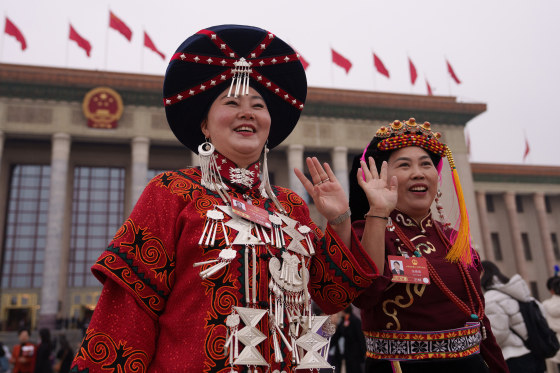
BEIJING — China is moving to approve a sweeping law to promote what it calls “ethnic unity,” a measure that critics say would further erode the rights of some minority groups as authorities cement a push toward assimilation.
The law, expected to be approved by the country’s ceremonial legislature Thursday, is designed to foster “a stronger sense of community among all ethnic groups in the Chinese nation,” said Lou Qinjian, a delegate to the National People’s Congress who introduced the proposal to the whole body.
The proposed law lays out the need to promote ethnic unity by all government bodies and private enterprises, including local governments and state-affiliated groups such as the All-China Women’s Federation.
“The people of each ethnic group, all organizations and groups of the country, armed forces, every Party and social organization, every company, must forge a common consciousness of the Chinese nation according to law and the constitution, and take the responsibility of building this consciousness,” it reads.
Academics and observers say the new provision represents a setback for the identity of ethnic minorities because it mandates the use of Mandarin Chinese in compulsory education, among other things.
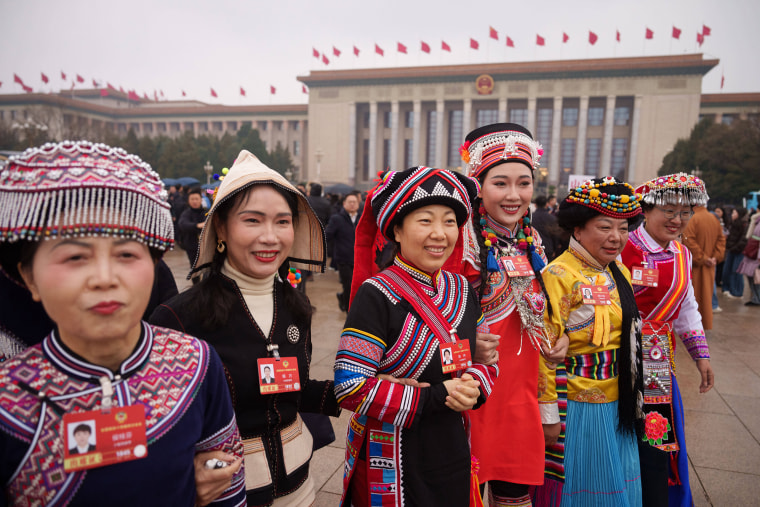
The majority of China’s population is Han Chinese and the official language is Mandarin. The country has 55 ethnic minority groups, making up 8.9% of the 1.4 billion population.
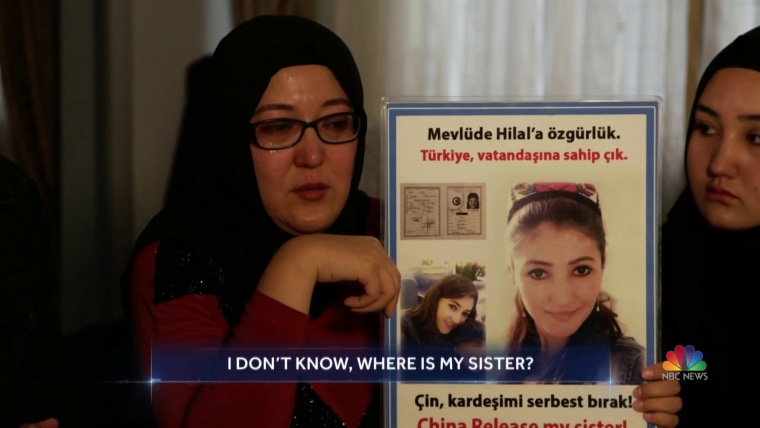
The constitution states that “each ethnicity has the right to use and develop their own language” and “the right to self-rule,” while the Law on Regional Ethnic Autonomy promises limited autonomy to those groups, including allowing them to create flexible measures to develop their economy.
Experts say that despite those provisions, the new law is likely to take priority in practice.
“It puts a death nail in the party’s original promise of meaningful autonomy,” said James Leibold, a professor at Australia’s LaTrobe University who has studied China’s changing policies toward its ethnic minorities. Leibold called the measure a capstone of Chinese President Xi Jinping’s “major rethink” of ethnic policies.
China’s United Front, which oversees ethnic minority policy, did not respond to a request for comment.
According to Article 15 in the new law, Mandarin Chinese is mandated to be taught to all children before kindergarten and throughout the rest of compulsory education up to the end of high school.
Mandarin is already the primary language of instruction in Inner Mongolia, Tibet and Xinjiang — Chinese regions with large ethnic minority populations — but the new law essentially states that minority languages cannot be the primary language of instruction nationwide.
Until recent years, ethnic minorities had some autonomy in what language could be used for teaching in schools.
In the past, students in Inner Mongolia, a Chinese autonomous region bordering Mongolia, could study large parts of the entire curriculum in Mongolian.
That changed in 2020, when new students found out their Mongolian language textbooks could no longer be used and they could only use Chinese textbooks. The policy change led to massive protests and an immediate crackdown, as well as later re-education campaigns, according to an essay co-written by Leibold and a Mongolian former journalist.
Students in the region can currently only study Mongolian as a foreign language class inside schools, one hour a day.
Scholars also note the mention of pushing for “mutually embedded community environments” in the law, which they say may result in the breakup of minority-heavy neighborhoods.
“The intention is to encourage Han and other minorities to migrate into each other’s communities,” said Minglang Zhou, a professor at the University of Maryland who has studied China’s bilingual policies.

