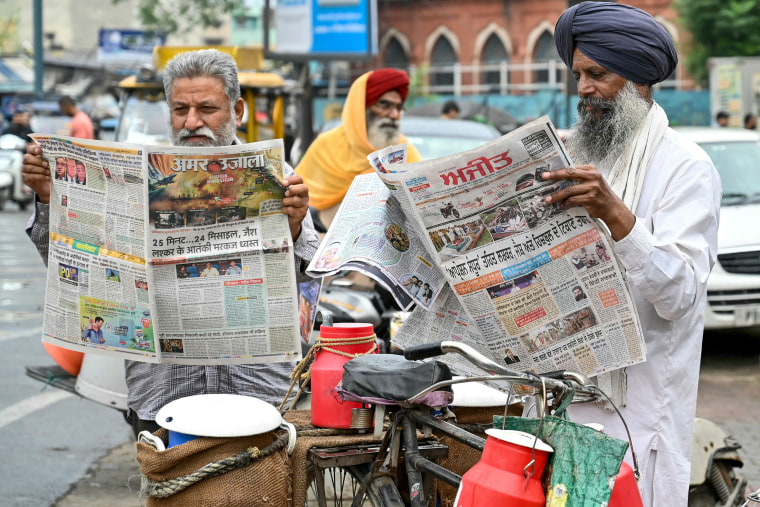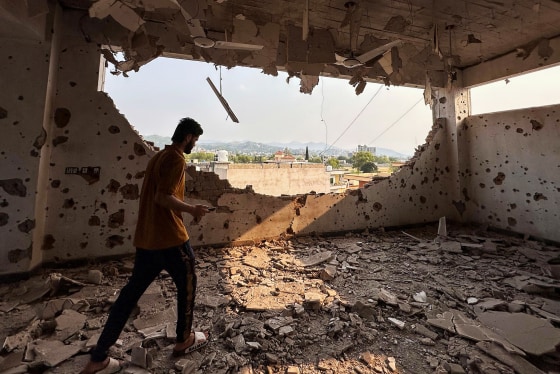
Pakistan’s military has vowed that India will “pay dearly” after its airstrikes on Wednesday left at least 31 people dead in Pakistan and Pakistan-administered Kashmir, raising fears of an all-out war between the nuclear-armed neighbors.
India says at least 16 Indian civilians, including three women and five children, have also been killed since Pakistan began shelling Wednesday across the two South Asian countries’ de facto border in the disputed Himalayan region of Kashmir. Exchange of live fire across the border also surged overnight.
Even as hostilities spilled into Thursday, both India and Pakistan emphasized that they had acted with restraint, and there are reports that security officials in both countries have started to open lines of communication. But in order to de-escalate, the two countries need international mediation and a way for both of them to declare victory, experts said.
New Delhi launched the strikes in response to an April 22 terrorist attack in Indian-administered Kashmir in which 26 people, mostly Indian tourists, were killed by militants India says were backed by Pakistan.
Pakistan, which denies involvement in the attack, has claimed partial victory in the Indian assault, saying it shot down five Indian fighter jets as well as 25 Indian drones. India has not confirmed those reports.
“Indian drones continue to be sent into Pakistan airspace,” military spokesperson Ahmed Sharif Chaudhry said Thursday, adding that India “will continue to pay dearly for this naked aggression.”
U.S. Consulate personnel in the Pakistani city of Lahore were told to shelter in place Thursday due to reports of drone explosions, downed drones and possible airspace incursions in the area.
Indian Foreign Minister S. Jaishankar said New Delhi has no intention to escalate the situation further, but that if Pakistan launches retaliatory strikes, they will be met with a “very, very firm” response.
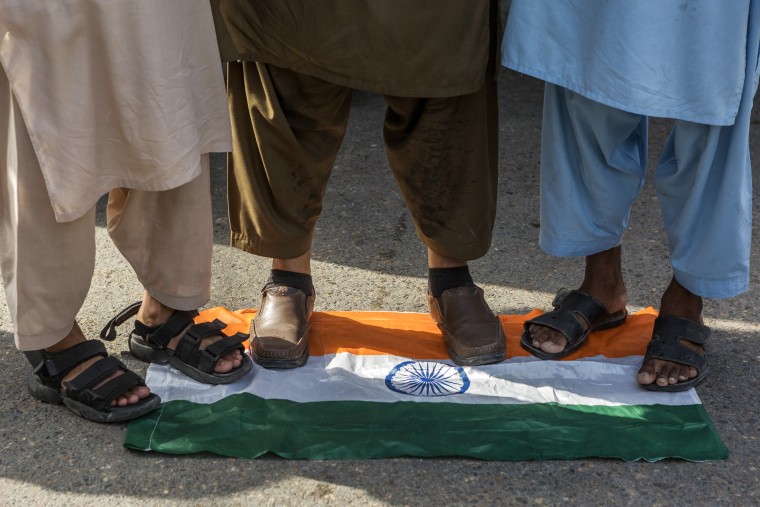
President Donald Trump, who has yet to nominate a U.S. ambassador to either India or Pakistan, said Wednesday that he wanted to “see them work it out.”
“They’ve gone tit for tat, so hopefully they can stop now,” he said.
Experts say whether the conflict between Hindu-majority India and Muslim-majority Pakistan spirals into the latest of several wars since the end of British colonial rule in 1947 depends on whether Pakistan can cast its response so far as sufficient and find a political off-ramp.
“The view in Pakistan is enough is enough,” said Moeed Yusuf, who served as Pakistan’s national security adviser from 2021 to 2022.
“There’s real anger in Pakistan that a nuclear country gets up, says there’s been a terrorist attack, and provides not even a shred of evidence to link it to Pakistan, and still goes ahead and uses military force,” said Yusuf, now a senior fellow at Harvard’s Belfer Center for Science and International Affairs.

The attack last month in Kashmir, which both India and Pakistan fully claim and partly control, was the worst of its kind on Indian civilians in two decades. India and Pakistan have fought three wars over Kashmir, the only Muslim-majority region in India, where tens of thousands of people have been killed in a decadeslong separatist insurgency.
India, which has long accused Pakistan of supporting cross-border terrorism, said it had “credible evidence” of Pakistan’s involvement in the Kashmir attack as well as intelligence suggesting that more attacks were coming, without publicly revealing details.
Islamabad denied the allegations and called on India to produce evidence.
Lt. Gen. Deependra Singh Hooda, former head of the Indian Army’s Northern Command, said “the ball is in Pakistan’s court.”
“The Indian perspective is, ‘Look, we’re tired of this,’” said Hooda, who was stationed in Jammu and Kashmir from 2012 to 2016.