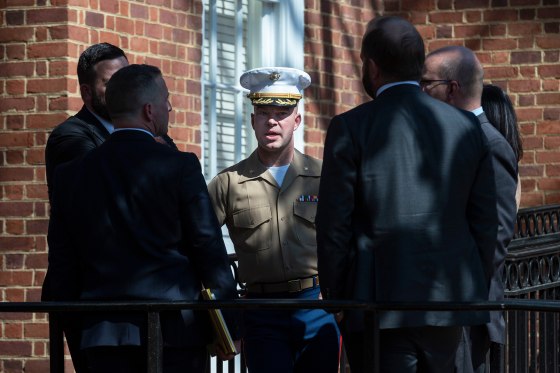
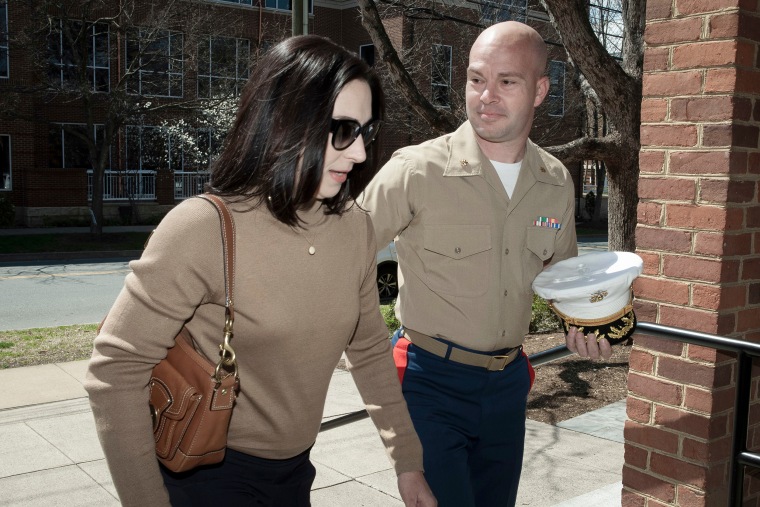
The Virginia Supreme Court ruled Thursday that a U.S. Marine and his wife will keep an Afghan orphan they brought home in defiance of a U.S. government decision to reunite her with her Afghan family. The decision most likely ends a bitter, yearslong legal battle over the girl’s fate.
In 2020, a judge in Fluvanna County, Virginia, granted Joshua and Stephanie Mast an adoption of the child, who was then 7,000 miles away in Afghanistan living with a family the Afghan government decided were her relatives.
Four justices on the Virginia Supreme Court on Thursday signed onto an opinion reversing two lower courts’ rulings that found the adoption was so flawed it was void from the moment it was issued.
The justices wrote that a Virginia law that cements adoption orders after six months bars the child’s Afghan relatives from challenging the court, no matter how flawed its orders and even if the adoption was obtained by fraud.
Three justices issued a scathing dissent, calling what happened in this court “wrong,” “cancerous” and “like a house built on a rotten foundation.”
An attorney for the Masts declined to comment, citing an order from the circuit court not to discuss the details of the case publicly. Lawyers representing the Afghan family said they were not yet prepared to comment.
The child was injured on the battlefield in Afghanistan in September 2019 when U.S. soldiers raided a rural compound. The child’s parents and siblings were killed. Soldiers brought her to a hospital at an American military base.
The raid was targeting terrorists who had come into Afghanistan from a neighboring country; some believed she was not Afghan and tried to make a case for bringing her to the U.S. But the State Department, under President Donald Trump’s first administration, insisted the U.S. was obligated under international law to work with the Afghan government and the International Committee of the Red Cross to unite the child with her closest surviving relatives.
The Afghan government determined she was Afghan and vetted a man who claimed to be her uncle. The U.S. government agreed and brought her to the family. The uncle chose to give her to his son and his new wife, who raised her for 18 months in Afghanistan.
Meanwhile, Mast and his wife convinced courts in rural Fluvanna County, Virginia, to grant them custody and then a series of adoption orders, continuing to claim she was the “stateless” daughter of foreign fighters.
Judge Richard Moore granted them a final adoption in December 2020. When the six-month statute of limitations ran out, the child was still in Afghanistan living with her relatives, who testified they had no idea a judge was giving the girl to another family. Mast contacted them through intermediaries and tried to get them to send the girl to the U.S. for medical treatment, but they refused to let her go alone.
When the U.S. military withdrew from Afghanistan in 2021 and the Taliban took over, the family agreed to leave and Mast worked his military contacts to get them on an evacuation flight. Mast then took the baby from them at a refugee resettlement center in Virginia, and they haven’t seen her since.
The AP agreed not to name the Afghan couple because they fear their families in Afghanistan might face retaliation from the Taliban. The circuit court issued a protective order shielding their identities.
The Afghans challenged the adoption, claiming the court had no authority over a foreign child and the adoption orders were based on Mast repeatedly misleading the judge.
The Virginia Supreme Court on Thursday wrote that the law prohibiting challenges to an adoption after six months is designed to create permanency, so a child is not bounced from one home to another. The only way to undercut it is to argue that a parent’s constitutional rights were violated.
The lower courts had found that the Afghan couple had a right to challenge the adoption because they were the girl’s “de facto” parents when they came to the United States.
Four of the Supreme Court judges — D. Arthur Kelsey, Stephen R. McCullough, Teresa M. Chafin and Wesley G. Russell Jr. — disagreed.
“We find no legal merit” in the argument that “that they were ‘de facto’ parents of the child and that no American court could constitutionally sever that relationship,” they wrote. They pointed to Fluvanna County Circuit Court Judge Richard Moore’s findings that the Afghan couple “are not and never were parents” of the child, because they had no order from an Afghan court and had not proven any biological relationship to her.