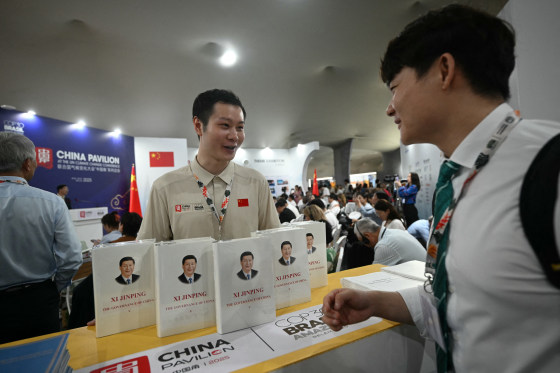
With the United States absent from the U.N. annual international climate summit for the first time in three decades, China is stepping into the limelight as a leader in the fight against global warming.
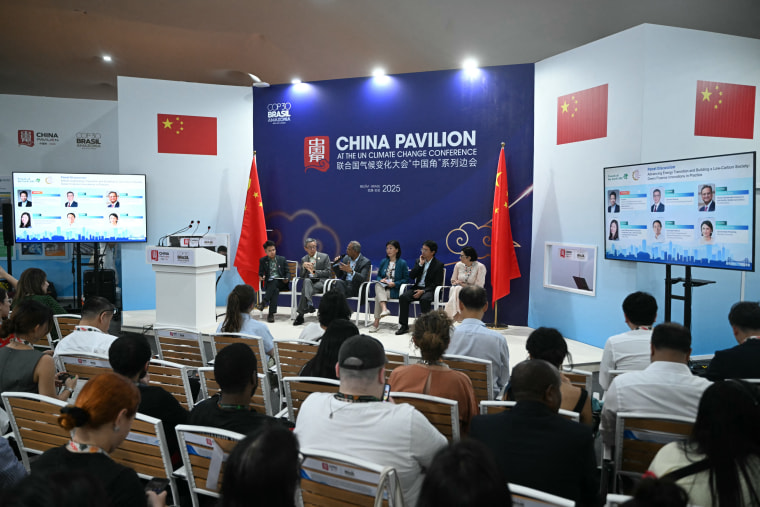
Its country pavilion dominates the entrance hall of the sprawling COP30 conference grounds in Brazil's Amazon city of Belem, executives from its biggest clean energy companies are presenting their visions for a green future to large audiences in English, and its diplomats are working behind the scenes to ensure constructive talks.
Those were Washington's roles, but they now reside with Beijing.
"Water flows to where there is space, and diplomacy often does the same," Francesco La Camera, director general at the International Renewable Energy Agency, told Reuters.
He said China's dominance in renewable energy and electric vehicles was bolstering its position in climate diplomacy.
China’s transformation from a quiet presence at the U.N.’s Conference of the Parties summits to a more central player seeking the world’s attention reflects a shift in the fight against global warming since U.S. President Donald Trump’s return to office.
Long a skeptic of climate change, Trump has again pulled the United States - the world's largest historic emitter - from the landmark international Paris Agreement to limit global warming. This year, for the first time ever, he declined to send an official high-level delegation to represent U.S. interests at the summit.
"President Trump will not jeopardize our country’s economic and national security to pursue vague climate goals that are killing other countries," White House spokeswoman Taylor Rogers told Reuters.
But critics warn the U.S. withdrawal from the process cedes valuable ground in the climate negotiations, particularly as China, currently the world's top greenhouse gas emitter, rapidly expands its renewable and EV industries.
"China gets it," said California Governor Gavin Newsom during a visit to the conference earlier this week. "America is toast competitively, if we don't wake up to what the hell they're doing in this space, on supply chains, how they're dominating manufacturing, how they’re flooding the zone."
Beautiful world
Unlike previous years, when China had a modest pavilion with just a handful of seats available for mostly technical and academic panels, its COP30 pavilion occupies prime space near the entrance next to host country Brazil.
Cups of sustainable Chinese single-origin coffee, panda toys and branded swag lure in passers-by who can watch presentations by Chinese officials and executives from the world's biggest renewable energy companies.
"Let's honor the legacy and fulfill the Paris guided by the vision of shared future," Meng Xiangfeng, vice president of China's CATL, the world's largest battery maker, told an audience on Thursday.
"Let's advance climate cooperation and build a clean, beautiful world together."
The battery giant already supplies one-third of batteries for EV makers including Tesla TSLA.O, Ford F.N and Volkswagen VOWG.DE. It was CATL's first time hosting an event at a COP, seeking to reach an audience of governments and NGOs.
Earlier that afternoon, China's vice minister of ecology Li Gao told a packed audience that China's status as the world's leading producer of renewable energy "brings benefits to countries, particularly in the Global South".
China's State Grid, the world's largest electric utility, and solar giants Trina and Longi also made presentations.
Chinese electric auto giant BYD introduced a fleet of plug-in hybrid vehicles compatible with biofuel manufactured at its plant in Bahia, Brazil, for use at COP30.

