BUDAPEST, Hungary — Facing tough odds in an upcoming election, Hungary’s pro-Russian prime minister is trying to convince voters that the greatest threat to the country is not economic stagnation — the focus of his top opponent — but neighboring Ukraine.
Viktor Orbán is running an aggressive media campaign replete with disinformation whose central message is that Hungarians should refuse to align with the rest of Europe in supporting Ukraine against Russia’s invasion. That path, he argues, risks bankrupting the country and getting its youth killed on the front lines.
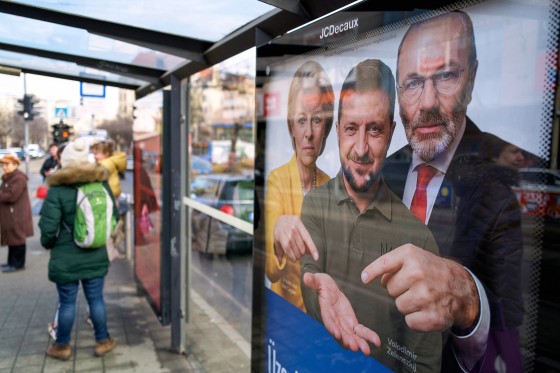
Billboards erected across the country show AI-generated images of Ukrainian President Volodymyr Zelenskyy flanked by European officials, holding out his hand as if demanding money. It’s a not-so-subtle reference to the European Union’s efforts to help Ukraine financially and bolster its defenses as the war enters its fifth year.
“Our message to Brussels: We won’t pay!” the publicly funded billboards read.
If there had been any doubt, it became clear on Monday why the outcome of Hungary’s upcoming election will reverberate beyond its borders. Hungary blocked a new package of E.U. sanctions on Russia in response to interruptions in Russian oil supplies that pass through Ukraine, and vowed to veto any further pro-Ukraine policies until oil flows resume.
Orbán is widely seen as the Kremlin’s strongest ally in the E.U. While almost all of the bloc’s other 26 nations have distanced themselves from Russia since it launched the war on Feb. 24, 2022, Hungary has deepened cooperation.
The prime minister has cast his relationship with Russian President Vladimir Putin as pragmatic, stemming from Hungary’s access to reliable supplies of Russian oil and gas. But Orbán’s anti-LGBTQ+ policies, crackdowns on the media and nongovernmental organizations, and his labeling of critics as “foreign agents” have led to accusations that he’s reading from Putin’s authoritarian playbook.
Campaign of fear
Orbán, who retook office in 2010, faces the strongest challenge to his power in an election set for April 12. The E.U.’s longest-serving leader and his right-wing Fidesz party are trailing in most independent polls to an upstart center-right challenger, Péter Magyar.
A 44-year-old lawyer and former Fidesz insider who broke with the party in 2024, Magyar has focused his campaign on stemming the rising costs of living, improving social services and reining in corruption. He also promises to restore Hungary’s Western orientation and bolster democratic institutions which have eroded during Orbán’s 16 years in power.
His rise was aided by political scandals that have damaged the credibility of Orbán’s party; a presidential pardon given to an accomplice in a child sexual abuse case led to a public outcry, prompting the president and justice minister to resign.
Losing ground to Magyar and his Tisza party, Orbán and Fidesz have sought to change the conversation. They have blanketed the country with taxpayer-funded billboards, as well as advertisements on radio, television and social media. A petition mailed to every Hungarian of voting age claimed the EU’s plans to help Ukraine financially would bring economic ruin.
Other ads, paid for by a shadowy pro-government organization with Fidesz ties, depict Magyar as a puppet of Zelenskyy and the EU who would sell out the country to foreign interests and draw Hungary into the war.
Hungary’s public media, along with many private news outlets loyal to Orbán’s government, faithfully mimic the claims. They say Ukraine wants to prolong the bloody conflict that has killed tens of thousands of its citizens — and is conspiring with the EU to do it.
Disinformation is fueled by artificial intelligence
Orbán has recently claimed that the E.U. — not Russia — poses the greatest threat to Hungary. He says rising defense spending across Europe — driven by Russia’s war and pressure from the U.S. to increase NATO contributions — is evidence that the E.U. is preparing for conflict with Moscow and plans to forcibly conscript Hungarians to fight.
In an AI-generated video Fidesz released on social media last week, a little girl asks her forlorn mother in Hungarian: “Mommy, when is daddy coming home?”
In the next frame, the fictional father — bound, blindfolded and kneeling on a muddy battlefield — is approached by a soldier, and shot in the head. “We won’t allow others to decide on the fates of our families,” a narrator says. “Let’s not take a risk. Fidesz is the safe choice.”
Although some E.U. countries have proposed sending troops to Ukraine to monitor any future ceasefire, they are not intended to engage in combat, and participation would be voluntary, said András Rácz, a Russia expert at the German Council on Foreign Relations.
Rácz notes that, despite the false premise behind many of Orbán’s claims, Fidesz has won two previous elections after raising fears that its political opponent would drag the country into the war.

