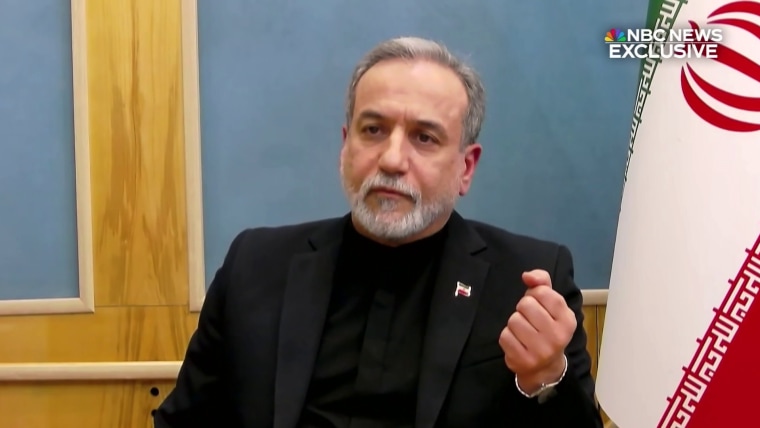
Iranian Foreign Minister Abbas Araghchi said Thursday that his country is ready for a ground invasion by American troops as the war launched by the United States and Israel has quickly spread across the region. He also refused any negotiations with the U.S. and said that Iran had not asked for a ceasefire.
Araghchi spoke with “NBC Nightly News" anchor Tom Llamas in a video interview from Tehran as U.S. and Israeli airstrikes continue to hit the country.
Watch “NBC Nightly News with Tom Llamas” tonight at 6:30 p.m. ET/5:30 p.m. CT. and read updates on this story at NBCNews.com.
His comments came after the U.S. and Israeli militaries began a sweeping attack on Iran on Saturday, which decimated its military defenses and killed its top authority, Supreme Leader Ayatollah Ali Khamenei.
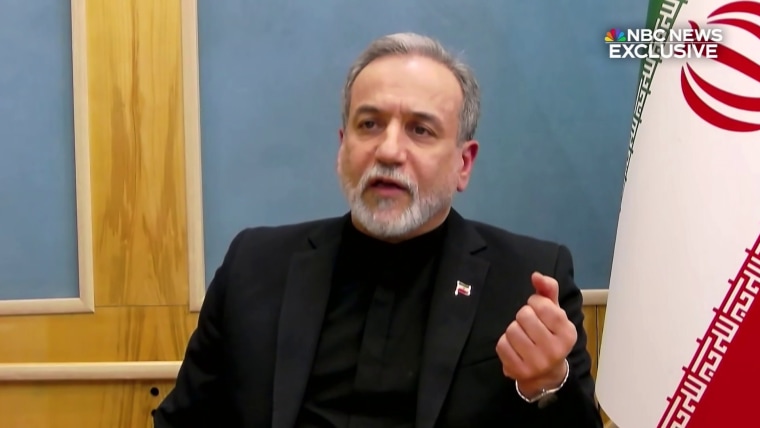
Asked if he was afraid of a possible U.S. ground invasion, Araghchi struck a defiant tone.
"No, we are waiting for them," he said and added, "Because we are confident that we can confront them, and that would be a big disaster for them."
Araghchi also said that Iran has not asked for a ceasefire, despite U.S. and Israeli strikes across the country.
"We didn’t ask for a ceasefire even last time. In previous time, it was Israel who asked for a ceasefire. They asked for an unconditional ceasefire after 12 days that we resisted against their aggression," he said, referring to the 12-day war last June when the Israeli and U.S. militaries targeted Iran's nuclear facilities.
Llamas asked about an attack on an elementary school in Minab that has killed dozens of schoolchildren, which the U.S. military said is being investigated, and questioned whether it could have been an errant Iranian military munition.
Araghchi said that 171 children were killed in the attack and that the American and Israeli militaries were responsible.
"This is what our military said. So it is either U.S. or Israel. What is the, what is the difference?"
Last Thursday, Araghchi was in a very different place, negotiating a possible deal with President Donald Trump's envoy Steve Witkoff and son-in-law Jared Kushner in Geneva.
The attack while the negotiations were ongoing has soured Iran on any future talks, Araghchi said, adding that he has had no communication with Witkoff or Kushner since last week.
"The fact is that we don’t have any positive experience of negotiating with the United States. You know, especially with this administration. We negotiated twice last year and this year, and then in the middle of negotiations, they attacked us," Araghchi said.
He added, "So we see no reason why we should engage once again with those who have, who are not honest in negotiation, and they don’t and do not enter into negotiation in good faith."
Araghchi had a grim outlook on the outcome of the current conflict.
"There is no winner in this war," he said. "Our win is to be able to resist against, you know, the illegal, you know, goals, and this is what we have done so far."
The killing of Khamenei has left a power vacuum in Iran, with rumors swirling that Mojtaba Khamenei, the former supreme leader's second son, could be chosen as his successor.
