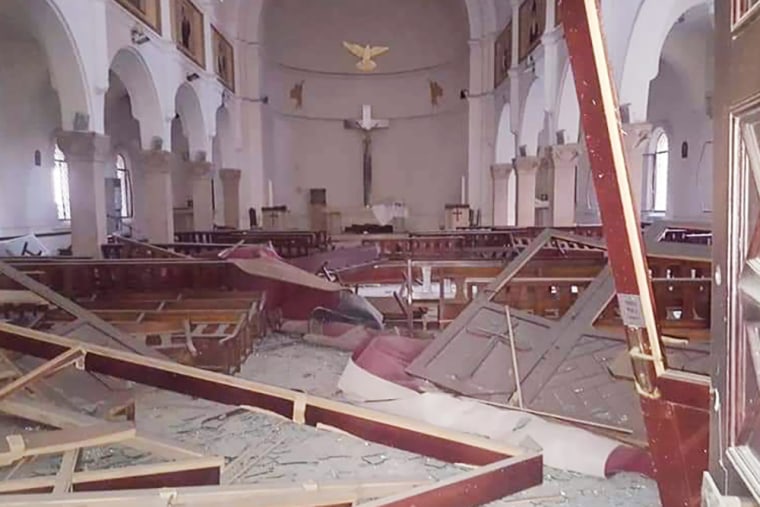
BEIRUT — Holy icons no longer witness Mass at St. Anthony of Padua Catholic Church in the Lebanese capital and there are no pews five years after an explosion in the main port sent a devastating shock wave through the city.
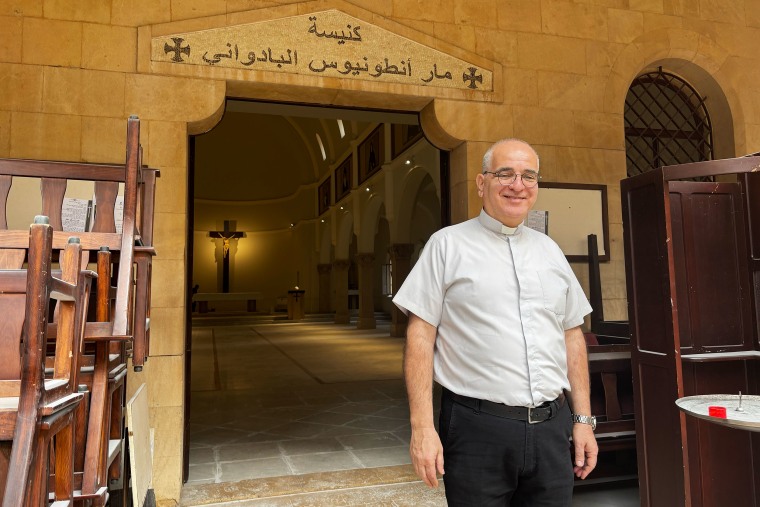
While new slabs of white marble have replaced the old floor and the walls are freshly painted, the Rev. Miled Abboud is hopeful that Pope Leo XIV’s visit to the blast site Tuesday will highlight the amount of rebuilding that still needs to be done. He also believes Leo's visit will bring “a message of hope” and reconciliation between Lebanon’s diverse Christian communities — a large number of whom have left in recent years — and coexistence with the majority Muslim population.
“The pope’s visit is a sign of hope,” Abboud told NBC News on Saturday. “There are a lot of bleak things, of things that make us despair, but we have Christ who gives us strength to carry on.”
Abboud, who said he had only been a priest at this Maronite church for a few months, added that he hoped to restore it to its former glory to inspire the local community, although many younger members of his congregation have left the city or country altogether, largely because of the dire economy.
“The majority of young people have moved to other regions or to the Gulf, to Europe, to France, because we have a lot of French universities here, so once they finish their studies, people move to France,” he said.
Many of them took the decision to leave in the aftermath of the massive August 2020 port explosion, which tore through Beirut after hundreds of tons of ammonium nitrate detonated in a warehouse, according to Paul Salem, a senior fellow at the Middle East Institute, a Washington-based think tank.
In total, 218 people were killed and 7,000 others wounded by the blast which devastated large swaths of the city, causing billions of dollars in damages.
Much of the destruction was in “majority Christian neighborhoods of east Beirut,” Salem said in a series of voice notes Monday. For some it was “the last straw,” he added.
As much as people loved their homeland, he said, the explosion “traumatized so many” in the country, which was already reeling from an economic collapse and struggling to cope with an influx of around 1.5 million refugees who crossed into Lebanon as civil war-ravaged neighboring Syria. Some have returned to their country since the overthrow of Syrian President Bashar al-Assad last year.
Pointing out that members of Christian populations have a long history of migration “from the Middle East to the West from the 19th century,” Salem said “they were attracted to and feel comfortable going to the West, which is generally Christian.”
But, he said, both Christians and Muslims had left during the civil war which wracked the country between 1975 and 1990 and the war with Israel in 2006.
After the economic collapse, he said, “there weren’t great jobs in Lebanon but there were in Dubai, Abu Dhabi or Riyadh or further afield in Canada or the U.S.” Others had left to pursue higher education in the West, he added.
More recently, the country has been rocked by the spillover of Israel's war in Gaza and also the war between Israel and the Lebanese Shia Muslim militant group Hezbollah until a fragile ceasefire was brokered around a year ago.
But just a week before Leo landed in Beirut, an Israeli airstrike on the city killed Haytham Ali Tabatabai, a senior Hezbollah commander, and four other people, while injuring 28 more.
Elsewhere, some Syrian Christians have left their country amid concerns about the new government under interim President Ahmad al-Sharaa, former leader of the Islamist insurgent group Hayat Tahrir al-Sham. In June, an unprecedented terrorist attack in Damascus on the Greek Orthodox Mar Elias Church during Mass killed at least 30 people and injured 54.
Large numbers had already fled the country, as well as neighboring Iraq, after the Islamic State militant group, or ISIS, declared a caliphate.
In Gaza, the small surviving Christian community has seen churches shelled and worshippers killed during Israel’s war with Hamas, while in the occupied West Bank, Christian communities have been targeted by Israeli settlers and the economy has suffered as tourists' numbers have dropped dramatically.
While Lebanese Christians have lived in relative peace in the Muslim-majority country, the country’s dire economic situation has led many to seek a new life abroad.