Young people in Taiwan are used to living with uncertainty when it comes to China — a situation they generally say is for the best for the time being, particularly when recent actions by the Trump administration have some of them asking a certain question.
“Can Taiwan continue to view the U.S. as an ally?” said Chan Yu-hsiang, 25, a graduate student at National Taiwan University.
Chan’s question reflects growing concern in Taiwan over the reliability of the U.S. as a security partner under President Donald Trump, who has expressed support for the Beijing-claimed island in the face of Chinese military threats but also made critical remarks and upended trade relations.
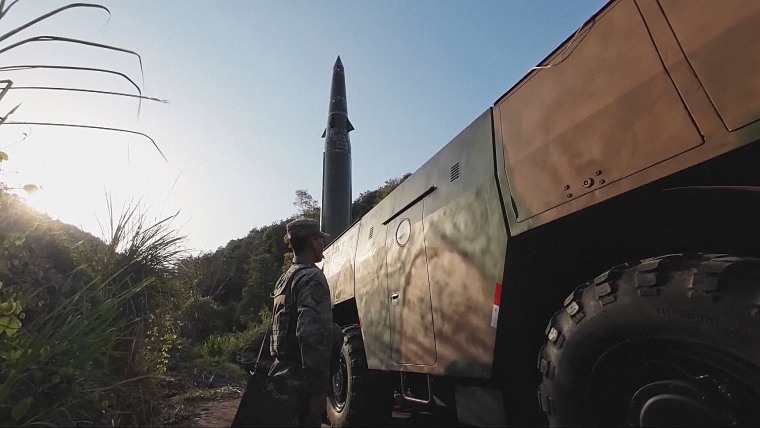
In a Taiwan government poll released in March, the percentage of respondents who said the U.S. military would “definitely” intervene in the event of a Chinese invasion dropped to 14% from 19% a year earlier. Almost half of respondents said the U.S. military was unlikely to intervene, the same as a poll by the Brookings Institution conducted the same month.
According to the same Taiwan government poll, 36% of respondents said U.S.-Taiwan relations would get worse under Trump, a 12% increase since January.
Taiwan’s rising wariness toward the U.S. comes amid growing pressure from China, which claims the self-governing democracy as its own territory and has not ruled out the use of force in achieving its unification goal. Beijing sends warplanes and ships toward the island on near-daily sorties.
Last month, the Chinese military conducted large-scale drills around Taiwan in what it said was a warning to “separatist” forces. The Taiwan government has warned that Beijing could hold more drills in the coming days as the island marks one year under President Lai Ching-te, whom China describes as a “separatist” and “troublemaker.”
China has rebuffed multiple offers of talks from Lai, who says only Taiwan’s 23 million people can decide its future. Beijing insists the island’s future is “by no means an ‘internal affair of Taiwan,’” warning that Taiwanese authorities would “suffer an apocalypse” if they sought formal independence.
Strategic ambiguity
The U.S. has no formal relations with Taiwan but is its most important international backer, bound by law to provide it with defensive weapons. On Monday, Taiwan test-fired for the first time a new rocket system provided by the U.S. that Ukraine has also used against Russia.
Washington has long maintained a policy of “strategic ambiguity” when it comes to whether the U.S. military would defend Taiwan against a Chinese attack, not giving a definitive answer either way.
Trump has not given any indication of a change in that policy. But he has unnerved Taiwan with comments accusing it of stealing semiconductor business from the U.S. and calling for Taiwan to pay more for its own defense, which it has pledged to do.
Last month, he also slapped Taiwan with a 32% tariff on its goods, with an exemption for the chip industry, which makes up a big part of the Taiwan economy and which the U.S. relies on heavily.
Taiwan has said it will not retaliate against the U.S. and that it is ready for trade talks “at any time,” offering a package of zero tariffs on American goods and increased U.S. investment.
The duties came as a surprise to Taiwan after state-backed chipmaker TSMC announced a plan in March to invest an additional $100 million in the U.S., where it is already building multiple factories.
For Chan, this suggested that even Taiwan’s “silicon shield” — the semiconductor industry that makes the island so indispensable to the global economy — is not enough to guarantee U.S. support.
“If you keep giving away Taiwan’s last line of defense, the U.S. will take advantage of it, but they won’t necessarily treat you well,” he said.
“Why would Taiwan still believe that Trump would definitely deploy troops if it was to fall?”
Maintaining the status quo
Though some U.S. officials and Taiwan’s military point to 2027 — the 100th anniversary of the founding of China’s People’s Liberation Army — as a possible timeline for China to attack, polls show that most Taiwanese believe an invasion is unlikely in the next five years.
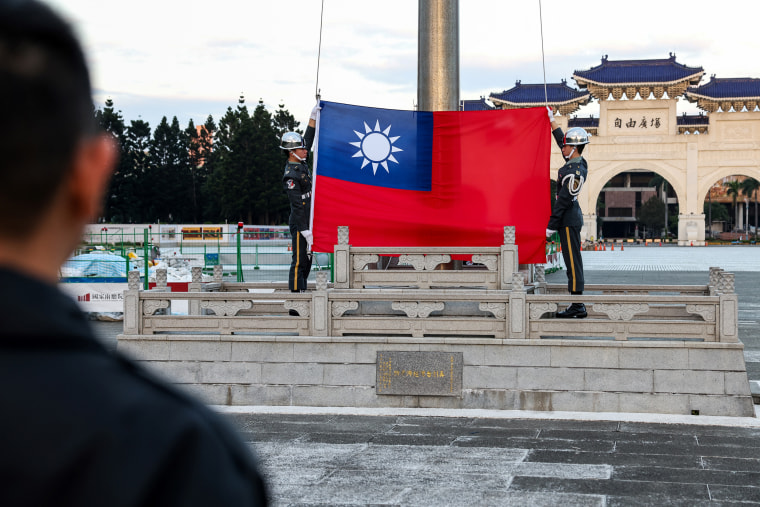
A survey last year by National Chengchi University in Taipei showed that over 88% of people in Taiwan support maintaining the status quo, in which Taiwan operates as a de facto independent country without formally declaring independence, a move that would risk all-out war with China.