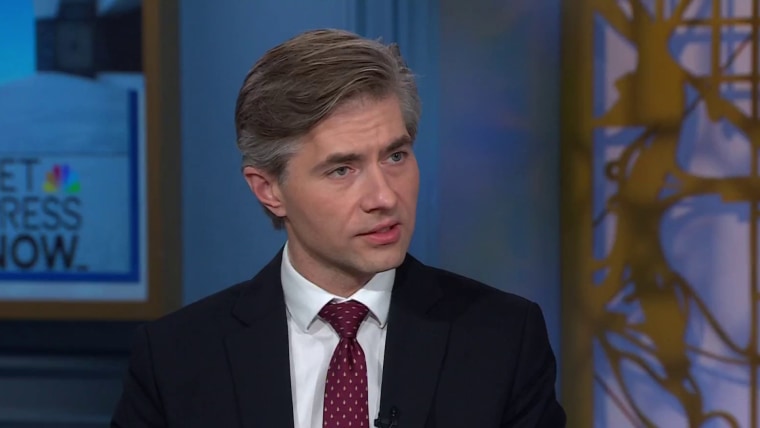
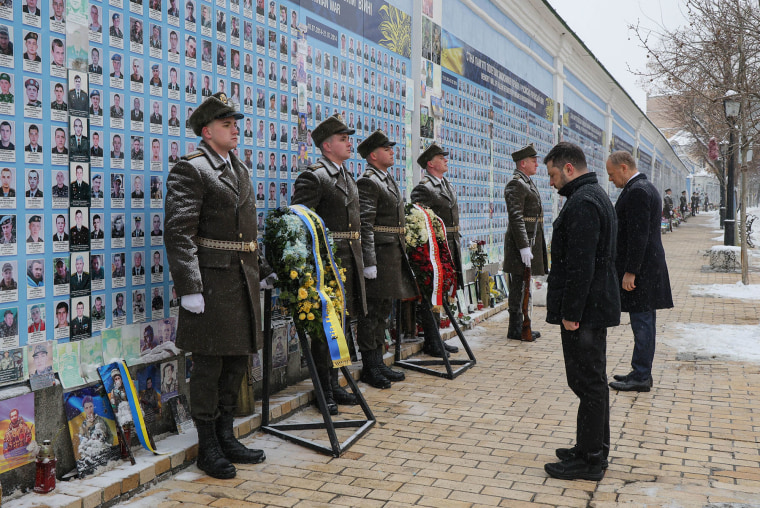
More than 50,000 Ukrainian soldiers have been killed fighting Russian troops, President Volodymyr Zelenskyy said, acknowledging the conflict's devastating toll as negotiators in Abu Dhabi wrapped up the latest round of peace talks.
In addition to 55,000 troops dying in the four-year-old war, a “large number of people” are considered officially missing, Zelenskyy told France 2 TV on Wednesday. In February 2025, he said more than 46,000 Ukrainian servicemen had been killed on the battlefield.
Russia and Ukraine usually don't regularly report the number of their war dead, wounded or missing, but a recent analysis revealed a staggering battlefield toll since 2022: nearly 500,000 dead and 1.5 million wounded or missing on both sides. The report by the Washington-based Center for Strategic and International Studies think tank put the number of Russian soldiers killed at 325,000, with up to 140,000 deaths on the Ukrainian side.
Russian, Ukrainian and American negotiating teams concluded a second day of talks in Abu Dhabi, United Arab Emirates, on Thursday. On Wednesday, Ukraine's top negotiator Rustem Umerov said the talks have been “substantive and productive.”
President Donald Trump’s special envoy, Steve Witkoff, who was taking part in the talks, announced an exchange of 314 prisoners in a post on X. “This outcome was achieved from peace talks that have been detailed and productive,” he said.
Witkoff said the delegations agreed to “report back to their respective capitals and to continue trilateral discussions in the coming weeks,” while Zelenskyy said in his nightly address on Thursday that “further meetings are planned in the near future, likely in the United States.”
The U.S. and Russia have meanwhile agreed to reopen a channel of communication for “high level military-to-military dialogue” for the first time since 2021 following the meeting, he said.
The hotline “provides a means for increased transparency and de-escalation,” the U.S. European Command said in a statement.
Kyiv is trying to hammer out concessions from Russia and iron-clad security guarantees from its allies to end the war as it manages Trump's hot-and-cold attitude toward supporting Ukraine. Meanwhile, Russia is pounding Ukrainian cities, leaving hundreds of thousands of people in the dark and cold as temperatures plummet.
In his address on Thursday, Zelenskyy said Ukraine is “ready for all working formats that can truly bring peace closer,” adding: “It is crucial that this war ends in a way that leaves Russia with no reward for its aggression. This is one of the key principles that restore and guarantee real security. I thank all our partners who support us in this.”
The first trilateral talks in Abu Dhabi took place last month but did not produce major breakthroughs. Trump has still sounded optimistic about reaching a deal he has been trying to broker since returning to the White House last year.
“I think we’re doing very well with Ukraine and Russia,” Trump said Monday.
The negotiations are deadlocked over the issue of the eastern Donbas region, which Russian President Vladimir Putin has said he wants to take in its entirety, even though Kyiv still partially controls it. Zelenskyy has refused to cede those territories voluntarily.
Ukraine also wants strong security guarantees from the West, which despite promises from its allies, including Washington, have not been formalized yet.
According to Estonian President Alar Karis, Putin has shown no sign that he is willing to “start real negotiations.”
Karis told NBC News that Estonia opposed territorial concessions, but the issue was ultimately up to Ukraine.
“Ukrainian people are dying, not only in battles, but also in Kyiv and in some other places, civilians, children,” he said during a sit-down interview in Dubai. “So you have to find a balance at some point, either to give temporarily some land away and stop this war.”
Estonia shares a border with Russia and is a member of NATO. Since the invasion of Ukraine in 2022, the Baltic states have overwhelmingly supported Kyiv’s fight amid fears that if Putin is not contained in Ukraine, he could expand his conquest of neighboring states further west.


