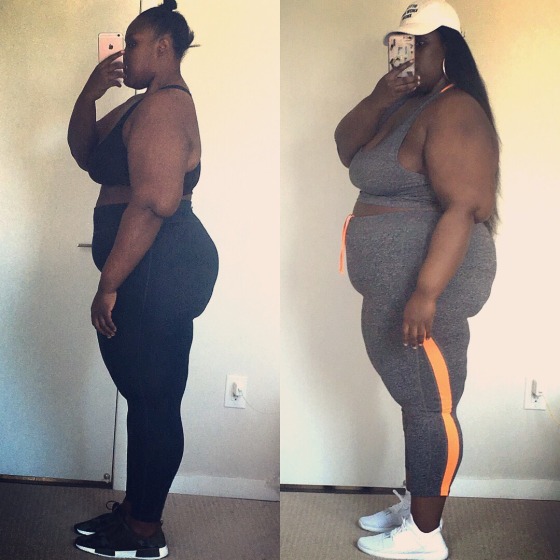
At 337 lbs, health and beauty influencer Janielle Wright was afraid she would die. Her body was in pain and she had trouble breathing at night.
“I was going to sleep worried that I wouldn’t wake up the next morning,” Wright told NBC News BETTER.
She was also afraid that she wouldn’t live to see her 3-year-old daughter, Novah, grow up. That was when Wright, 28, realized something had to change.
“This is no way to live thinking you’re going to die because you’re overweight and you’re unhealthy,” she says.
Intermittent fasting is a time-restricted eating method where you only allow yourself to eat within a certain window of time.
In January, Wright began her weight-loss journey through intermittent fasting. It’s a time-restricted eating method where you only allow yourself to eat within a certain window of time. Wright says the method helped her lose 65 pounds so far.
“I just prayed and asked that [God] could see me through this journey, and could be consistent and be patient, because I feel that patience is key when it comes to weight loss,” recalls Wright.
How it works
Research suggests that weight loss is impacted by when we eat as much as by what we eat, which means intermittent fasting may help spur metabolism. There are several different methods for intermittent fasting, some of which are more restrictive than others. Wright recommends starting out with a less restrictive regime until your body is accustomed to it.
Wright began intermittent fasting with the 16:8 method, which required her to eat within an 8-hour window and fast for 16 hours. She cut out breakfast, she says, and ate just two meals a day — the first at 12 p.m., and the last meal around 8 p.m.
“I was only eating lunch and dinner, and it’s meant for you not to snack too,” Wright explains.
She says she stuck to low-carb meals, and limited her calories to between 1,800 and 2,000 calories a day. She tracked her calories on the MyFitnessPal app.
Related

Other intermittent fasting diets take a different approach. The 5:2 method, for example, requires you to eat as you normally would for five days a week, but on two nonconsecutive days, you eat just one meal a day. Wright says she spent five months conditioning her body to the 16:8 method. At that point, she says, she switched to the 20:4 method. According to this method, you fast for 20 hours and have a 4-hour eating window.
“I wanted a change,” says Wright. “I wanted to try to boost my weight loss even more.”
Wright says you should be cautious about using a more restrictive method like the 20:4. Condition your body on a less restrictive method for an extended period first, she says. Since the window of time for eating on the 20:4 method is small, Wright says you should be careful to space your meals apart and not eat all your calories in one sitting.
“I’ll maybe take like 30 minutes to digest some of that food,” she says, “and then I’ll go and eat the rest.”
Make sure you eat healthy
One thing Wright enjoys most about intermittent fasting is that you decide what kind of foods you want to eat (she prefers a low-carb diet). But she warns against junk food.
“It’s definitely important to eat nutritious food when you’re on the diet,” she says. “I feel like if I was doing intermittent fasting just eating pizza and burgers and fries, I feel like I wouldn’t have had the amount of success I have right now.”
She says it’s important to consume all the macros your body needs — proteins, fats and carbs — and to have nutritiously diverse meals
“I’ll have egg whites and spinach, and I’ll have some carrots fruit on the side ... [or] I’ll have maybe a chicken breast with some quinoa on the side,” Wright says.
Allow yourself up to three cheat meals a month
Fasting for long periods of time can become tedious. That’s why Wright lets herself have three cheat meals a month. Whether it’s nachos, Chinese food or a Subway sandwich, cheat meals help her stay balanced, she says. But she warns not to overdo it.
“Once I’m done with my cheat meal I move on,” says Wright.
Exercise consistently
Wright incorporates exercise into her weight loss routine, working out out six days a week. Since she had a lot of weight to lose in the beginning, she was careful not to push herself too hard at first — just a brisk 15-minute walk on the treadmill each day.
“But as I got more comfortable with walking on the treadmill, I upped my time and I upped my speed and my incline,” she says.
After seven months, Wright now walks on the treadmill about 45 minutes a day. She includes high inclines and keeps at “a really brisk [pace].” Afterwards, she does about 30 minutes of high-intensity interval training.
Intermittent fasting teaches discipline
Wright says intermittent fasting is effective because it taught her self control. Since the rule required her to stop eating at 8 p.m., it prevented her from snacking before bed.

