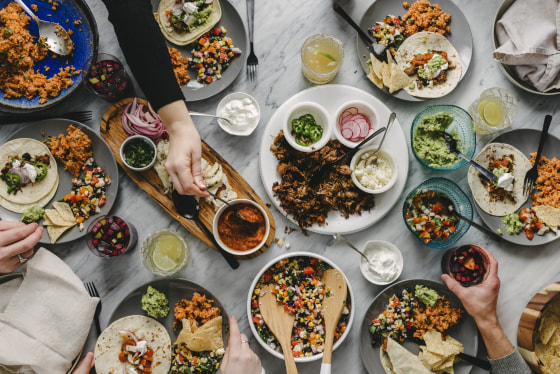
So you're throwing a dinner party. It seemed like such a great idea when you thought of it: friends, food, drinks, what could go wrong? Then you started thinking about what this will actually entail and you're completely overwhelmed. How bad would it be to just order pizza delivered or call it off altogether?
Before you enter full panic mode, take a deep breath and read on for some tips from experienced pros. Toby Amidor, RD, and best-selling cookbook author; food writer Phoebe Lapin, a gluten free chef and author of the Wellness Project; and James Beard award winning chef and author Virginia Willis, talked with NBC News BETTER to share their secrets to successful — and as low-stress as is humanly possible — dinner parties. Here's how to plan, prepare for, and navigate the big night.
Step 1: Making a Plan
Determine the crowd size
First up, you'll need to know how many guests you can accommodate. Is your kitchen small, or your dish collection not up to a large crowd, but you have a ton of friends you want to invite? Lapin says there's no reason to fret about this. “Just invite as many as you want,” she said. (If you think you don't have enough space, check out the original supper club from Jim Haynes in Paris; the host packs dozens — dozens! — of people into his miniscule apartment and nobody minds.)
The key is you'll go more casual the larger the number of guests. If you're having a seated meal the math is easy — number of chairs equals number of guests.
However, she said, “you don't want to be somewhere in between. If you have chairs for 10, you don't want to invite 13 — you gotta go big or meet your table parameters.” And forget about your dish cabinet inventory. “With plateware if worst comes to worst you can always buy fancy disposable.”
Choose a format
Knowing how many are coming and what you're serving will help you decide how to serve. If it's a larger group with varied diets, “there are beautiful buffet menus you can make,” Lapin said. “Many times I've thrown chili parties with like 30+ people and you just need two cauldrons full of chili — [one] veggie and [one] not. Have apps spread around the house and a salad, and cornbread and lots of toppings.
”For a sit-down dinner, think a large, slow-roasted protein, and at least another main, plus of course a slew of sides. “Centerpieces like big pieces of meat cooked low and slow over time are great options,” Lapin said. “I love a big roasted pork shoulder that I'll just shred last minute in front of people — their mouths water. Or a big roast I'll carve at the last second.”
Related

How much do you need? Though dietary guidelines are four ounces of meat per person, you should always count on leftovers, Amidor said, that you can use to meal prep or freeze. “When I do Thanksgiving I try offer a pound of meat per person.” At non-major holiday dinners, like Super Bowl Sunday, where stuffing oneself is a competitive sport, if you're taking about something like a roast “six ounces is generous depending on how many courses,” Willis said. Keep in mind though, to get six ounces cooked, you'll start closer to eight ounces raw, so think one pound for every two people.”
Taco bars take the guesswork out of party planning
A taco bar was popular as a party solution among our experts. Willis likes to do “supercasual” off-the-stove buffets with tacos and Lapin seconded that. “I do a lot of taco nights and burrito bars that involve sides and accoutrements that can be mixed and matched so any restriction can be accommodated,” Lapin said. “Especially with fillings — a quinoa side can be a main for vegetarian.” This approach also lets you delegate, she said. Ask someone to bring chips and salsa, and “if someone doesn't want to cook they can go to the Mexican place on the way there.”
Go for tried-and-true recipes
Yes, it's tempting to read up on fun new recipes to try out for a party, but resist this urge, Willis said, especially if it's not from a source you know well. I was happy to have taken her advice when we recently hosted friends who are newly vegan. I found a recipe for vegan chocolate pot de crème online from a new-to-me blog and whipped up a test batch the night before. It was a definite no-go. Fortunately I still had time to tweak it and make a new batch the next day that was a winner. Moral of the story: stick with your tried and true.
Do the math on beverages
If your friends enjoy the occasional adult beverage, a trip to the liquor store is in order. How much should you buy? Not to be a buzzkill, but think responsibility here. “If they're driving home, as the host you have to be responsible,” Amidor said. “You don't want to have people drinking and driving.” Even if they're Ubering or walking, do you want them to blame you tomorrow for a hangover? So on the safe side, plan on about two drinks per person, said Amidor.
Now, “if you're going to have a proper adult dinner party usually it's like one to two cocktails before dinner, and wine with dinner,” Willis said. A bottle of wine has about five glasses (or four at my house), so crunch some numbers based on how boozy your friends will get with the meal, and keep things simple before dinner by batching cocktails.
And of course “we always always have a non-alcoholic option,” Willis said. That might be a blueberry lemonade in the summer (that guests can add vodka to if they like.) In fall or winter, warm apple cider can be mulled. “It's sort of festive.” And you can always add bourbon.
Guests may not be drinking alcohol for any number of reasons, and if they're skipping the adult beverages it doesn't mean they should be stuck with the last case of LaCroix you picked up at Costco.
Amidor likes to serve mocktails in pretty glasses, or even something simple like mulled apple cider or cranberry and orange juice, with fresh mint.
Get dietary restrictions and other challenges out of the way early
Whether it's deluxe or super casual, “the whole goal of a dinner party is hospitality,” Willis said. And that means making people comfortable, whether that's finding out if they're allergic to your adorable dogs, or have any intense dislikes.
“After deciding on guest list, the first thing to do is ask people for dietary restrictions because there are so many these days,” Lapin said. “In this day and age ... it's not uncommon to have pescatarian and gluten-free and dairy free [all at the same dinner.] I feel like it makes guests who have restrictions feel more comfortable so they're not worried about making the ask themselves — you put them at ease.”
Step 2: Organizing and prepping for your party
Put pen to paper
Once you have your guest count, party format, and menu in mind, get out your pen and paper. “I know there are apps but you need to look at each of your recipes,” Amidor said. “You need to sit in your kitchen and look in pantry — you don't want to overbuy and end up with three paprikas.” To save yourself some time, and maybe even a repeat trip to the store, she said, “make your shopping list in order of the flow of supermarket.”
Don't wait until the day of
The last thing you want is to be scurrying around frantically as your guests arrive. “When you go to a restaurant all of the prep isn't started the minute you walk in,” Willis said. “The bartender isn't squeezing the juice for you when you order the drink. The chef isn't chopping the herbs right then.” Take your cue from these professionals and get as much work done in advance as you can. Because this last-minute stuff will frazzle you, and “If the host isn't having fun no one's having fun,” she said.
With that pen and paper, “list for yourself, 'what can I make and freeze?'” Amidor said. “'What can I store in fridge for a few days, and what do I need to make night before?'” Even for the more last-minute things, can you get your mise en place, the chopping, cutting, and measuring, done?
“Anything you can freeze, you can do up to two months in advance,” she said. Come party week, “salad dressings last five days to a week,” she said. “Throughout the week make small things, and make salads the day of.”
“Anything with roasted vegetables, those can be pre-roasted and if you really want it hot tossed back in the oven right before,” Lapin added. “Soups, stews, casseroles are great make-ahead things. There are very few things that can't be made in advance.”
To help expedite things when you do get down to the last minute crunch, “I encourage people to pull out their serviceware and platters and all that [ahead of time],” Willis said. Add a sticky note to the bowl for the Brussels sprouts (or whatever) “so your partner or whoever helping, when you 'honey say go get the Brussels sprouts bowl,' honey knows what that is.”
Delegate, delegate, delegate
Inevitably, your guests will ask if they can help — don't feel bad asking for or accepting it. Even though Lapin does this for a living and has things under control when she's hosting, “I've noticed that people really want to bring something,” she said. “I remind myself it's not a burden [on them], it's a generosity thing, a way to let them feel like they're contributing.” So make the most of it, she said. “People genuinely want to bring something and if you don't specify it will be wine — which is fine and also great, but usually you don't need a bottle per person, so you may as well help them bring something useful.”

