
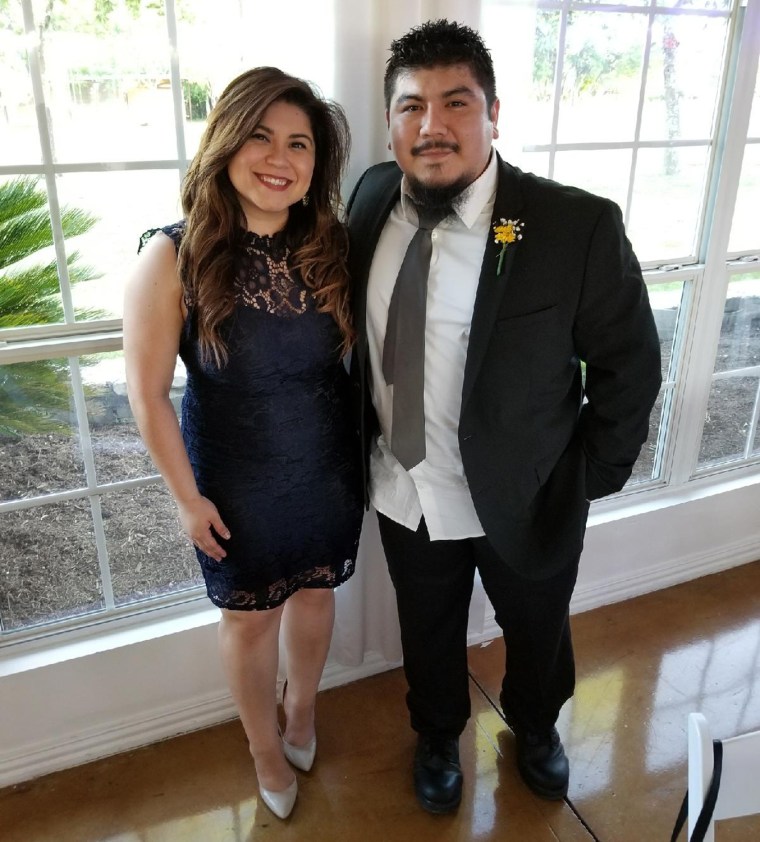
SAN ANTONIO — Ray Cisneros never wanted to be a husband or a dad, but three years ago he fell in love, married and became a stepfather.
To give his new family a better life, Ray took steps to start his own graphic design business. He had planned for quality family time in 2020, including taking the kids to baseball games with his sister Tina.
Instead, 2020 is the year Covid-19 killed Ray. He was 35 years old when he died July 27. The coronavirus also killed his aunt and grandfather.
"Within a matter of three weeks, we lost all of them," Tina Cisneros said. "It's hard to comprehend sometimes that all of this has happened."
Covid-19 has snaked through the lives of Latinos for the larger part of a year, striking with its poison, maiming and killing.
The Cisneroses' grief, their stress and depression, the economic clubbing of Ray's family and the fallout for his children are multiplied many times over in many families.
As of Dec. 23, Covid-19 had killed more than 54,000 Latinos, according to the Centers for Disease Control and Prevention'sCOVID Tracking Project, which acknowledges that its numbers are incomplete.

The coronavirus exploited many Latinos' long-standing gaps compared to white Americans in income, education and access to health care — including fewer doctors' visits to treat diabetes, hypertension and higher rates of obesity while having less savings and lower wealth, as well as limited business capital.
It thrived on many Latinos' employment in jobs that can't be done from home, as well as language barriers for some.
"The only state where Latinos are not overrepresented in cases and casualties is in New Mexico, and that is because Native Americans have been hammered," said Gabriel Sanchez, director of the University of New Mexico Center for Social Policy, earlier this month. By late December, Latinos in New Mexico, who are 49 percent of the population, made up 55 percent of the coronavirus cases and 37 percent of deaths, according to Johns Hopkins University and Medicine's tracking.
Exploiting the gaps, Covid-19 ripped up the foundations of family and work and toppled what progress many Hispanics had made toward better economic standing.
A mortal strike on younger Latinos
"It has been a hellish, hellish year," said Rogelio Sáenz, professor of demography at University of Texas at San Antonio, who helped paint the true picture of the destruction Covid-19 was wreaking that was later borne out by CDC numbers.
"Once you adjusted for age, you really see clearly that Latinos were dying at rates more than three times as high as the white population," Sáenz said. "Texas continues to be the only state where more than half of the people who have died from Covid are Latino."
An even more shocking truth is that Covid-19 has killed greater shares of the youngest members of the Latino population than other groups, according to states' race and ethnicity numbers.
Latinos have the greatest share of deaths in age groups under 54, according to CDC data, while among whites, the greatest share of deaths has occurred in age groups over 65.
Among Americans in Ray Cisneros' age group, 35 to 44, almost half (48.9 percent) of those who died were Latino, compared to 27.3 percent of Black people and 15.5 percent of whites, according to an analysis of 226,240 deaths using CDC data.
By contrast, in the 65-74 age group, 45.3 percent killed by Covid-19 were white, 24.7 percent were Black and 23.1 percent were Latino.
The horror of Covid-19's snatching young and working-age adults was vivid early in the pandemic, as meat plant workers, whose safety has been a problem for decades, became ill and died, forcing a recognition that Latinos were overrepresented in "essential" jobs in service industries, farm work, grocery stores and more.
Economic, educational gains — then Covid
The deaths and cases catapulted many Latinos backward from what had been better times.


