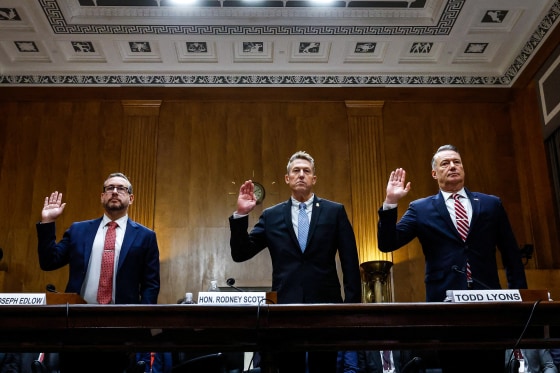
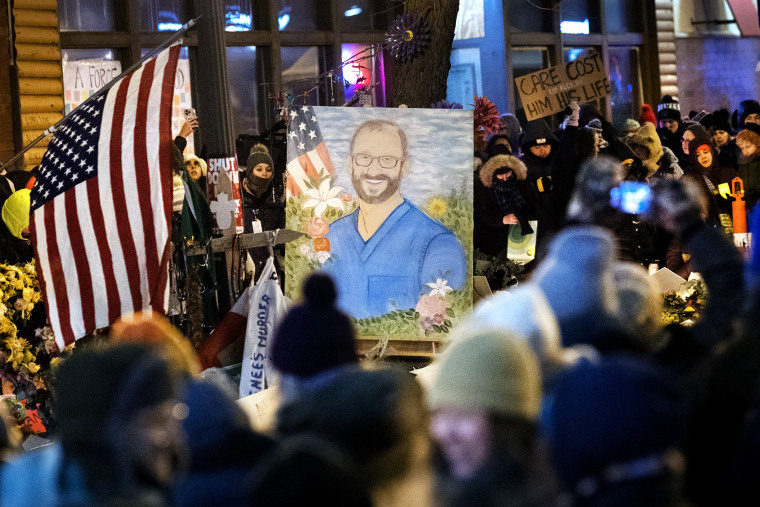
Customs and Border Protection Commissioner Rodney Scott said Thursday that the agency would release body camera footage in the fatal shooting of Alex Pretti in Minneapolis.
Scott made the assertion as he and the heads of Immigration and Customs Enforcement and U.S. Citizenship and Immigration Services were grilled by lawmakers over the deaths of Pretti and Renee Good, both of whom were killed by immigration agents last month.
Amid tense questioning from senators, Scott did not share publicly details of when the footage would be released or what it would show. Sen. Rand Paul, R-Ky., chair of the Homeland Security Committee, organized the hearing with the stated intent of holding immigration agencies accountable amid violence and chaos from federal agents in cities like Minneapolis.
The FBI and CBP are involved in an investigation into Pretti’s fatal shooting, Scott said, and “there’s a lot of other video, there’s bodycam video that’s all being looked at, and until all that evidence is evaluated, I can’t jump to a conclusion.”
“I would ask America to do the same thing, but I am committed to transparency, to making sure all the information we have is made public when it’s appropriate,” he said.
In addition to Scott, acting ICE Director Todd Lyons and USCIS Director Joseph Edlow answered questions from lawmakers including Paul, Sen. Gary Peters, D-Mich., Sen. Ron Johnson, R-Wisc., and Sen. Ruben Gallego, D-Ariz. The hearing came as funding for the Department of Homeland Security is set to lapse after talks between Democrats and the White House failed to reach a consensus on overhauling ICE.
“Americans are led to believe that exercising the right, the right of being there and protesting shouldn’t place them at the risk of lethal force. If it does, public trust collapses at the same time,” Paul said.
The senators played a video clip capturing what led to Pretti’s shooting and pressed the witnesses about the tactics the immigration agents used in the encounter.
Pretti was “retreating at every moment. He’s trying to get away, and he’s being sprayed in the face. I don’t think that’s de-escalatory,” Paul said.
Lyons said there had been an increase in threats against federal immigration law enforcement, adding that after he testified earlier this week, “I went back to numerous death threats against my family.”
“There was a video tape of my wife walking to work that people actively posted. The cartels have actually posted the schematics to my home. ICE agents feel that every day,” he said.
Several lawmakers called for the agencies to issue specific directives regarding limits with the use of force and when to de-escalate a situation after repeatedly showing images of agents using chemical agents on peaceful protesters and throwing people to the ground.
“The fact that this is happening all the time means that you’ve created a space, a command structure, that has allowed this because these men feel that there’s going to be no accountability,” Sen. Ruben Gallego said.
Lyons said ICE agents are held accountable and that from January 2025 to last month, the agency opened 37 investigations for excessive use of force. Of those, 18 were closed, 19 were still pending and one was referred for further action, he said.
Also during the hearing, top Minnesota government officials testified about the surge operation in the state where Good and Pretti were killed.
Minnesota Attorney General Keith Ellison told the Senate Homeland Security Committee that it “has caused real harm to our state.”
He asked the committee to require that ICE provide a full accounting of everyone in Minnesota who had been stopped, detained, arrested and deported during the surge in immigration enforcement in the state.
Ellison also called for ICE to document conditions in its facilities and allow additional access inside them, for the FBI to conduct investigations in partnership with Minnesota into the deaths of Good and Pretti, and requiring ICE to stop engaging in the use of masks and “stop the racial profiling, stop conducting warrantless searches, and finally, pass comprehensive immigration reform.”

