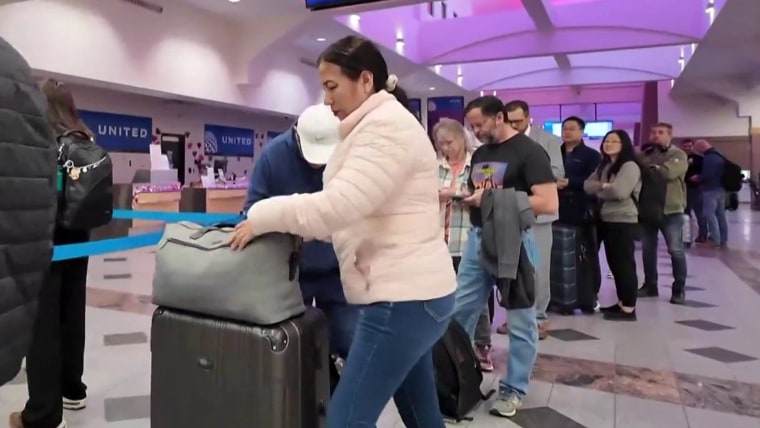
The grounding of aircraft at El Paso International Airport early Wednesday morning was in response to the U.S. military testing technology that can be used to take down drones, according to four sources familiar with the matter.
The testing was taking place in the proximity of the airport, raising concerns within the Federal Aviation Administration, which responded by issuing a Temporary Flight Restriction Notice, the sources said.
Three of the sources said the military testing, which was taking place near Fort Bliss, was of high-energy lasers that are designed to protect against drones from drug cartels that could cross over the U.S. border.
The Federal Aviation Administration halted all flights out of the El Paso International Airport in Texas for 10 days for what it said were “special security reasons” before abruptly lifting the order.
It did not explain the about-face. A Trump administration official earlier told NBC News that Mexican cartel drones had breached American airspace and the Defense Department had disabled them.
There is no confirmation from the Pentagon that any drones were shot down, despite the statement from the administration official.
The military did recently shoot down a small party balloon, two of the sources said.
Two of the sources say a miscommunication, or possibly a dispute, between the FAA and Defense Department about whether the testing could impact commercial aviation that preceded the grounding of aircraft at El Paso airport.
They said the FAA issued the temporary restriction until the agency could get more information about the testing or be assured it wasn’t impacting aviation.
Some lawmakers on Capitol Hill told defense department officials that the grounding of flights was due to a counter-drone exercise that was not coordinated with the FAA, according to a fourth source familiar with the matter.
El Paso Mayor Renard Johnson said the temporary flight restriction was unnecessary and "should have never happened."
"This unnecessary decision has caused chaos and confusion in the El Paso community," he said at a news conference. "You cannot restrict airspace over a major city without coordinating with the city, the airport, the hospitals, the community leadership. That failure to communicate is unacceptable."
Johnson said medical evacuation flights had to be diverted to Las Cruces, about 45 miles away. All aviation operations, including emergency flights, were grounded, he said.
“This was a major and unnecessary disruption, one that has not occurred since 9/11,” he said.
The FAA had said in a Notice to Airmen that no flights would be able to operate in the airspace over El Paso and the neighboring community of Santa Teresa, New Mexico for 10 days between Feb. 11 and Feb. 21.
The FAA, which is only responsible for U.S. airspace, did not elaborate on why the restrictions had been put in place for El Paso, which borders Mexico and the city of Ciudad Juárez.
The notice said the airspace was classified as national defense airspace. Deadly force could be used on an aircraft if it is determined that it “poses an imminent security threat,” it said. Pilots that violated the order “may be intercepted, detained and interviewed” by law enforcement and security personnel, according to the notice.
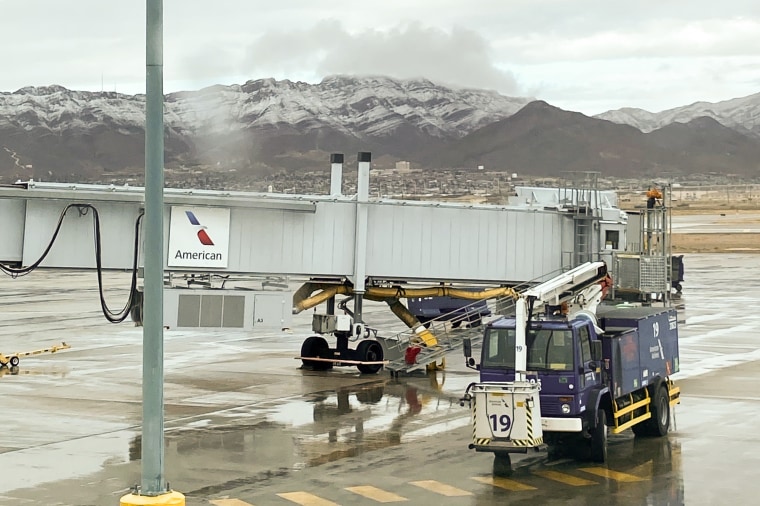
The airport, which handled 3.49 million passengers in the first 11 months of 2025, confirmed the initial 10-day restriction in a travel advisory issued on social media, saying that all flights “including commercial, cargo and general aviation” were grounded.


