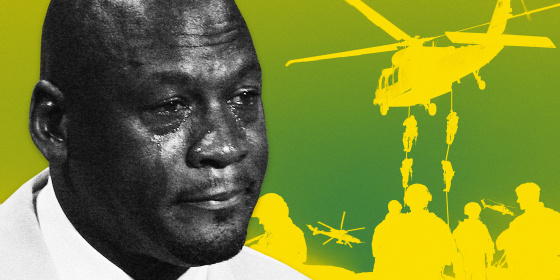
Shortly after the news broke that the United States killed Iranian Gen. Qassem Soleimani, a high-profile commander of Iran's Quds Force, Abhi Agarwal, a student at Bates College in Lewiston, Maine, and his peers began discussing what had happened by sending jokes in their group chat.
The group began swapping memes and asking what their battalion would be called if they were to be drafted.
But under the surface of those jokes, a sense of renewed fear coursed.
"Obviously, there's a sense of palpable fear and I don't think any of us were processing that war was really an option," Agarwal, 19, said. "We weren't brushing it off but we were joking about it because what else can you do?"
Agarwal is one of a half dozen young people who spoke to NBC News about how they've used dark humor to cope with the feeling of dread that the U.S. could be on the precipice of what many teens on social media have deemed "World War III."
On the short-form video app TikTok alone, the hashtags "WWIII" and "WW3" have been viewed more than 1.6 billion times. After news broke of Soleimani's death, erroneous memes about being drafted — conscription was abolished in 1973 — and of a so-called "World War III" began to gain momentum.
A group of young people started a satirical Twitter account called "UrFavIsDrafted," joking about celebrities and others who have supposedly been drafted to serve. "Siblings who eat the food you’ve been looking forward to all day have been drafted!," one tweet said. "ppl who bite into their kiwi with the skin on have been drafted!" announced another tweet.
In a matter of days, the account ballooned to more than 49,000 followers after joking that singer Harry Styles had been drafted.
Related

"I guess that I feel like as a generation, that’s how we deal with stuff. Anything bad happens, we just make a meme of it," said Scarlett Acosta, 21, one of the account's moderators who lives in Panama.
Rebecca Berry, a clinical psychologist and a clinical associate professor in the Department of Child and Adolescent Psychiatry at NYU Langone Health, said it's not uncommon for adults and teens to use humor as a way to cope with stress.
"If we think of World War III, if we look into that, any of us could be really scared. So it helps us quell that uncertainty by trying to make light of it," she said.
When a person jokes about a serious situation, it adds levity and reduces the amount of cortisol, a stress hormone, in the brain, Berry said.
"Dark humor — it’s not a form of avoidance but it's a way people are trying to make sense of the uncertainty," she said. "It's like processing the event in a way that makes sense to them by trying not to get more anxious about the event."
But for those who have a closer tie to an incident or to the epicenter of an event, dark humor does not work in the same way as someone who is further removed, according to Berry.
"Humor in those moments wouldn’t be so keen if a person was more attached to the event," she said.
The jokes about the situation between the U.S. and Iran have landed a little harder on Roz A., 17, an Iranian American from California.
Roz, who asked that her full last name not be used in order to protect her identity, made a TikTok about seeing her cousins in Iran on the battlefield if she were to be drafted — a joke she said she's told in some variation for years.
Her video has garnered 103,000 likes since it was posted Jan. 4.


