When former FBI agent Katherine Schweit heard about the disappearance of Nancy Guthrie, her mind drifted to a crime that took place in rural Wisconsin more than two decades ago.
An 88-year-old grandmother was abducted from her home in February 2003 and placed in the trunk of her car. Her abductor drove her to his property and shackled her inside a trailer. Soon after, the woman’s grandson, who owned a construction company, started to receive messages demanding millions for her release.
“The kidnapper thought he could get a big ransom from the family,” said Schweit, who investigated the case and helped capture the suspect and rescue the woman five days after she was taken.
The Guthrie case doesn’t seem to be following that script, Schweit said. “If you were going to abduct somebody for cash, why wouldn’t you aggressively try to get the cash by communicating with the family right from the start, so you could get your money and return the victim?”
It’s one of the big questions baffling investigators, law enforcement experts and the millions of Americans following the high-profile case. Even the recent release of home surveillance footage showing a potential subject provides no additional information about the person’s possible motive or what happened to Guthrie.
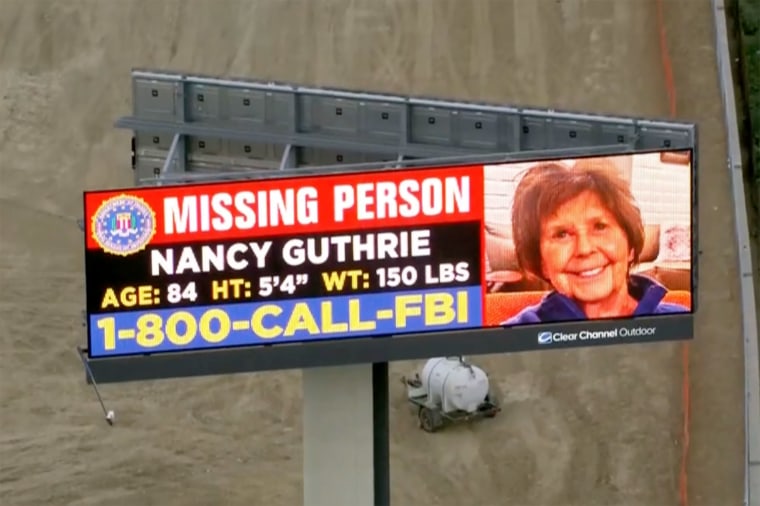
The 84-year-old mother of NBC’s “TODAY” show co-anchor Savannah Guthrie vanished from her home outside of Tucson, Ariz., after she was dropped off by family members on the night of Jan. 31.
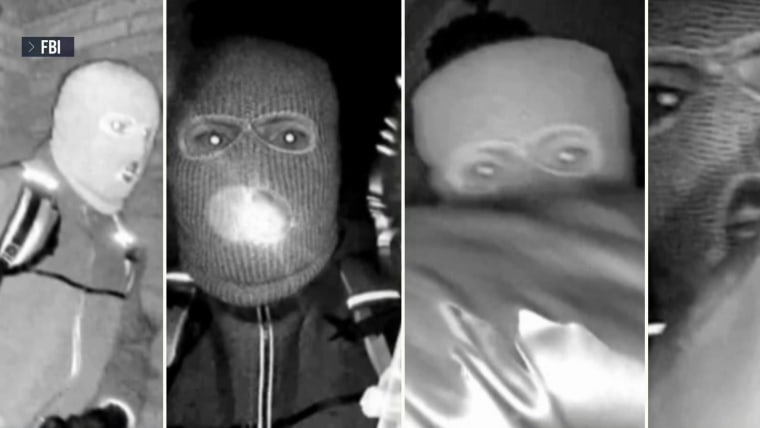
Eleven days later, the identity of her abductor or abductors remains a mystery. But Tuesday, the FBI released images and videos from Guthrie’s home security camera showing a person in a ski mask and gloves and carrying what appears to be a handgun. The person walks up to her house, head down, and then attempts to tamper with the camera.
Michael Alcazar, a retired New York Police Department detective who is now an adjunct professor at the John Jay College of Criminal Justice, said he expects the new images and videos to produce a flood of tips that will help investigators identify the person.
“One hundred percent, somebody is going to recognize him,” Alcazar said.
Alcazar said he thinks it’s significant that the suspect approached the house with the head down, an apparent effort to keep the doorbell camera from recording the face. “That tells me he’s been there before,” said Alcatraz, who added that he wouldn’t discount the possibility that it was a burglary gone wrong.
Following the release of the new images and videos, Savannah Guthrie posted on her Instagram page: “We believe she is still alive. Bring her home.”
Abductions involving adults are rare in the United States, and rarer still are the kind that do not involve family disputes, drug traffickers or gangs, experts say.
Chip Massey, a retired FBI hostage negotiator, said the unusual circumstances of the case — an abduction involving a famous American family — reminded him of the 1932 kidnapping of famed aviator Charles Lindbergh’s 20-month-old son from his home in New Jersey.
“This is the stuff of movies,” he said.
In Guthrie’s case, a possible ransom note was sent to three news outlets, and the FBI said it referenced an Apple Watch, which she is believed to have worn. The note contained two deadlines — one at 5 p.m. Feb. 5, and a second deadline Monday, according to Heith Janke, the special agent in charge of the FBI’s Phoenix division. But he said the note did not establish a means for communication.
A second note was sent to local TV station KOLD, but it did not contain a ransom demand and was different “in almost every way” from the first one, according to its news director Jessica Bobula.
Massey, the retired FBI hostage negotiator, said the lack of communication complicates law enforcement’s ability to identify whoever is responsible.
“If I can’t hear a voice, if they can’t hear mine, a lot of my training and background is now useless,” he said.