
HONG KONG — China and the U.S. hailed “progress” and pledged to stabilize a spiraling relationship Monday but stopped short of achieving a significant breakthrough after Secretary of State Antony Blinken met with President Xi Jinping.
The 35-minute meeting at the Great Hall of the People in Beijing, China's capital, capped the second and final day of a high-stakes visit by America’s top diplomat aimed at easing tensions between the world’s two largest economies.
“We have no illusions about the challenges of managing this relationship. There are many issues on which we profoundly, even vehemently, disagree,” Blinken said at a news conference after the meeting.
However, he added, “it’s the responsibility of both countries to find a path forward, and it’s in both our interests and the interests of the world that we do so.”
Blinken said that he expected further visits to China by senior U.S. officials in the coming weeks and that the U.S. welcomed visits from Chinese officials, as well.
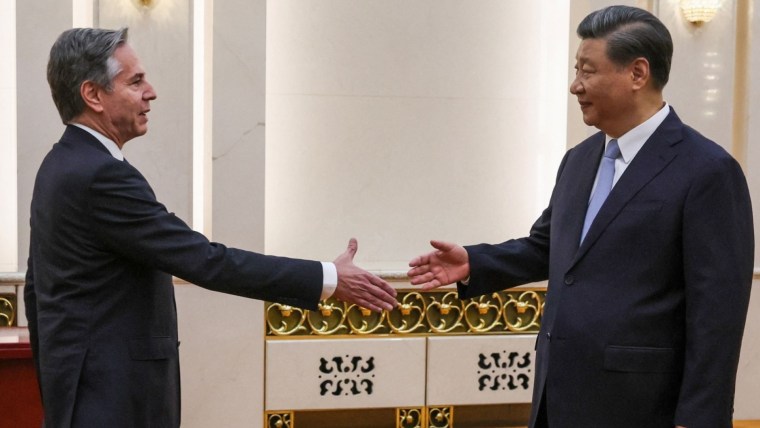
In remarks before the meeting, Xi said that “the two sides have also made progress and reached agreement on some specific issues,” without giving details.
There was no apparent progress, however, on restoring several military-to-military communication channels that China cut in protest of former House Speaker Nancy Pelosi’s visit to Taiwan last August. Blinken called those communications “absolutely vital,” particularly given recent military encounters between the U.S. and China in the Taiwan Strait and the South China Sea.
“China has not agreed to move forward with that,” Blinken said.
Is is the first trip to China by a U.S. secretary of state since 2018, and Blinken is also the highest-ranking U.S. official to visit China since President Joe Biden took office. His talks with Xi — seen as key to the trip’s success — were expected but had not been confirmed until shortly before they were scheduled to begin.
Ties between the two countries have deteriorated in recent months over trade, Taiwan, human rights, Chinese military aggression in the South China Sea and Russia’s war in Ukraine.
During the meeting with Blinken, Xi said China does not seek to challenge or displace the U.S. on the global stage but insisted America must respect China’s rights and interests, according to a readout from the Chinese Foreign Affairs Ministry.
Blinken denied that the U.S. is trying to contain China economically, as Xi has charged, and said Washington wanted to see economic growth in every part of the world.
“But at the same time, we can, we will and we must take steps necessary to protect our national security,” he said, referring to U.S. efforts to limit China’s access to semiconductor technology, among other actions he described as “narrowly focused.”
Blinken met earlier with Wang Yi, China’s top diplomat, and with Foreign Affairs Minister Qin Gang, both of whom were also at the meeting with Xi.
State Department officials had said the two countries were unlikely to reach any breakthroughs during Blinken’s trip, which had originally been planned for February but was postponed after the discovery of a suspected Chinese spy balloon over U.S. territory.
China, while emphasizing the importance of resuming high-level communication, had also expressed less enthusiasm ahead of Blinken’s visit this week than it did before the earlier trip was postponed.
But it could lay the groundwork for talks later this year between Biden and Xi, who last met in Indonesia in November on the sidelines of a summit of the Group of 20 major economies.
After he arrived Sunday, Blinken met with Qin, China’s foreign minister, for talks that both sides described as “candid” and “constructive.” The talks lasted for almost six hours, followed by a two-hour working dinner, according to senior State Department officials.
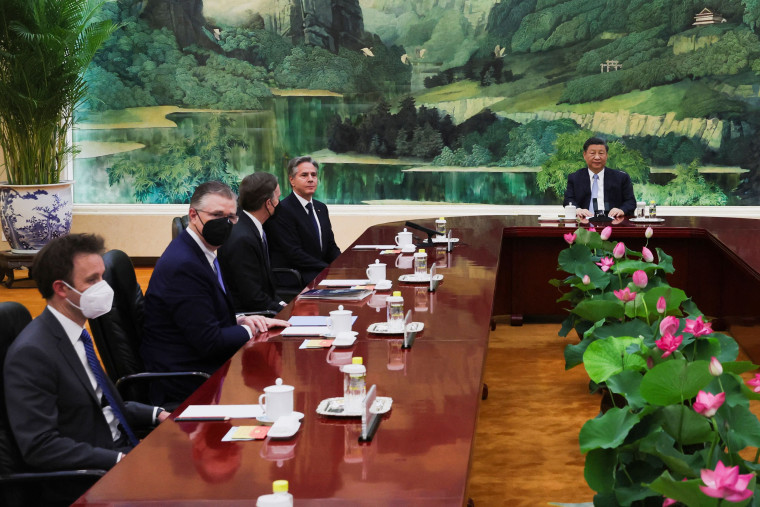
The two countries said Qin, who was previously the Chinese ambassador to Washington, had accepted an invitation from Blinken to visit the U.S. at a mutually suitable time.
