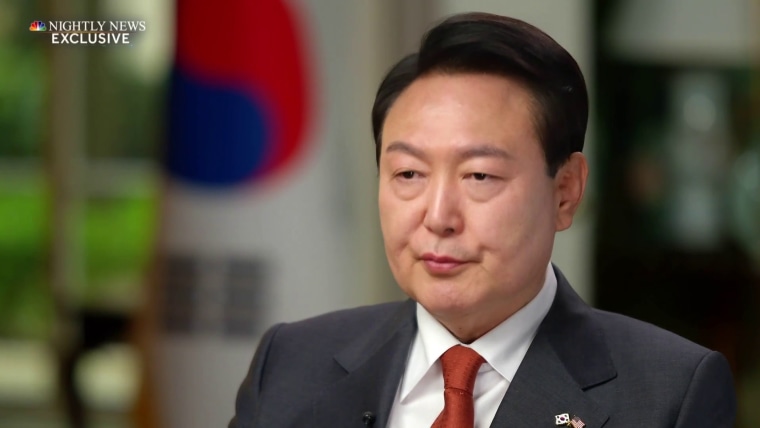
The recent leak of classified Defense Department documents, which show that the United States has been gathering intelligence on its ally South Korea, will not affect the relationship between the two countries, South Korean President Yoon Suk Yeol told NBC News in an exclusive interview.
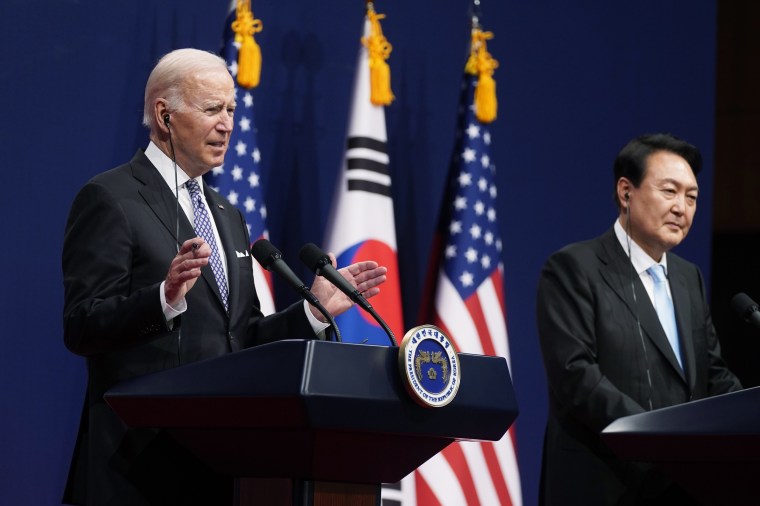
The interview came as he and President Joe Biden meet this week to discuss North Korea, China and other pressing challenges.
U.S. and South Korean officials have said that much of the information in the documents is inaccurate and may have been altered, without providing further specifics.
“I believe that this matter is no reason to shake the ironclad trust that supports the U.S.-South Korea alliance, because it is based on shared values like freedom,” Yoon said Monday.
One of the documents, which NBC News has seen, describes internal South Korean government discussions in which senior officials expressed concern that a request from Washington for South Korean-made artillery ammunition could open the door to the munitions being handed over to Ukraine‘s military.
The South Korean officials also saw the need for the government to formulate a clear position on the matter in case the White House pressed the issue. South Korea’s policy bars it from providing lethal aid to Ukraine. Opposition lawmakers in South Korea criticized the alleged U.S. surveillance as a violation of national sovereignty and a major security lapse by the Yoon government.
Though he acknowledged the awkwardness of the U.S. being exposed spying on its allies, Yoon said the relationship between the two countries was built on a high level of trust.
“When you have that trust, you don’t get shaken,” he said.
Yoon, a former prosecutor who was elected last year, arrived in Washington on Monday for a six-day state visit as the U.S. and South Korea mark the 70th anniversary of their alliance, which dates to the end of the Korean War. He and Biden will hold a summit Wednesday, and Yoon will address a joint meeting of Congress on Thursday.
It is the first U.S. state visit by a South Korean leader in 12 years and the first by an Indo-Pacific leader during the Biden administration, which is focusing more intensely on the strategically important region as it tries to counter growing Chinese influence.
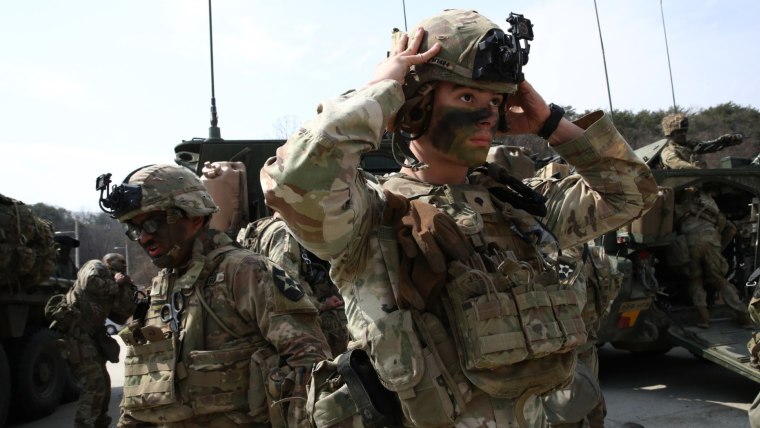
Yoon’s visit follows the largest U.S.-South Korea joint military exercises in years, aimed largely at countering the North Korean nuclear threat. The two countries are also stepping up their security coordination with Japan, holding trilateral defense talks in Washington this month. Biden is also expected to encourage Yoon to continue improving ties with Tokyo, with which Seoul has long had a fraught relationship.
At a time of heightened international turmoil, Biden and Yoon share a common interest in protecting the liberal international order, said Victor Cha, senior vice president for Asia and Korea Chair at the Center for Strategic and International Studies (CSIS) in Washington.
“President Yoon in particular, unlike previous [South Korean] presidents, really has emphasized freedom and democracy as a core theme of his foreign policy,” Cha told a news briefing last week.
At the top of the security agenda is North Korea, which has stepped up its weapons testing amid stalled denuclearization talks.
Earlier this month, North Korea launched its first solid-fuel intercontinental ballistic missile, in what analysts say is a meaningful advance in the country’s efforts to build a nuclear arsenal capable of threatening anywhere in the continental United States. U.S. and South Korean officials also say North Korea is preparing for its seventh nuclear test, which would be its first since 2017.
North Korea’s belligerence is stoking anxiety among the South Korean public, the majority of whom say South Korea should have its own nuclear weapons. Washington and Seoul say their goal is for the Korean Peninsula — both North and South Korea — to be nuclear-free.
Yoon, a conservative, takes a more hard-line approach to North Korea than his predecessor, Moon Jae-in, and then-President Donald Trump, both of whom tried to engage in diplomacy with North Korean leader Kim Jong Un. Though he has offered North Korea economic incentives in exchange for concrete steps toward denuclearization, Yoon said it was “unrealistic” to expect a deal with the North anytime soon.
“The important thing is that we have to make North Korea never dare to resort to its nuclear weapons,” he said.

