Russian President Vladimir Putin ordered troops into Ukraine on Monday, just hours after he formally recognized the independence of two Moscow-backed breakaway regions in the eastern part of the country.
The order was seen by the United States and its European allies as a dramatic provocation after weeks of warnings that Moscow was trying to create a pretext to invade its neighbor. It led to the U.S. and the European Union announcing sanctions targeting the two areas, with more set to follow, and drew condemnation at an emergency meeting of the United Nations Security Council.
Putin framed the troop movement as a “peacekeeping” effort in both regions. The move came after days of escalation in the ongoing conflict between Kyiv's forces and Russian-backed separatists in Ukraine's east — and hours after he delivered a lengthy speech presenting his view of the relationship between the two nations.
Many experts believed Moscow’s formal recognition would effectively scuttle a previous cease-fire agreement in the conflict, which has been ongoing since Russia annexed Ukraine's Crimean Peninsula and moved to back the separatists in 2014.
Some Western leaders had hoped diplomatic progress in eastern Ukraine could provide a route out of the broader, monthslong crisis. Instead this escalation now leaves Europe facing the prospect of a deadly new conflict.
Russia has deployed more than 150,000 troops to converge on its neighbor's borders from three sides, prompting fears of an invasion that it has firmly denied it is planning.
In a wide-ranging televised speech Monday evening, Putin described Ukraine as a historical part of Russia that was illegitimately taken from Moscow and is now run by a “puppet regime” controlled by the U.S. and the West.
"Ukraine is not just a neighboring country. They are a part of our culture," he said.
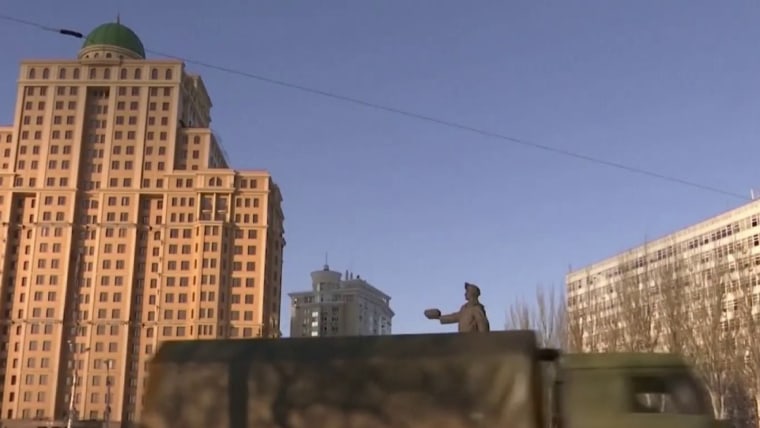
Noting that Ukraine has taken down some of its Soviet-era statues, he warned Kyiv: "You want decommunization? We will show you what it’s like."
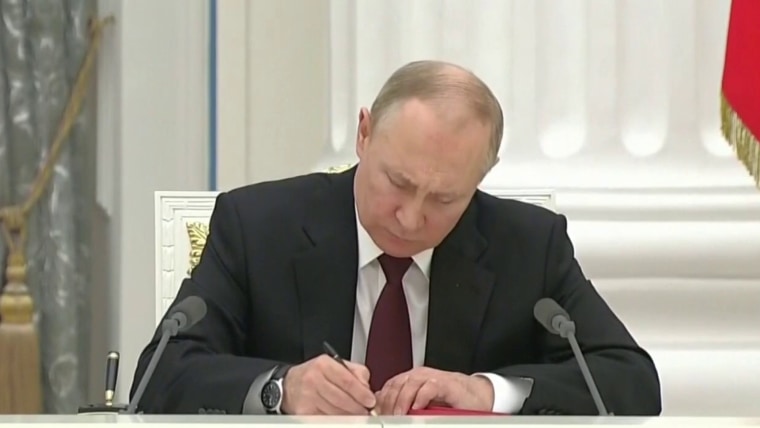
He then signed a decree formally recognizing the self-proclaimed "Donetsk People’s Republic" and "Luhansk People’s Republic," which have been controlled by Russian-backed separatists since 2014.
Alongside him were Denis Pushilin and Leonid Pasechnik, the heads of the Donetsk and Luhansk republics.
The separatist leaders called for evacuations of civilians to Russia last week, warning of an imminent Ukrainian offensive, and then announced a full military mobilization in the regions over the weekend.
Ukraine has repeatedly denied any plans to carry out an attack on the breakaway territories, and its Western allies have accused Moscow of attempting to create a pretext for an invasion, ears that were stoked further by an escalation in shelling on the frontlines.
More than 60,000 evacuees have arrived in Russia as of Monday, according to Russian emergency ministry officials.
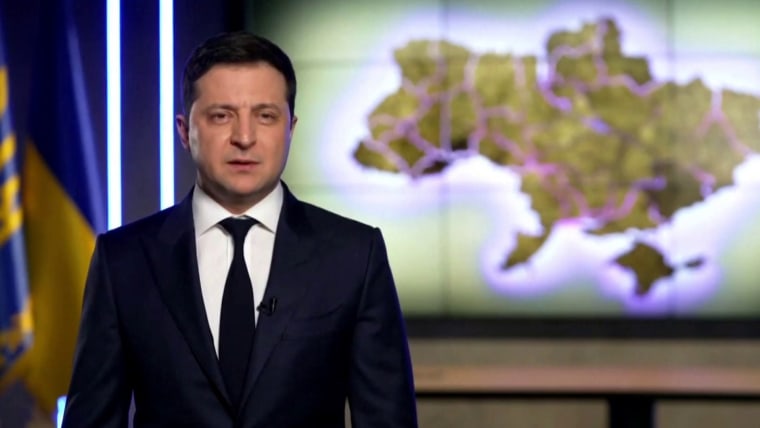
Ukrainian President Volodymyr Zelenskyy said his country unequivocally sees Putin's action as a violation of its sovereignty and territorial integrity. It could mean a unilateral withdrawal from the Minsk agreements that sought to end war in the Donbas region, he said.
"All responsibility for the consequences in connection with these decisions rests with the political leadership of the Russian Federation," Zelenskyy said in an address late Monday.
"We are not afraid of anything or anyone," he said later in the address, referring to Russia's presence in Donbas since 2014.
"We owe nothing to anyone, and we will not give anything to anyone," Zelenskyy said, "and we are sure of that, because now is not February 2014, but February 2022 — another country, another army, one goal — peace, peace in Ukraine. Glory to Ukraine!”