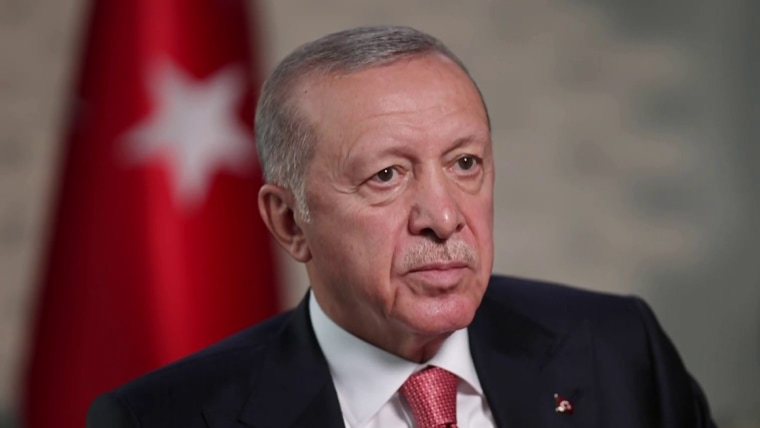
Ukraine’s proposal for NATO membership is not a question “to be rushed,” Turkish President Recep Tayyip Erdoğan told NBC News in an exclusive interview Tuesday, adding that relations between his country and Russia were “expanding.”
Speaking on the sidelines of the United Nations General Assembly in New York, Erdoğan said that the U.S. and other members of the Western alliance “don’t want Ukraine to be a member state.”
“These are not questions to be rushed,” he said. “And when making our minds, when we are taking our decisions, we always take into consideration the stance of other NATO member states, we discuss those possible questions around the table and make the final decision accordingly.”
His comments will likely prove disappointing for his Ukrainian counterpart, Volodymyr Zelenskyy, who is set to present his victory plan to the White House this week.
While the specifics of Zelenskyy's proposal have been closely guarded until it can be presented to President Joe Biden, some of the basic details have emerged including the need for fast action and, crucially, a security guarantee of NATO membership, according to Zelenskyy's chief of staff, Andrii Yermak.
In a Telegram post late Tuesday, Zelenskyy said he had “discussed the implementation of the peace formula” with Erdoğan.
But the Turkish leader appeared to dash any hopes of a fast-track to NATO membership in his interview with NBC News.
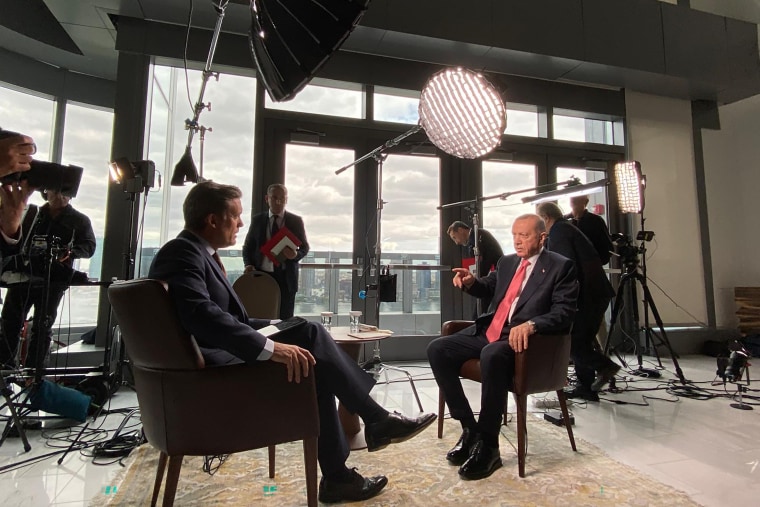
He said he would consider the position of other members of the alliance. “We are going to follow the developments, the deliberations, and reach a final decision accordingly. These are not decisions to be rushed in an excited way,” he said.
Erdoğan shocked members with a threat to veto the bids of Sweden and Finland, who abandoned their long-held nonaligned status and applied to join NATO, shortly after Russia launched its invasion of Ukraine, frustrating other NATO allies who had been pressing for their swift accession.
The parliaments of all 30 NATO members must ratify newcomers, but Erdoğan blocked the move, insisting the Nordic pair change their stance on Kurdish rebel groups that Turkey considers terrorists. He also called for the extradition of wanted terrorists to Turkey and for the lifting of arms restrictions imposed after his country’s 2019 military incursion into northeast Syria.
But eventually Turkey ratified both countries for membership. Erdoğan linked Sweden’s NATO membership to the U.S. Congress’ approval of a Turkish request to purchase 40 new F-16 fighter jets and kits to modernize the country’s fleet.
Erdoğan has also been criticized in some quarters for accepting an invitation to attend the BRICS conference in Russia next month, signaling his openness to the bloc of developing countries led by Brazil, Russia, India, China and South Africa.
“Our relations with Russia are multidimensional, political, economic, cultural, defense industry related,” Erdoğan said. “There are many dimensions, dimensions there and our solidarity, our interaction, has been going on and economically every day, these relations are expanding.”
Erdoğan’s lean toward Moscow follows years of tense U.S. relations, as Turkey occupies both a crucial geographic and political center between Moscow and Washington.
And one of the fault lines appears to be widening over the crisis in Gaza.
Erdoğan’s position on Hamas is an incendiary view for many, as he declines to condemn Hamas as terrorists while he denounces continued support for Israel’s leadership nearly a year into the war. He told NBC News that he does not “view Hamas as a terrorist organization” because he believes to do so would be to “abandon” Palestinians.
The Turkish leader has been one of fiercest critics of Israeli Prime Minister Benjamin Netanyahu, and in a scathing speech to the United Nations General Assembly on Tuesday he was extremely critical of Western states for failing to take a stance against Israel, which he said had perpetuated violence in the Middle East.
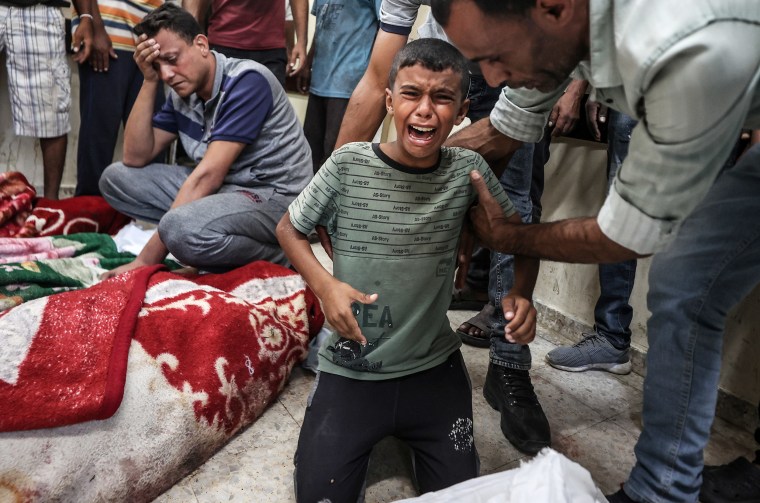
Health officials in Gaza say more than 41,000 have died in Gaza since Israel launched its offensive in the enclave after Hamas Oct. 7 terror attacks in which about 1,200 people were killed and Palestinian militants took around 250 hostages, according to Israeli tallies.


