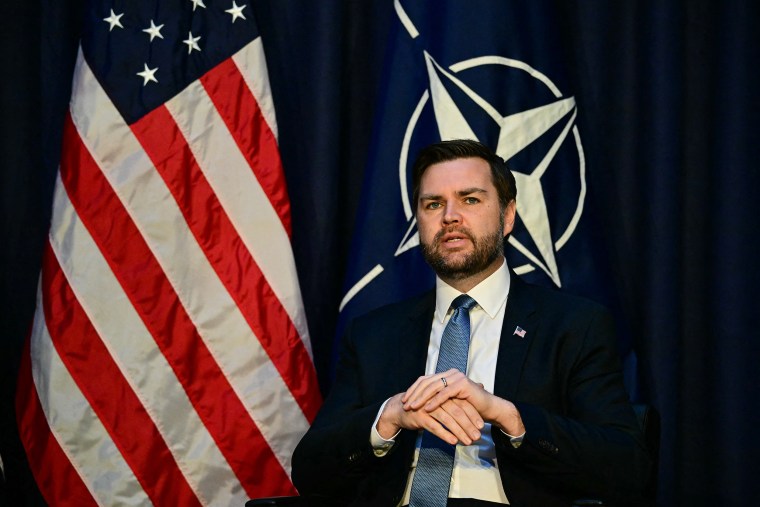
Vice President JD Vance publicly berated European leaders on a host of issues from free speech to security and mass migration, as simmering tensions between the United States and its close allies boiled over at an international conference in Munich on Friday.
The vice president used the podium at the high-level security gathering that had been focusing on the invasion of Ukraine and the threat Russia poses to Europe and the rest of the world to raise social issues animating many on the American right.

"The threat that I worry the most about vis-à-vis Europe is not Russia. It's not China. It's not any external actor," he said at the Munich Security Conference. "What I worry about is the threat from within — the retreat of Europe from some of its most fundamental values, values shared with the United States of America."
He added: “I’ve heard a lot about what you need to defend yourselves from and of course, that’s important. But what has seemed a little bit less clear to me ... is what exactly you’re defending yourselves for?”
The vice president's comments were met with an icy reception and only scattered applause — and groans when he joked about how if American democracy could "survive 10 years of Greta Thunberg scolding, you guys can survive a few months of Elon Musk.”
German Defense Minister Boris Pistorius denounced Vance's remarks during a session at the conference later in the day, saying in German that it was "not acceptable" that the U.S. vice president compared "the condition of Europe with the condition that prevails in some auto-authoritarian regimes."
"This is not acceptable," Pistorius said. "This is not the Europe, not the democracy where I live and where I conduct my election campaign right now. And this is not the democracy that I witness every day in our parliament. In our democracy, every opinion has a voice."
"I was in the room in Munich for VP Vance’s speech," Sen. Andy Kim, D-N.J., wrote in a post on X. "No talk about Russia, Ukraine, China. Just criticisms of our allies and focus on “the threat from within.” His speech is going to embolden our adversaries who will see this as a green light to act while America is distracted/divided."
Meeting with Zelenskyy
A rift between the U.S. and Europe had been growing after President Donald Trump was accused of excluding Kyiv and the continent from peace talks to end the nearly three-year war in Ukraine.
Later in the day, Vance, Secretary of State Marco Rubio and Gen. Keith Kellogg, the U.S. special envoy for Ukraine and Russia, were part of the U.S. delegation that met directly with President Volodymyr Zelenskyy and other Ukrainian officials for a bilateral meeting at the conference.
“The goal is, as President Trump outlined it, we want the war to come to a close," Vance told reporters who were briefly brought into the room after the meeting started. "We want the killing to stop, but we want to achieve a durable, lasting peace, not the kind of peace that’s going to have Eastern Europe in conflict just a couple years down the road."
Zelenskyy thanked the U.S. and Trump for supporting Ukraine and said they will work toward a plan that addresses “how to stop Putin and finish the war.”
Before becoming vice president, Vance had conveyed in recent years that he wasn't a fan of providing U.S. assistance to Ukraine. After Russia invaded the country in February 2022, Vance said on a podcast, “I don’t really care what happens to Ukraine one way or another.” In the Senate, he voiced opposition to the Ukraine aid packages provided by Congress and under Biden.
Throughout the event in Munich, European leaders appeared to ramp up their criticism of the Trump administration's handling of peace efforts.
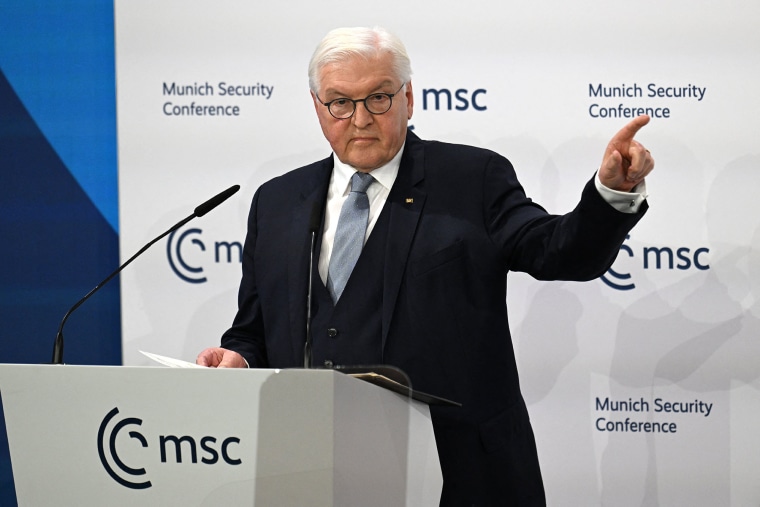
"The new American administration has a very different world view to ours, one that has no regard for established rules, partnership and grown trust,” German President Frank-Walter Steinmeier said at the conference Friday, prior to Vance's comments.
"We have to accept that and we can deal with it. But I am convinced that it is not in the interests of the international community for this worldview to become the dominant paradigm,” said Steinmeier, whose post is largely ceremonial, according to Reuters.
European Commission President Ursula von der Leyen said the world had reached a "moment in history" where "great challenges loom," as she called on the international community to hold Russian President Vladimir Putin accountable for proving "he has given up" a bid to "destroy Ukraine."
There is growing alarm across Europe after what Trump described as a “lengthy and highly productive” conversation with Putin about ending the war in Ukraine.