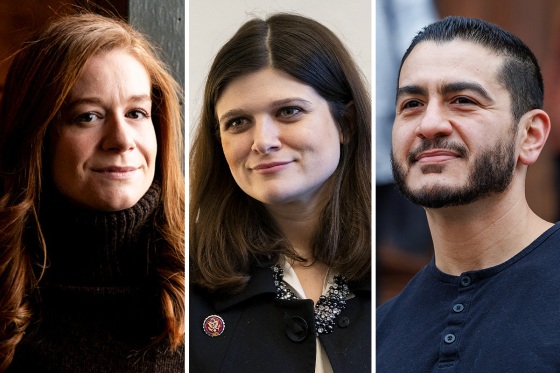
Democrats running to be Michigan’s next U.S. senator tangled Wednesday over who is best suited for the job, with campaign contributions from corporate political action committees emerging as a dividing line during a forum hosted by the United Auto Workers.
Responding to a question from a laborer concerned about the influence of corporate money in government, two of the three candidates — physician Abdul El-Sayed and state Sen. Mallory McMorrow — said their campaigns are not accepting such donations.
The third, Rep. Haley Stevens, whose Senate bid has been funded in part by corporate PACs representing Ford Motor Co., General Motors, Walmart and others, sidestepped the question.
Instead, Stevens focused on her desire to “end Citizens United,” the 2010 Supreme Court ruling that loosened campaign finance restrictions and has become a rallying point for Democrats. As the forum continued, a “rapid response” email circulated by Stevens’ campaign emphasized her support for “legislation to reduce the influence of big money in politics and implement anti-corruption measures.”
“Look, friends, I’m not a millionaire, and I don’t own stock,” Stevens said. “I’m running my campaign in a grassroots way, where 95% of my donations are $200 or less. They’re coming from grocery clerk workers, nurses, folks on the factory line. I cannot be bought.”
McMorrow, whose earlier state campaigns received corporate PAC money, called out Stevens for not offering a “yes” or “no” answer, after the discussion shifted to pension benefits.
“As we talk about our retirement, we need to know who our next senator is working for,” McMorrow said.
The topic of corporate money in politics yielded one of the most pronounced contrasts in a forum that showcased the three leading Democrats’ different principles and ideologies, as well as their unified support for organized labor. The event, part of the UAW’s biannual Community Action Program conference in Washington, D.C., marked the first time the trio shared a stage together, providing each an opportunity to audition for union workers whose votes will be crucial in Michigan, the epicenter of the U.S. auto industry.
Former Rep. Mike Rogers, the top Republican contender for the Senate seat, declined an invitation to participate, UAW officials said. He was represented on stage by an empty chair. A spokesperson for Rogers did not respond to a request for comment. In a social media post later Wednesday, Rogers disputed the claim that he had received an invitation.
Samantha Cantrell, a spokesperson for the National Republican Senatorial Committee, issued a statement accusing El-Sayed, McMorrow and Stevens of supporting environmental policies that would be harmful to the state’s economy.
“They are not the champions of Michigan’s auto industry they are pretending to be,” Cantrell said.
The seat is open after Sen. Gary Peters, a Democrat, decided against seeking a third term. The Aug. 4 primary is one of a handful of midterm year races that has commanded national interest and will help clarify the direction of a Democratic Party struggling with its identity. Recent polls show a competitive primary, with no candidate running away from the pack.
“We are going to fight,” LaShawn English, the UAW Region 1 director, told the audience before the debate. “But we need our politicians, our political leaders, to fight hard for us, our members, just like the UAW fights for us. The outcome of this year’s midterm election and the 2028 election will go a long way towards fighting the path for working-class citizens.”
El-Sayed has positioned himself on the party’s left wing and has endorsements from Sen. Bernie Sanders, I-Vt., and other leading progressives. He repeatedly mentioned Wednesday that he has never taken money from corporate PACs, a stance dating to his unsuccessful run for Michigan’s Democratic nomination for governor in 2018 — and a contrast with Stevens and McMorrow. El-Sayed also emphasized his support for Medicare for All, though he recently clarified his stance after McMorrow criticized his position as confusing.
“This is about an opportunity to think different about the world we actually want to achieve,” El-Sayed said in his closing remarks Wednesday. “So if you want to continue to do the same, I’m not your guy. But if you want someone who’s going to fight tooth and nail around the things that got me into medicine in the first place, maybe I am.”
Stevens practices more moderate politics and is closely aligned with the party’s establishment, boasting support from former House Speaker Nancy Pelosi. She focused her attacks at the forum on Rogers and President Donald Trump, linking the two together while looking past her primary rivals. She also emphasized her work in the Obama administration on the Great Recession-era rescue plan for Detroit’s Big Three automakers.
“My line is always open to each and every single one of you,” Stevens told the audience. “This race is about the future of Michigan. We’re not going to let Mike Rogers trample on our rights to organize. We’re not going to let Mike Rogers go along and clink his martini glass and pretend to be Donald Trump’s best friend.”
McMorrow, who is backed by Sen. Chris Murphy, D-Conn., has presented her campaign as something of a middle ground between El-Sayed and Stevens.

