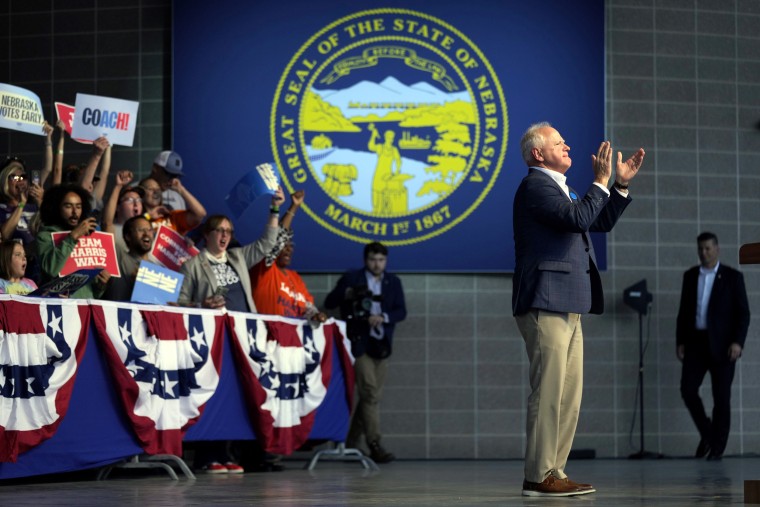
Only three House Republicans won re-election in 2024 while Kamala Harris carried their districts — and one of them, Rep. Don Bacon, is retiring this year in Nebraska, giving Democrats a big opportunity in the Omaha-area seat they’ve been trying to capture for years.
This has given way to a crowded Democratic primary sparring on issues from policy positions to whether one candidate is, by seeking the seat, jeopardizing the party’s limited power in the state Legislature. And unlike in most congressional districts around the country, in Nebraska’s 2nd Congressional District, a so-called blue dot, this could have national implications.
Harris and Joe Biden each carried the district and the electoral vote that comes with it under Nebraska law. Many Republicans there want to change that law to the more common winner-take-all format, which would mean another practically automatic GOP electoral vote in the deep-red state. Previous efforts to change the law have failed, but changes in the makeup of the state Legislature could tip the balance.
Opponents of state Sen. John Cavanaugh are starting to raise the issue as the Democratic primary heats up.
“The No. 1 reason that I actually got into the race was because of my concern about Sen. Cavanaugh’s candidacy,” said Crystal Rhoades, clerk of the Douglas County District Court. “His candidacy is extremely problematic, because if he is successfully elected to Congress, our Republican governor is going to appoint his replacement in the Nebraska Legislature. And when that happens, the Democrats are no longer going to have enough votes to sustain a filibuster.”
Though legislators serving in Nebraska’s unicameral state Legislature are technically nonpartisan, members of the Republican-leaning bloc currently hold a narrow supermajority, with 33 GOP-leaning members to 16 Democratic-leaning members.
If Cavanaugh wins the primary and the general election in November, he would have to resign his seat in the Nebraska Legislature, granting Republican Gov. Jim Pillen the chance to appoint a successor to serve for the next two years.
Democrats in the state assume that, given the opportunity, Pillen would appoint a Republican to Cavanaugh’s seat, temporarily expanding the GOP-leaning supermajority in the state Legislature.
“I think that person, who the governor would appoint, would support ‘winner-take-all,” Barry Rubin, a nonpartisan political operative in Nebraska who once served as executive director of the state’s Democratic party, told NBC News. “If [Cavanaugh] wins and nothing changes, the ‘blue dot’ is gone,” he continued, pointing to other policy issues that could be affected, too.