IE 11 is not supported. For an optimal experience visit our site on another browser.
How Trump decided to strike Iran
Iran balked at a proposed deal Thursday, a senior U.S. official said. “They weren’t willing to say they will not have a nuclear weapon. Very simple,” Trump told NBC News.
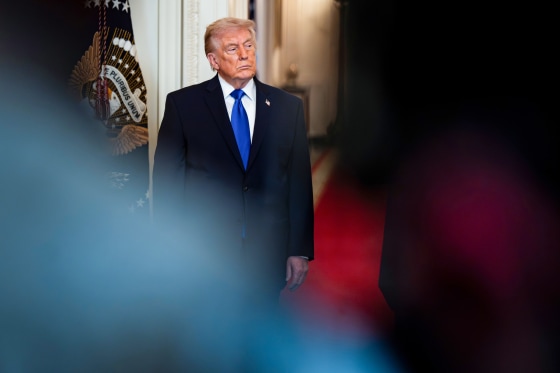
President Donald Trump ordered strikes on Iran after growing frustrated with prolonged negotiations.Al Drago / Bloomberg via Getty Images
WASHINGTON — A last chance to avert war with Iran played out Thursday in Geneva, where Trump administration officials told Iranian counterparts they must not take certain steps needed to build a nuclear bomb.
It didn’t go well.
As the U.S. delegation laid out its position that Iran couldn’t enrich uranium for the next 10 years, the Iranian side balked, said a senior Trump administration official who described the meeting on condition of anonymity.
Iran has an “inalienable right” to enrich uranium, Abbas Araghchi, the Iranian foreign minister, told the Americans. And the U.S. has an “inalienable right” to stop you, Steve Witkoff, a member of the U.S. delegation, replied.
After having heard the U.S. demands, Araghchi started yelling at Witkoff, who was accompanied at the meeting by President Donald Trump’s son-in-law Jared Kushner, among others, said the senior official.
“If you prefer, I can leave,” Witkoff said.
Araghchi’s representatives didn’t immediately respond to a request for comment.
Afterward, the American delegation reported back to Trump what had happened. Trump was “nonplussed,” the senior official said.
By Saturday morning, the U.S. was at war.
“Major combat operations” against Iran had begun, Trump said in a video released at 2:30 a.m. ET on his social media site.
The phrase was a distant echo of then-President George W. Bush’s statement when he boarded an aircraft carrier and, in front of a banner reading “Mission Accomplished,” announced that “major combat operations” with Iraq had ended.Twenty-three years later, the president is different, the enemy is different, but the Middle East remains a hot zone for the U.S.
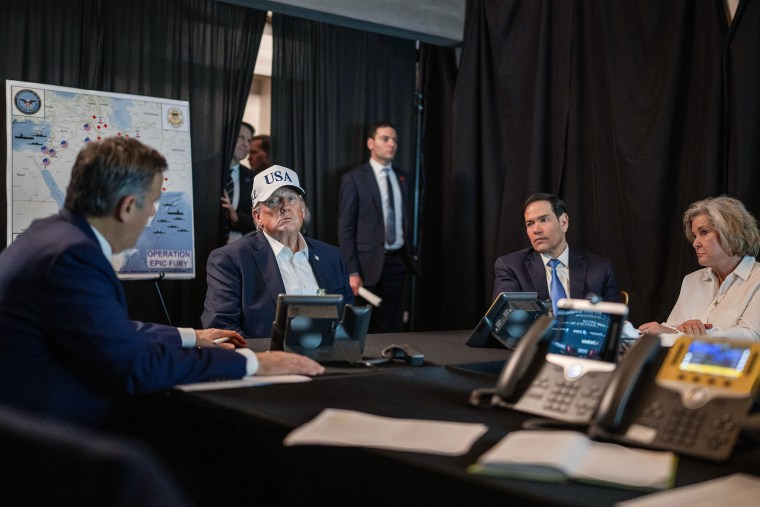
President Donald Trump oversaw "Operation Epic Fury" at Mar-a-Lago in Palm Beach, Fla., on Saturday.Daniel Torok / White House via Getty Images
Trump’s decision to strike Iran and kill off its leadership followed prolonged negotiations between the two sides that left him frustrated and convinced that a diplomatic off-ramp wasn’t within his reach. Nor was he especially eager to fight. One reason for his caution was that he didn’t believe advisers had given him a clear enough picture of Iran’s postwar future, a national security official said in an interview.
Why did he ultimately decide to attack? NBC News asked him Sunday in a brief phone interview.
“They weren’t willing to stop their nuclear research,” Trump said. “They weren’t willing to say they will not have a nuclear weapon. Very simple.”
Trump built his political career on a promise to avoid foreign wars that his predecessors pursued, he has said, without producing any appreciable gain for Americans. In 2011, he predicted that then-President Barack Obama would start a war with Iran “in order to get elected” and because “he has absolutely no ability to negotiate."
“I was elected on getting out of these ridiculous, endless wars, where our great military functions as a policing operation to the benefit of people who don’t even like the USA,” he wrote on social media in 2019, during his first term.
Yet he also pledged to stop Iran from acquiring a nuclear weapon, a position he reiterated last week in his State of the Union speech. Iran would “soon” have missiles that could reach the U.S., he said in the address to Congress. An additional concern was that Iran might launch its own pre-emptive attack on American forces in the region if the Trump administration stood down, another senior official told reporters over the weekend.
“As president, I will make peace wherever I can, but I will never hesitate to confront threats to America wherever we must,” Trump said in his State of the Union address.
With negotiations stalled after Thursday’s meeting, Trump embarked on a war of his own choosing. How it ends could reshape the Middle East for the foreseeable future. A generation ago, Bush decided to sink blood and treasure into the same part of the world, resulting in the deaths of nearly 4,500 U.S. service members and reducing him to a spent force in American politics. Now, it’s Trump’s turn to see whether he can use the fearsome U.S. military to defang Iran in pursuit of an elusive peace.
One distinction he draws with past presidents is that they presided over prolonged conflicts. He has shown a preference for quick, decisive strikes. He told the Daily Mail on Sunday that the war may end in four weeks or less.
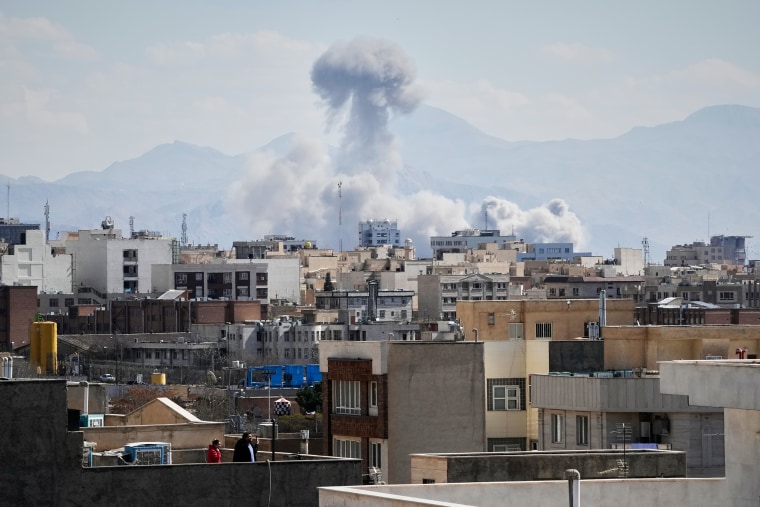
People watch from a rooftop as a plume of smoke rises from a strike in Tehran, Iran, on Sunday. Vahid Salemi / AP
In his video announcing the strikes, Trump said he’d like the Iranian people to rise up and topple the ruling regime, though there is no guarantee that the successors would govern any differently.
Before the U.S. and Israel launched their aerial assault, the CIA concluded that if the supreme leader, Ayatollah Ali Khamenei, was killed, he could be replaced by equally hard-line officials from within the regime, according to two people familiar with the matter.
Khamenei died in the attack; it’s unclear whether an opposition faction has been groomed to step in to replace him. In January, Trump told Reuters that Reza Pahlavi, son of the late deposed shah of Iran, “seems very nice” but that he didn’t know whether Pahlavi was suited to lead the country.
“The problem here may be Trump attacks for two or three days, declares victory and walks away from it, which would certainly not be enough to overthrow the regime,” said John Bolton, who was the White House’s national security adviser for part of Trump’s first term but has fallen out with him. “His lack of forward, strategic planning could be a problem here.”
Yet one of Trump’s confidants said he was certain Trump would see the war through to a successful outcome.
“The president and his team don’t believe they are out of the woods yet,” Sen. Lindsey Graham, R-S.C., said in an interview. “They still believe Iran is dangerous and are closely monitoring the situation. The administration is prepared for more strikes and action in the coming days to finish the job.”
Attacking Iran wasn’t ordained. Trump had his own private doubts. In the run-up, he pressed for a deal in which Iran would forgo nuclear weapons, with some sweeteners attached. U.S. negotiators said they offered to provide Iran with free nuclear fuel, but the regime said no.
In the meeting in Geneva, Araghchi’s response to the American offer was “we don’t need any favors from you,” the senior administration official said. “‘We don’t want you to pay for our fuel.’”
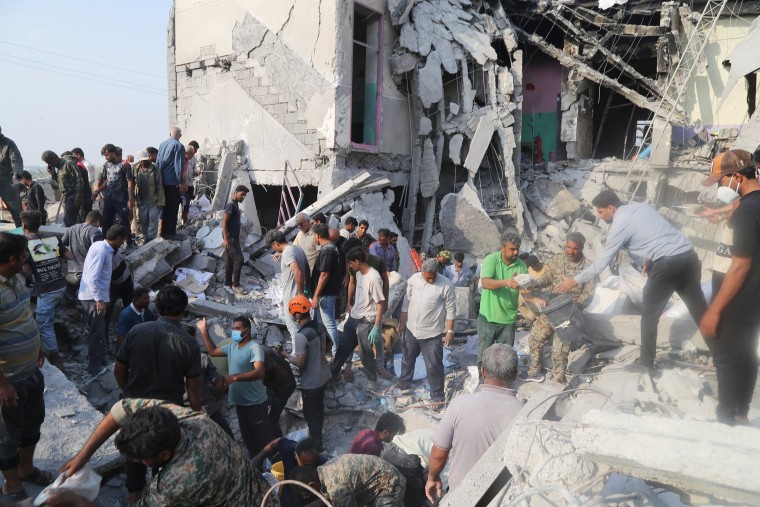
The aftermath of an Israeli strike on a school in Minab, Iran, on Saturday. Abbas Zakeri / Mehr News via Reuters
Negotiators held talks about Iran’s nuclear program on Feb. 6 in Oman and again on Feb. 17 in Geneva. Sandwiched between those meetings came a report that Trump had ordered the USS Gerald R. Ford — the largest aircraft carrier in the fleet — to sail from the Caribbean to the Middle East.
Trump said bluntly on Feb. 13 that he wanted another carrier in the region, “in case there isn’t a deal."
But Trump employed other tools to keep Iran on edge. Treasury Secretary Scott Bessent told Congress last month that the U.S. had purposely touched off an economic crisis in Iran that led to the massive street protests early this year that jarred the regime. By creating a dollar shortage in Iran, the U.S. forced Iran to print money, sparking inflation and stoking internal enmity toward the leadership, Bessent said.
Trump, meanwhile, had his own misgivings about an attack, according to the national security official. He wasn’t persuaded that the battle plans would provide the durable outcome he wanted. No one could give him assurances about what the strike would spawn, the official said.
Still, Trump left little doubt that he might order an attack. On Feb. 19, he gave Iran a 10-to-15-day deadline to agree to a deal, warning that “really bad things” will happen if it defied him.
No one in Tehran could assume he was bluffing. He’d already hit the country once, sending B-2 bombers in June to pummel nuclear sites, and claimed they had been “obliterated.”
On Friday, the day after Kushner and Witkoff met with Iranian leaders, Trump said in a speech in Corpus Christi, Texas: “Now we have a big decision to make. You know that. Not easy, not easy.”
The same day, the U.S. ambassador to Israel, Mike Huckabee, advised embassy staff members that those who wanted to leave Israel should “do so TODAY.”
From Texas, Trump flew to Mar-a-Lago, his home in Palm Beach, Florida, where he monitored the strike in the company of senior advisers, as he has done for several foreign strikes this term. He also made time Saturday to attend a political fundraising event at his seaside resort.
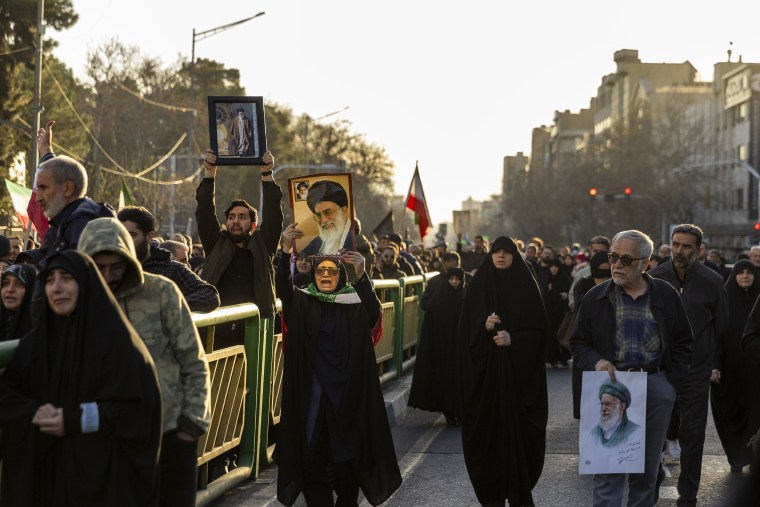
People hold posters and flags as thousands gather in Enghelab Square in Tehran on Sunday for a pro-government demonstration after Ayatollah Ali Khamenei was killed.Majid Saeedi / Getty Images
A picture released by the White House showed Trump in a USA ball cap, sitting at a table along with Secretary of State Marco Rubio and White House chief of staff Susie Wiles. On the wall was a map of the Middle East showing the deployment of U.S. ships.
“Operation Epic Fury” started at 1:15 a.m. ET Saturday (9:45 a.m. in Tehran). The U.S. deployed B-2 stealth bombers, fighter jets, missiles, rockets and other weapon systems that the Defense Department wouldn’t disclose. They targeted Iran’s navy, missile sites, command and control headquarters and air defense systems.
The timing was no accident. Both the U.S. and Israeli spy agencies had been tracking Khamenei’s whereabouts. The intelligence showed that he would be meeting with senior deputies that morning, according to two people briefed on the matter.
Rather than launch the operation at night, leaders moved the assault to daylight in hope of killing him and his cohorts, the people said.
Trump said in his interview with NBC News that the operation was “ahead of schedule, and obviously, when we get 48 leaders, that’s a big event.”
The weekend attacks rocked Iran and touched off counterstrikes by the regime. Explosions were heard in central Tehran near the Intelligence Ministry, and hundreds of targets were hit.
Air raid sirens sounded in Israel, warning of incoming Iranian missiles.
Airlines canceled more than 1,500 flights scheduled to arrive in the Middle East as missiles flew back and forth overhead.
An Iranian counterstrike in Kuwait killed three U.S. service members and injured five more, two U.S. officials said.
In his public statements over the weekend, Trump, now a wartime president, seemed to be bracing Americans for more casualties.
“Sadly, there will likely be more before it ends. That’s the way it is,” he said in a video released Sunday afternoon.