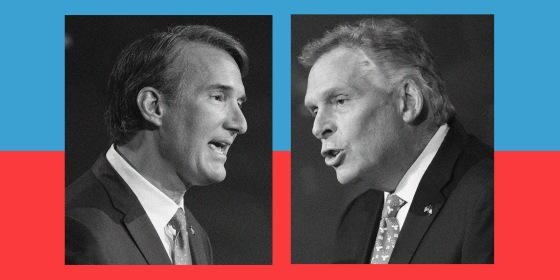
A tense race for governor in Virginia is testing a new reality for Democrats and Republicans: how to run when Donald Trump is not in the White House and not on the ballot.
Democrat Terry McAuliffe, a former governor seeking a return to the office in next month’s election, is trying to depict Republican Glenn Youngkin as the second coming of the former president, who lost Virginia by 10 percentage points last year.
“The Trump years were just terrible for Republicans in Virginia,” said J. Tucker Martin, a Richmond-based consultant who served as communications director for former Republican Gov. Bob McDonnell. “He blotted out the sun. He made it impossible to get anybody's message across. Every campaign in the state was just a proxy vote on how you feel about Donald Trump, which, if you're in North Dakota, is a great deal for Republicans. If you're in Virginia? Horrible deal.”
Youngkin, who has Trump’s endorsement and shares many of the former president’s conservative views on policy but has little else in common with him tonally or stylistically, presents himself as uniquely capable of uniting Trump enthusiasts and haters.
“Glenn just benefits from there suddenly being oxygen again,” Martin said. “He can be himself. He can speak to voters. They’re listening.”
The results of the Nov. 2 election will be instructive for the 2022 midterm campaigns.
Virginia gubernatorial elections fall the year after presidential elections, inviting interpretation as both a referendum on the party in power and a harbinger of what's to come. Polls this year show a close race, with McAuliffe's efforts to tightly yoke Youngkin to Trump so far failing to dent Republican enthusiasm.
“I think there is a sense among some that we beat Trump, mission accomplished, and it lessens the obvious urgency and existential threat,” said Josh Schwerin, a Democratic strategist who was McAuliffe’s press secretary during his first successful run for governor. “Which is something that we have to overcome.”
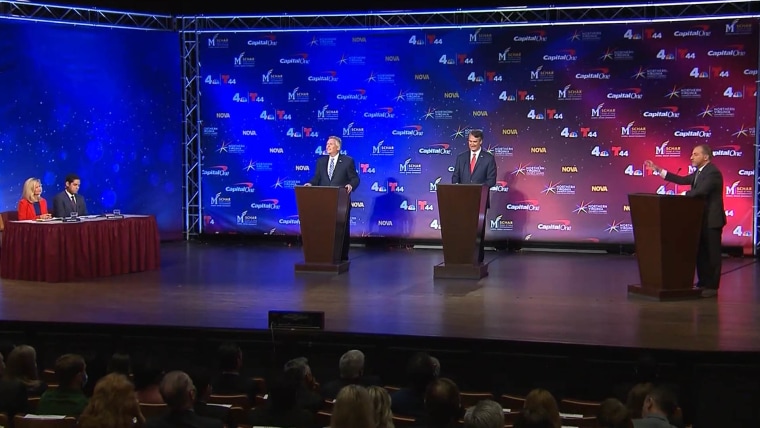
At their final debate this week, both candidates stuck to their strategies.
McAuliffe twice called Youngkin, a former CEO of the private equity giant Carlyle Group, a Trump “wannabe.” He noted that his rival had made “election integrity” — a phrase Republicans often use to appeal to those who strongly but falsely believe the last election was stolen from Trump — a top priority during the GOP primary.
“He wants to bring Trump-style politics to Virginia,” McAuliffe said, “and we’re not going to allow it.”
Youngkin offered a relatively tepid response when moderator Chuck Todd of NBC News asked if he would back Trump for president in 2024, saying only that he would support Trump if he’s the GOP nominee. Youngkin also mocked McAuliffe’s fixation on Trump, observing halfway through the hourlong debate that he had already mentioned the former president’s name more than 10 times.
“The only person invoking Trump,” Youngkin charged, “is you.”
Youngkin has kept Trump at arm’s length since winning the Republican nomination, accepting his endorsement but showing little interest in rallying alongside him. He’s kept his focus on local issues, such as his plan to eliminate Virginia’s grocery tax, rather than wade into hyperpartisan fights that have energized Trump’s base and nationalized other state and local races.
McAuliffe, meanwhile, could be dealing with political headwinds from President Joe Biden, whose approval numbers have dropped amid a prolonged pandemic and a chaotic withdrawal of U.S. troops from Afghanistan.
"Terry McAuliffe is losing, and his last-ditch effort to make this race about anything but Glenn Youngkin vs. Terry McAuliffe is desperate and isn't working,” Youngkin spokesperson Macaulay Porter said.
Youngkin’s Republican allies say he has adeptly managed his coalition, keeping “Never Trump” and “Forever Trump” Republicans in the same GOP tent. But for Democrats, who argue Youngkin still strikes Trumpy chords when speaking to conservatives, it’s a sign of duplicity.
“It's not like he's suddenly turned into Larry Hogan,” said Schwerin, referring to the Republican governor of neighboring Maryland, who has been an outspoken Trump critic. “As Terry said on the debate stage, he's saying one thing to one crowd and another to another crowd and hoping he can get away with it.”


