Democrats on Sunday demanded answers about the killing of top Iranian Gen. Qassem Soleimani as tensions mounted with Iran and Secretary of State Mike Pompeo insisted that the United States had faced an imminent threat.
Senate Minority Leader Chuck Schumer, D-N.Y., said on ABC's "This Week" that he worried that President Donald Trump's decision "will get us into what he calls another endless war in the Middle East." He called for Congress to "assert" its authority and prevent Trump from "either bumbling or impulsively getting us into a major war."
Speaking on "Fox News Sunday," Rep. Chris Van Hollen, D-Md., said public assurances from the Trump administration that such a threat was "imminent" were simply not enough.
"I think we learned the hard way ... in the Iraq War that administrations sometimes manipulate and cherry-pick intelligence to further their political goals," he said.
"That's what got us into the Iraq War. There was no WMD," or weapons of mass destruction, he said. "I'm saying that they have an obligation to present the evidence."
Democratic presidential candidate Pete Buttigieg said on CNN's "State of the Union" that until the administration provides answers on "how this decision was reached ... then this move is questionable, to say the least."
"I still worry about whether this president really understands that this is not a show, this is not a game," he said. "Lives are at stake right now."
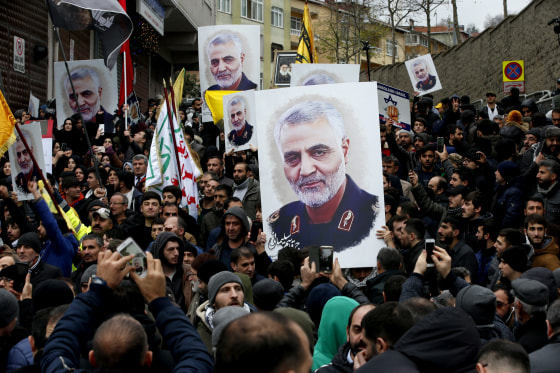
The fraught relationship with Iran has significantly deteriorated in the days since Soleimani's death, which came days after rioters sought to storm the U.S. Embassy compound in Baghdad and a U.S. contractor was killed in a rocket attack on an Iraqi military base in Kirkuk.
The Defense Department said Soleimani, the high-profile commander of Iran's secretive Quds Force, who was accused of controlling Iranian-linked proxy militias across the Middle East, orchestrated the attacks on bases in Iraq of the U.S.-led coalition fighting the Islamic State militant group, including the strike that killed the U.S. contractor. In addition, the Defense Department said Soleimani approved attacks on the embassy compound in Baghdad.
"We took action last night to stop a war," Trump said Friday in a televised address, referring to the airstrike that killed Soleimani. "We did not take action to start a war."
But the administration has yet to make public its evidence that Soleimani was acting out of step in comparison with his years of similar planning as a leader in Iran's proxy wars and other covert operations, which have led to U.S. deaths.
Iran and its allies vowed to retaliate for the general's death, and Trump has since escalated his language in response.
Download the NBC News app for breaking news and politics
On Saturday, Trump tweeted that the United States had 52 Iranian targets in its sights, including "some at a very high level & important to Iran & the Iranian culture," that it will "HIT VERY FAST AND VERY HARD" if Iran retaliates. In response, Iranian Foreign Minister Mohammad Javad Zarif accused Trump of threatening a "war crime" by targeting cultural sites, tweeting, "That is, a big(ly) 'no no.'"
On Sunday, Iraq's parliament voted to ask its government to end the presence of U.S. troops in the country, while Iranian state TV reported that Iran will no longer abide by any limits of the 2015 nuclear deal — an agreement from which Trump withdrew the United States in 2018.
Pompeo said on "This Week" that the administration would "behave lawfully" when striking Iranian targets, responding to accusations that hitting such cultural targets would violate international law.
"We'll behave inside the system. We always have, and we always will," Pompeo said.
"I've seen what we are planning in terms of the target set. I'm sure the Department of Defense is continuing to develop options," he said. The "American people should know that every target that we strike will be a lawful target, and it will be a target designed with a singular mission, of protecting and defending America."